Showing posts with label 1st Arrondissement. Show all posts

Sunday, September 4, 2011

Free Museum Day: Louvre & Centre Pompidou

Today was our last chance to check out the Paris museums for free (first Sunday of every month).  Our plan of attack was to spend a few hours in the Louvre in the morning then go home, take a break, and tackle the Pompidou Center in the evening.  Despite the long line to get in via the Louvre's Pyramid entrance, the Porte des Lions entrance did not let us down and we were in without any line at all, other than waiting for the five people who walked in ahead of us to take their stuff off the security x-ray belt.  We then zoomed past the Italian Renaissance paintings to the pyramid area.


From there we explored some of the galleries we didn't see on our previous visits.  Scantily clad people seemed to be the order of the day.

Grande Odalisque by Jean Auguste Dominque Ingres

Venus de Milo

Remember this guy from our walk along the Promenade Plantée?


I tried to hold back from taking too many photos of specific pieces of art.  Instead I tried to capture an overall impression of the museum galleries. 

Italian renaissance paintings

large-format French paintings

Northern Europe late gothic sculpture

Italian sculpture

Greek antiquities

View down into the central sculpture court

Something people always say is "Remember to look UP when you're in the Louvre".  So I made sure to do that from time to time as well...


We appreciate the Louvre because its layout allows you to go from room to room without having to backtrack (very much) through rooms you've already seen.  It's actually a pretty good museum design, even though the building wasn't originally intended to be a museum.

In direct contrast was the Pompidou Center (to me, anyway). The escalator runs along just one side of the building.  This is the main pathway to get to all the floors.  On a crowded day like today, there are considerable traffic issues when there are a lot of people coming down and someone who is going up (on the outside lane) needs to cross over into the museum space.


But then again, the plexiglass walls of the escalator do give a great view towards the northwest of Paris.


My other main complaint was that there wasn't really a good "flow" from one exhibit room to the next...we found ourselves walking back through rooms we had already seen to get to new areas.  It's almost as if the designers focused more on how the building would look from the outside than how it would work as a museum.  Anyway, the classic modern "greats" were very well-represented, including Braque, Miró, Dalí , Kandinsky, Matisse, and Picasso.

Top right: Henri Matisse Pink and White Head, bottom right: Pablo Picasso Portrait of Young Girl


Dado's La Grande Ferme deserves a closer look.


The more recent modern art was a mixed bag...some of it I really liked, like Chuck Close's portrait of  Arme Glimcher (Arme).


Other pieces that I found interesting were this (perhaps?) couch, this reworked chain-link fence, this out-of-focus-on-purpose painting, and this...well, whatever this is.

Clockwise from left: V. Panton Siége, Demakersvan Panneau Lace Fence, M. Fornes *Y/Struc/Surf., B. Frize Oma
 
Here are three works by Yves Klein.  Amazingly, his monochromatic paintings have sold for multi-millions.  This gives me a serious case of "Uhhh...I can do that".


Don't be deceived, Mimmo Paladino's Elmo has nothing to do with the popular Sesame Street character.


Some of the art just seemed very pretentious.  Definitely do not touch the oversize croquet pegs leaning against the wall.  Stay behind the black line on the floor, please.

André Cadere Six Round Wooden Sticks


If you hadn't guessed, Modern art isn't really my cup of tea.  But usually I can understand why it is art.  There were a couple of cases where I honestly felt like the artist was "putting one over" on the art dealers, curators, general populace, etc.

Allan McCollum's Plaster Surrogates 1985


This looks like something you might see at a Home Depot or Mr. Bricolage:

Marthe Wéry Peinture Venise 82


And this one just looks like a kindergarten geography/craft lesson gone awry: 

Thomas Hirschhorn Outgrowth 2005


I'm sure it all comes down to personal preference...art is very subjective.  For me, it's enough to call it art if it looks like the artist at least put a little creative effort into the work.  Painting/arranging boards, hanging blacked-out picture frames, and papier mâché-ing a bunch of globes seems to me a bit like phoning it in.

But...one of the very nice things about the Pompidou Center is the view from the roof terrace.  It was early evening and a little overcast but we could still make out Sacré Coeur.


We could also see the colorful figurines in the Stravinsky Fountain down below.


We thoroughly enjoyed our last free museum day, it is wonderful that the city of Paris opens its museums to the public once a month like this.  A fun fact that I've recently learned from a tour guide is that if you looked at every piece of artwork in the Louvre for 3 seconds it would take 3 months solid to see it all.  I am sure we only scratched the surface, and probably missed many great artworks, but for now it will have to do.

Friday, August 12, 2011

Musée de l'Orangerie and the Place Vendôme

You wouldn't think that people would flock to a museum where the main exhibit is just eight paintings.  But there were plenty of people lined up to see Monet's water lily paintings this afternoon.  After not too long a wait, we were inside.

Claude Monet Matin


In 1918, Monet offered some of his larger Nymphéas (water lilies) paintings to the state to commemorate the end of WWI.  These works are more than six feet tall, and are between 20 and 40 feet long. 

Reflets Verts


Monet worked with the architect to renovate an existing greenhouse space in the Tuileries garden.  They decided on a layout of two oval salons, each one displaying four of the Nymphéa paintings.

Soleil Couchant


The white shades on the ceilings diffuse the light, which is an effect that Monet intended in order to best view these paintings.  In case my previous photos make you think we had the room to ourselves, here is what it looked like in the first salon.


For Monet, painting the same subject in a series of paintings allowed him to show the subject in various lighting conditions at different times of day or in different seasons.  He worked on his water lily series for the last 30 years of his life, spending a lot of time at his garden in Giverny, France.

Le Matin Clair aux Saules


The exhibit at the Orangerie opened in 1927, five months after Monet's death at the age of 86.

Reflets d'Arbres


Downstairs is an exhibit area that was renovated in 2006.  While they were digging, they discovered the remnants of one of the walls that used to encircle Paris, dating to the 1630's.  They left it exposed for visitors to view.


On display downstairs is a permanent exhibit containing works by Picasso, Matisse, Renoir, and Cézanne, donated by art collectors Paul Guillaume and Jean Walter.  At the beginning of the exhibit are some miniature rooms showing what the homes of these collectors looked like.


Here is Kevin next to Paul Cézanne's La Barque et les beigneurs.  After hours in an art museum, he kind of looks like he'd rather be on a boat right about now.


These three Matisses were eye-catching.  From left: Odalisque à la culotte grise, Femmes au canapé, and Odalisque à la culotte rouge.


I really liked this one, André Derain's Arlequin et Pierrot.


And a few more interesting ones.  Clockwise from left:  Chaim Soutine's La Maison Blanche and Les Maisons, Amedeo Modigliani's Antonia, and Maris Laurencin's Portrait de Madame Paul Guillaume.


 After the museum, we walked up Rue de Castiglione towards Place Vendôme.  Of course, we had to stop by the Westin Vendôme.


The Ritz, by comparison, doesn't look nearly as inviting!


And this is the Place Vendôme, a large square lined with high-end hotels and fashionable jewelry stores.  The column in the center of the square is the Vendôme Column, modeled after Trajan's column in Rome.  Napoleon had it built to celebrate a military victory at Austerlitz.


Our final stop was at the Église Saint-Roch on Rue du Faubourg-St.-Honoré.  Due to several interruptions, the baroque church was built over the course of a century from the 1650's to the 1750's.


The inside is really beautiful, with a huge dome and gorgeously painted ceiling.


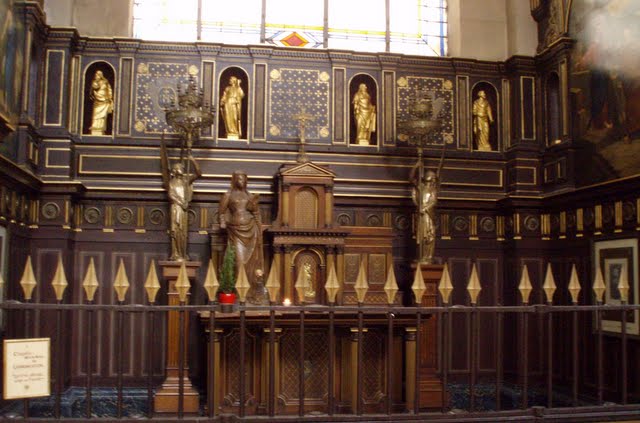
Each of the side chapels was fully decorated, almost a museum in itself.  This is the Chapel of the Annunciation, with its carved wooden altarpiece.


This is the awe-inspiring Chapelle de la Vierge (Lady Chapel).  Michel Anguier's marble Nativity sculpture Val de Grace is at the center, and above is Étienne Maurice Falconet's Divine Glory.


And finally, a better view of the central dome in the transept with the painted ceiling by Adolphe Roger called The Triumph of Christ.


One last image from the end of our walk -- this is the entrance to the Palais-Royal metro stop, just down Rue du Faubourg St.-Honoré.  It's an aluminum and Murano glass work by Jean-Michel Othoniel.


Wednesday, August 10, 2011

Musée des Arts Decoratifs - L'Art de L'Automobile

Today's walk took us to the Palais Royal.  On our way there we passed through the Galerie Vivienne, a passage built in 1823 that has pretty mosaic floors, a wine shop, a bookseller, and a famous teahouse A Priori Thé.


We then walked down the Rue Vivienne to the Palais Royal, former home to Cardinal Richelieu.  It is now home to the Ministry of Culture and the Constitutional Council.  It has a central garden where people were enjoying the sunshine.  It also has some very questionable artwork -- several colorful wind sculptures, and these striped columns in the Cour d'Honneur.


The Louvre building houses not only the Louvre museum, but also a less-visited museum called the Musée des Arts Decoratifs in the northwestern wing of the building.  We stopped in here because there was a special exhibit going on featuring several limited-edition cars owned by designer Ralph Lauren.

From the museum's website, shown is the 1955 Jaguar XKD


The 17 automotive masterpieces on display in this exhibit represent racing cars designed for both speed and aesthetics, from the 1930's to the present.  It is a "must-see" for car buffs.  Of course photo taking is prohibited.  We walked through the exhibit with the camera safely tucked away.  However, I had no control over Kevin once we got to the museum's upper floors.  At the entrance to the exhibit was a sleek Bugatti 57 S(C) Atlantic from 1938.  The car was capable of speeds up to 125 mph.


Here's an overview of the exhibit, you can see from the front: a maroon Alfa Romeo 8C 2300 Monza (1931), a cherry red Alfa Romeo 8C 2900 Mille Miglia (1938), a black Bugatti 59 Grand Prix (1933), a red Ferrari 375 Plus (1954), a silver Porsche 550 Spyder (1955), and a red Ferrari 250 GTO (1962).


And here is a view of the 1958 Ferrari 250 Testa Rossa (top) with the 1962 Ferrari 250 GTO.  A closeup of the Testa Rossa is below.


Another shot of the 1938 Alfa Romeo Mille Miglia, in the wings you can see a small glimpse of a rare 1996 McLaren F1 LM (1 of just 5 prototypes).  It is a V12 with 691hp and can achieve 0 to 80 mph in 5.9 seconds, with a top speed of 225 mph.  Trust me -- if we could've managed a better photo of that car, we would have...but it had its own security guard!


The museum had some other special exhibits -- one was on the use of animals in the decorative arts.  But really, does anyone actually "decorate" with Care Bears?

Care Bear Stare!  I like that they gave them the French names, ie. "Grosgateau" instead of "Birthday Bear".


The rest of the museum was a typical decorative arts museum, focusing on furniture.  It was organized chronologically, starting with the Middle Ages/Renaissance...


...on through the 17th and 18th centuries...


....then through the 19th century....


And into the Art Nouveau/Art Deco period.


By the time we got to the 1960's - 1990's the displays started looking like an Ikea furniture showroom.


Although I liked this mountain of swinging 60's and 70's chairs.


From the top floors of this wing of the Louvre palace, we got great views of La Defense (and incidentally the Tuileries Funfair), and of course, the Eiffel Tower.