Showing posts with label Shopping. Show all posts

Saturday, September 24, 2011

Chiang Mai Walking Street and Muay Thai Fights

Earlier this week we went to the fun but very tourisy Night Bazaar here in Chiang Mai.  Tonight is Saturday night, when they hold the weekly "Walking Street" market.  It seemed to us to be more of a fun local thing to do on a Saturday night; we saw lots of families out and about and there were definitely fewer obvious tourists.


There were lots of musicians playing everything from traditional music to singing karaoke on portable machines.  This little girl was very talented.  I think she is playing a khim, which is a hammered dulcimer.


We enjoyed walking up and down the street, checking out all the booths.  But the main reason we came here was for dinner, to try some local foods.  Of course we started off sharing an order of phad thai.


Then Kevin had a local sausage (kind of like the ones shown here, but shaped differently and from a different stall).


This lady sold all kinds of good-looking things; we bought a delicious grilled banana skewer to share.


And for dessert there was a tasty ice cream square.


There were a few delicacies that we just weren't adventurous enough to try.  Normally, Kevin loves calamari, but this squid on a stick just didn't appeal for some reason.


And not even the low, low price of 20 baht (about 65 cents) was enough to tempt us to try these fried insects.


After our street-food dinner, we took a tuk-tuk to the Thai boxing stadium.  Our driver was a lady, which I thought was pretty cool.  We haven't seen any female tuk-tuk drivers here.  She also had the most tricked out tuk-tuk in town.  The rear passenger seat sat on top of a thumping bass, and the ride was equipped with speakers that could be heard down the block. Very fun!


We arrived at the Thapae Boxing Stadium just in time for the start of the fights.


Muay Thai is a style of boxing/fighting that originated in Thailand.  It is nicknamed the "Art of Eight Limbs" because fighters are permitted to use fists, elbows, feet, and knees.


The stadium had an interesting setup.  Most of the spectators were farangs (foreigners) although there was one section full of Thai people, most likely friends and families of the fighters.  There were several bars selling overpriced beers.


Bookies competed with each other to convince the foreigners to wager on each fight.  Here are a group of tourists placing bets.


Traditional music accompanies each fight, getting faster as the rounds progress.  The clarinet-style instrument is called a Pi Muay, Pi Java, or Pi Kaek.


One of the fights we saw was a championship fight for the 85 lb weight class.  These were some tough kids!


For intermission, they also had a "special fight" -- five guys blindfolded and forced to duke it out with each other (no kicking allowed).  Things got interesting whenever they mistook the referee for a combatant.


Afterwards, the blindfolded guys came around asking for contributions and taking photos with the spectators.

Tuesday, September 20, 2011

Chiang Mai Night Bazaar

This morning we left Bangkok bright and early to catch a plane to Chiang Mai, in the north part of Thailand.

Guardian statue like the ones at Wat Phra Kaew in the Departures area

Our hotel in Chiang Mai (The RatiLanna) is gorgeous.  The lobby and common areas are all decorated in the Lanna style.  The Lanna Kingdom existed in the north until the early 1700's, when it was incorporated into the Kingdom of Siam.


Our room is stunning, with hardwood floors, a waterfall next to the tub, and even traditional clothes for the water bottles.


Our balcony has a lounge bed and fantastic views of the Mae Ping river and the lily pond below.


We spent the day lounging at the hotel, and then went for dinner and shopping at the Night Bazaar.


It is a huge tourist attraction and it's open every night of the week.


Vendors sell clothing, DVD's, knockoff luxury goods, and local crafts.


I did buy a few things: a pair of "Havianas", a "Pandora" bracelet, a scarf, and a belt.  Most of the vendors spoke English but they seemed to like that I was able to say numbers in Thai.  Very helpful when haggling!


My favorite things for sale were the colorful lanterns, so pretty!


We also made sure to stop at some of the food kiosks for dinner.  Chicken satay with peanut sauce in the food court...


And these delicious banana cake/crepes covered in chocolate sauce from a vendor cart.  Yummy!


Of course, some people find shopping boring so there is always the nearby cabaret show.  We didn't go (we might another night), but the "ladies" were kind enough to let us take a photo!

Monday, September 12, 2011

La Défense

Today we rode the Metro to the end of Line 1 to have a look at La Défense.  We had seen it from a distance many times, but we decided we should probably go see it up close before we leave the city.  The business district is called La Défense not because it has anything to do with military defense, but because in the center of the district is a statue called La Défense de Paris, which commemorates those who defended Paris during the Franco-Prussian War.


The most recognizable structure in the district is the Grande Arche.  Built in 1989, it is 350 feet tall -- the entire cathedral of Notre Dame could fit underneath it.


The monumental building was one of François Mitterand's Grands Projets, a major scheme to add modern buildings to the city.  A Danish architect won the design competition to build a monument inspired by the Arc de Triomphe. 


Government offices are housed in the two sides of the arch.  You used to be able to ride an elevator to the top observation deck, but the outdoor elevators were poorly designed and have been shut down for now.


From the marble steps of the Grande Arche you can see all the way to the Arc de Triomphe.  The Grand Arche, Arc de Triomphe, Champs-Elysées, the obelisk at the Place de la Concorde, the Tuileries Garden, and the Louvre are all in a straight line called the Axe Historique (historical axis).


The La Défense district is home to some other interesting buildings as well.  The CNIT (Center of New Industries and Technologies) building was one of the first structures built in the area, in 1958.  An enormous concrete shell covers 200,000 square meters of office and retail space.  But what makes it interesting is that the space is entirely open -- there are no support beams to disrupt the interior space.


This very modern-looking church is the Notre-Dame de Pentecôte, built in 2001.


There are more than 50 sculptures and public artworks placed around the esplanade.  Clockwise: L'araignée rouge (The Red Spider) by Alexander Calder, Le Pouce (The Thumb) by César Baldaccini, and an untitled monumental ensemble by Joan Miró.

The thumb photo is not mine, I forgot to take a photo so had to find one via google images


I probably wouldn't describe La Défense as a must-see in Paris.  But after seeing so many 19th century (and older) buildings in Paris, it was a nice change of pace to spend an hour or so looking at more modern architecture.

Friday, August 12, 2011

Musée de l'Orangerie and the Place Vendôme

You wouldn't think that people would flock to a museum where the main exhibit is just eight paintings.  But there were plenty of people lined up to see Monet's water lily paintings this afternoon.  After not too long a wait, we were inside.

Claude Monet Matin


In 1918, Monet offered some of his larger Nymphéas (water lilies) paintings to the state to commemorate the end of WWI.  These works are more than six feet tall, and are between 20 and 40 feet long. 

Reflets Verts


Monet worked with the architect to renovate an existing greenhouse space in the Tuileries garden.  They decided on a layout of two oval salons, each one displaying four of the Nymphéa paintings.

Soleil Couchant


The white shades on the ceilings diffuse the light, which is an effect that Monet intended in order to best view these paintings.  In case my previous photos make you think we had the room to ourselves, here is what it looked like in the first salon.


For Monet, painting the same subject in a series of paintings allowed him to show the subject in various lighting conditions at different times of day or in different seasons.  He worked on his water lily series for the last 30 years of his life, spending a lot of time at his garden in Giverny, France.

Le Matin Clair aux Saules


The exhibit at the Orangerie opened in 1927, five months after Monet's death at the age of 86.

Reflets d'Arbres


Downstairs is an exhibit area that was renovated in 2006.  While they were digging, they discovered the remnants of one of the walls that used to encircle Paris, dating to the 1630's.  They left it exposed for visitors to view.


On display downstairs is a permanent exhibit containing works by Picasso, Matisse, Renoir, and Cézanne, donated by art collectors Paul Guillaume and Jean Walter.  At the beginning of the exhibit are some miniature rooms showing what the homes of these collectors looked like.


Here is Kevin next to Paul Cézanne's La Barque et les beigneurs.  After hours in an art museum, he kind of looks like he'd rather be on a boat right about now.


These three Matisses were eye-catching.  From left: Odalisque à la culotte grise, Femmes au canapé, and Odalisque à la culotte rouge.


I really liked this one, André Derain's Arlequin et Pierrot.


And a few more interesting ones.  Clockwise from left:  Chaim Soutine's La Maison Blanche and Les Maisons, Amedeo Modigliani's Antonia, and Maris Laurencin's Portrait de Madame Paul Guillaume.


 After the museum, we walked up Rue de Castiglione towards Place Vendôme.  Of course, we had to stop by the Westin Vendôme.


The Ritz, by comparison, doesn't look nearly as inviting!


And this is the Place Vendôme, a large square lined with high-end hotels and fashionable jewelry stores.  The column in the center of the square is the Vendôme Column, modeled after Trajan's column in Rome.  Napoleon had it built to celebrate a military victory at Austerlitz.


Our final stop was at the Église Saint-Roch on Rue du Faubourg-St.-Honoré.  Due to several interruptions, the baroque church was built over the course of a century from the 1650's to the 1750's.


The inside is really beautiful, with a huge dome and gorgeously painted ceiling.


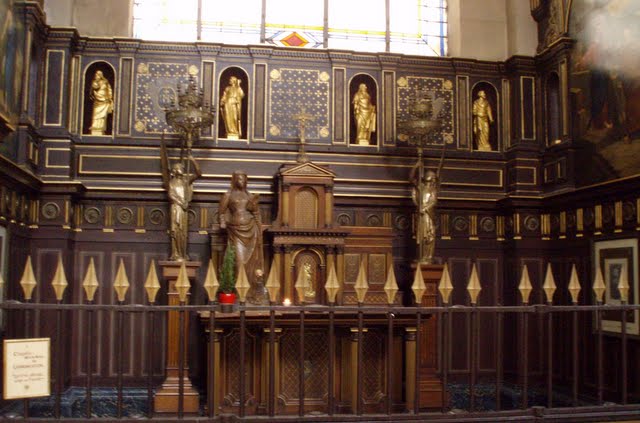
Each of the side chapels was fully decorated, almost a museum in itself.  This is the Chapel of the Annunciation, with its carved wooden altarpiece.


This is the awe-inspiring Chapelle de la Vierge (Lady Chapel).  Michel Anguier's marble Nativity sculpture Val de Grace is at the center, and above is Étienne Maurice Falconet's Divine Glory.


And finally, a better view of the central dome in the transept with the painted ceiling by Adolphe Roger called The Triumph of Christ.


One last image from the end of our walk -- this is the entrance to the Palais-Royal metro stop, just down Rue du Faubourg St.-Honoré.  It's an aluminum and Murano glass work by Jean-Michel Othoniel.