Showing posts with label Eiffel Tower. Show all posts

Sunday, September 11, 2011

The French Will Never Forget

With the crisp weather and the falling leaves it is really starting to look like Autumn here in Paris.  It was gray and rainy in the early afternoon today, but we were determined to go to the Place du Trocadéro one last time. 


The Place du Trocedéro was the site of today's memorial service in honor of the victims of 9/11.  In between the buildings of the Palais de Chaillot stand two symbolic towers, each 10 stories high.  In the afternoon was a service commemorating the solemn occasion, and in the evening a candlelight vigil was planned.


The event was sponsored by a group called "The French Will Never Forget", an association that is committed to remembering the events of 9/11 as well as the gratitude of France for the US actions during WWII.  The group emphasizes the continued goodwill and historical connections between the French and American people.  On the left-hand tower are inscribed the names of the 9/11 victims, and on the right-hand tower were hundreds of messages of sympathy, solidarity, and friendship from the people of France and America.

Monday, September 5, 2011

Night Cruise on the Seine

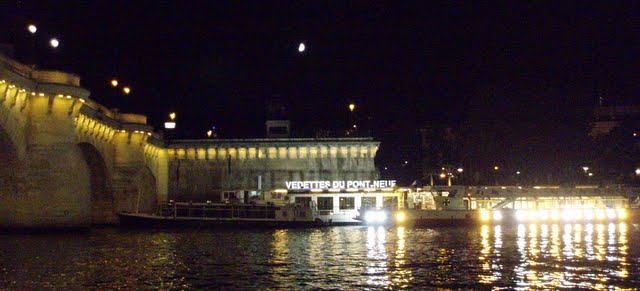
It's getting dark earlier in the evenings now, so tonight after dinner we decided to take a cruise on the Seine to view the city lights.  The cruise began at Pont Neuf, Paris' oldest bridge.


Directly across the river is the Samaritaine building, one of the oldest department stores in Paris.  The building is currently closed and is being redesigned as a luxury hotel.


Here is one of the clocks on the facade of the Musée D'Orsay.  (Sorry that nearly all of my pictures are blurry, the boat didn't slow down for photos!)


Next door is the Palais de la Légion d'Honneur, a museum displaying French medals, honors, and decorations.  The Legion of Honor is the highest decoration in France.


Here are a couple of shots of the Left Bank


After going under the Pont de la Concorde bridge...

Arch between some of the bridge's pilings


...we were rewarded with this lovely view of the moon over the Assemblée Nationale.


Then we went under the Pont Alexandre III.


And also under the Pont des Invalides.


This was my best attempt at catching the moon and the Eiffel Tower in the same shot.


The boat paused for a minute as it turned around at the base of the Eiffel Tower.


At the base of the tower is a carousel which is also lit up at night.  The tower is open to visitors until 11pm.


From there we traveled back the way we came.


The Louvre and the Pont Royal


When we got to the  Île de la Cité, we could see that the evening picnics were in full swing.


The brightly lit building with the white bands of light is the Institut du Monde Arabe.


Coming around the other side of the Île de la Cité, we passed by the Conciergerie.  Marie Antoinette was imprisoned here just prior to her execution in 1793.


We had another chance to view the Pont Neuf and the carved heads that decorate it as we approached the dock.


We were now back where we started and our cruise was at an end.


As we walked home, we passed by the brasserie Au Chien qui Fume ("The Smoking Dog"). It looked inviting, but we had already eaten dinner and weren't feeling like drinks so we just headed home.

Wednesday, August 31, 2011

Behind the Scenes Tour of the Eiffel Tower

Taking the "Behind the Scenes" tour of the Eiffel Tower was like being on the TV show "How Stuff Works" on the Discovery Channel.


Our tour guide, Aurora, was animated and informative as she described the history of the tower.  Contrary to popular belief Eiffel did not design the tower all by himself.  A team of engineers from his firm did the designing, including architect Stephen Sauvestre and structural engineers Maurice Koechlin and Emile Nouguier.  But Eiffel made sure to keep 99% ownership.  Upon his death, ownership of the tower passed to his family, but the city of Paris eventually purchased it from them.  Currently, the city leases operations to a private company and they split the ticket receipts 50-50.


Aurora walked us over to what appeared to be a maintenance shed near the tower.  It was the entrance to an underground military communications bunker that sits directly below the Champ de Mars and runs from the tower to the École Militaire at the other end.


Did you know that they originally intended to take the tower down after the 1889 World's Fair?  Eiffel saved it by obtaining permission to conduct scientific experiments at the summit.  Near the beginning of WWI, the military began using it as an antenna for the wireless telegraph which put an end to any discussion of taking down the tower.

Poster advertising use of the wireless telegraph; below right: original telegraph lines used (they have since been cut).


After exiting the bunker, we got in line at the tower's east pillar.  It is the only pillar that still uses one of the original elevators.


Before getting on the elevator Aurora took us below, to the inner workings of the elevator.  It was a very technologically advanced piece of machinery for 1889.  A hydraulic piston drives a series of Otis-designed pulleys to raise the elevators upwards and sideways to the 2nd floor.


The diagram does a good job of explaining how it works, but it was also very cool to see the equipment in action.  Aurora noted that because the equipment dates to the 1880's, modern lubricants can't be used.  They lubricate the cables with pork fat; other parts are lubricated with bull and sheep fat.


The white stuff underneath the piston on the left is animal fat.  Yuck.


And now it was time to actually get in the yellow elevator.  There is a little "operator" figure outside; it would have been a real person back in the 1880's.  The elevator moves vertically and horizontally on a diagonal track from the ground to the 2nd floor.  The 2nd platform is only 1/3 of the way up the tower.


There are two levels to the second floor.  The upper level seemed to be one long queue to get on the elevator going to the top.


The "Behind the Scenes Tour" stops on the 2nd platform.  But our "behind the scenes" access allowed us to climb some steps to the roof of the Jules Verne restaurant, and check out the views from there.  The Trocadéro, across the river (with La Défense behind)...


The Seine river, with a view of the Île aux Cygnes ...


A guy playing soccer all by his lonesome...


And of course the view of the Champ de Mars with the École Militaire and the Tour Montparnasse.


There is also a great view of the top of the tower, above...


...and of the tower's shadow across the Pont d'Iéna.


We also spotted the lights that make the tower sparkle at night as well as the upper pulleys for the elevators.


The tour ended on the second floor.  From there we had the option to purchase elevator tickets to the top for 5 euros, but the line was already more than 40 minutes wait time.  Instead we spent a few more minutes enjoying the view, then hiked down the stairs to the first platform and had lunch.


Even from the first floor the view was spectacular.


The people on the ground below look like ants.


We were quite glad to have taken the tour.  Not only was it a great explanation of the inner workings of the tower, but it allowed us to skip the ground floor queues for the elevators and stairs!


Saturday, August 20, 2011

Cité de l'Architecture et du Patrimoine

The name of this museum translates literally to "City of Architecture and Heritage".  It takes up one wing of the Palais de Chaillot.  Based on the name I wasn't quite sure what to expect but I had heard wonderful things about it so I went inside.  It turned out to be one of my favorite museums in Paris so far. It is comprised of three display areas: the Gallery of Casts, the Gallery of Modern & Contemporary Architecture, and the Gallery of Wall Paintings and Stained Glass.  I started my visit in the Gallery of Casts.

The High Gothic room


Each room contains a variety of casts and models.  The plaster casts are done to actual scale and showcase the key features of architecturally important buildings in France.

The tympanum from the Église Abbatiale Saint-Pierre in Moissac


The models show the entire building and usually have a cutaway so you can also see the interior.

Clockwise from left: cutaway and facade of the Abbey Church at Parlay-le-Monial, model of Notre Dame Cathedral in Laon


There were copies of other decorative elements as well, like these Pleurant (mourning) figurines -- the originals decorate the tombs of Phillipe le Hardi, Jean de Berry, and Philippe Pot.


Some of the sculptures tended toward the creepy and macabre, such as these two gargoyles and this decomposing skeleton statue.


The next room was also overflowing with casts and models.  In all, the museum has more than 350 casts, the oldest of which date to the 1880's.


Some of the models and casts are from buildings that no longer exist, like this model of the Minimes Abbey in Passy.  (This was the building that was once above the Wine Museum that I visited the other day).


And some of the models are of structures that have never existed, such as this plan for an opera house by Claude-Théophile Muly.  The director of the king's builders called the plans "unrealistic and unexecutable" at the time (1785), so it was never built.


Then it was upstairs to the Gallery of Modern and Contemporary Architecture.  Speaking of which, there was a pretty great view of a modern structure right out the window.


The gallery here lacked some of the "wow" factor of the exhibits below, since it was mostly small-scale models.  Although you can see in the back a full-scale replica of an apartment in Le Corbusier's "Radiant City" building in Marseilles (it is even furnished). 


A few of the more detailed models included the Crystal Palace from the 1851 Great Exhibition in London, the French Pavilion from the 1958 World's Fair in Brussels, one of the follies from the Parc de la Villette (which we visited last week), and this cross-section of the Théâtre des Champs-Élysées.


Other interesting displays showed the difference between Haussmann-era floorplans (note the lack of hallways), and newer 1900's-era plans.  I also liked these plaster mockups of Charles Garnier's house in Italy, the Castel d'Orgeval by Hector Guimard (famous for designing the Art Nouveau Metro entrances), and a strange bubble house by Antti Lovag.


Finally, it was upstairs to view the Gallery of Wall Paintings and Stained Glass.  Each room was a life-sized replication of a chapel or tomb somewhere in France.

The crypt from the Romanesque Church of Saint-Nicolas in Tavant

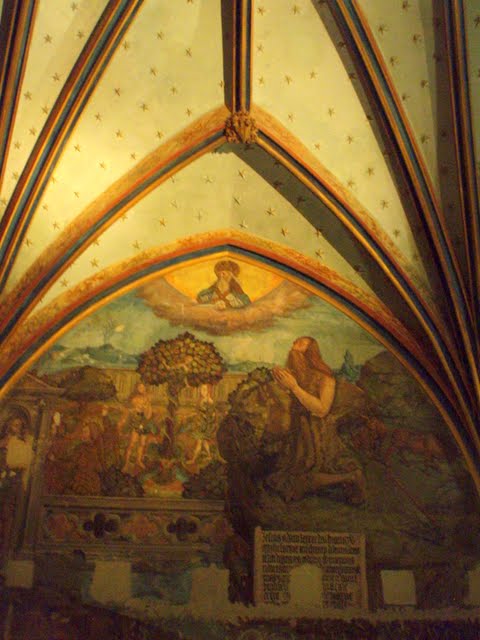
Adam and Eve fresco from the chapel at Château Dissay

The crowning achievement was the full-size replica of the painted dome from the cathedral at Cahors.


Eight prophets encircle the central scene which depicts the stoning of St. Stephen.


On my way out of the exhibits I passed this one last model of the Crac des Chevaliers, a castle built in Syria by the Crusaders from 1031 to 1170.  The real-life castle still exists and is mostly intact, one of the best preserved medieval castles in the world.

Crac des Chevaliers (it's only a model!)


The library and archives contain a comprehensive collection of research tools for historians.  And there is also a workshop, where artists work on the models and replicas used in the museum.


To my delight, there were also several classrooms for teaching schoolkids about the basics of architecture and construction techniques. My favorite is the corrugated cardboard castle.  Fun!