Showing posts with label Chiang Mai. Show all posts

Saturday, September 24, 2011

Chiang Mai Walking Street and Muay Thai Fights

Earlier this week we went to the fun but very tourisy Night Bazaar here in Chiang Mai.  Tonight is Saturday night, when they hold the weekly "Walking Street" market.  It seemed to us to be more of a fun local thing to do on a Saturday night; we saw lots of families out and about and there were definitely fewer obvious tourists.


There were lots of musicians playing everything from traditional music to singing karaoke on portable machines.  This little girl was very talented.  I think she is playing a khim, which is a hammered dulcimer.


We enjoyed walking up and down the street, checking out all the booths.  But the main reason we came here was for dinner, to try some local foods.  Of course we started off sharing an order of phad thai.


Then Kevin had a local sausage (kind of like the ones shown here, but shaped differently and from a different stall).


This lady sold all kinds of good-looking things; we bought a delicious grilled banana skewer to share.


And for dessert there was a tasty ice cream square.


There were a few delicacies that we just weren't adventurous enough to try.  Normally, Kevin loves calamari, but this squid on a stick just didn't appeal for some reason.


And not even the low, low price of 20 baht (about 65 cents) was enough to tempt us to try these fried insects.


After our street-food dinner, we took a tuk-tuk to the Thai boxing stadium.  Our driver was a lady, which I thought was pretty cool.  We haven't seen any female tuk-tuk drivers here.  She also had the most tricked out tuk-tuk in town.  The rear passenger seat sat on top of a thumping bass, and the ride was equipped with speakers that could be heard down the block. Very fun!


We arrived at the Thapae Boxing Stadium just in time for the start of the fights.


Muay Thai is a style of boxing/fighting that originated in Thailand.  It is nicknamed the "Art of Eight Limbs" because fighters are permitted to use fists, elbows, feet, and knees.


The stadium had an interesting setup.  Most of the spectators were farangs (foreigners) although there was one section full of Thai people, most likely friends and families of the fighters.  There were several bars selling overpriced beers.


Bookies competed with each other to convince the foreigners to wager on each fight.  Here are a group of tourists placing bets.


Traditional music accompanies each fight, getting faster as the rounds progress.  The clarinet-style instrument is called a Pi Muay, Pi Java, or Pi Kaek.


One of the fights we saw was a championship fight for the 85 lb weight class.  These were some tough kids!


For intermission, they also had a "special fight" -- five guys blindfolded and forced to duke it out with each other (no kicking allowed).  Things got interesting whenever they mistook the referee for a combatant.


Afterwards, the blindfolded guys came around asking for contributions and taking photos with the spectators.

Friday, September 23, 2011

Doi Inthanon National Park

Doi Inthanon is part of a mountain range located in northern Thailand, at the border between Thailand and Burma (Myanmar).  Only an hour or so from Chiang Mai, it is the tallest mountain in Thailand (2565 meters) and is part of a national park.  The summit is usually enshrouded in mist, but supposedly on a clear day you can see the whole valley including the city of Chiang Mai. 


We did an all-day excursion to the park.  Inside the park we visited two waterfalls, the impressive Wachirathan waterfall...


...and the smaller Sirithan waterfall.


The walk through the rainforest was great.  It was drizzling slightly, and the temperature was about 20 degrees cooler than in Bangkok.  We were actually cold at times, which felt nice.


Very near the summit are the Naphamethanidon chedi.


Twin stupas were erected by the Royal Thai Air Force to commemorate King Bhumibol's 60th birthday in 1987, and Queen Sirikit's 60th in 1992.


They are Buddhist places of worship.  The King's stupa (called Phra Mahathat Chedi Naphamethanidon) is a copper color.


The outside of this stupa is decorated with bas-reliefs and copper-colored mosaic tiles.


The interior has a yellow and blue motif (the colors of Thailand's royalty -- the king's flag is yellow, blue for the queen) and a large seated Buddha figure.  The history of the Buddha's life is inscribed on the walls in Thai and in English.


In contrast is the Queen's stupa, called Phra Mahathat Chedi Naphabolbhumisiri.  It is lilac in color and it's exterior is decorated with purple mosaic tiles and delicate tile frescoes portraying Buddhist themes.


Inside is a standing Buddha and the colorful mosaic ceiling tiles depict the Buddha's teachings.


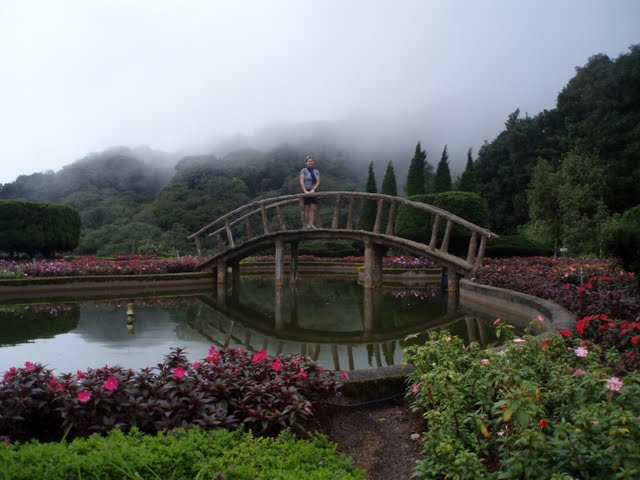
Beside the Queen's stupa is a lush garden.  All the grounds are beautifully manicured.


There were also a few whimsical touches here and there, like these playful elephants and the heart-shaped flower beds.


After visiting the national park, we stopped at a Karen hill tribe village nearby.  The Karen people live in small farming communities.  Their houses are built on stilts and some use the traditional roofing material of teak leaves, which need to be replaced every few years.  Corrugated tin is a modern alternative.


Rice is one of the primary crops grown by the Karen tribe.  They are generally environmental conscious and practice crop rotation to minimize the need for clearing new swaths of forest (unlike some farmers who use slash-and-burn techniques).  Here, rice grows in terraced fields.


There are several divisions within the Karen tribe, the villagers we visited are known as White Karen.  Unlike other subdivisions of the Karen tribe, the women in this tribe do not wear the neck rings that unnaturally elongate the neck.  They are called White Karen because the unmarried women of the tribe wear white woven tunics until they are married.


The women are skilled weavers, using back-strap looms to create colorful fabrics.  This woman is weaving two scarves on the same loom.


She finished just a few minutes later.  It takes about four days to complete each pair of scarves.  A single scarf sells for 250 baht (about $8.33).  When the scarves are sold, each one bears a sticker with the weaver's name on it.  The weaver earns 200 baht per scarf, the remaining 50 baht goes into a collective pool to buy weaving supplies for all the women to use.


This blanket was made by five women.  Each one wove a panel which was then stitched together to make the blanket.


We were so pleased that we were able to visit the national park area while we were in Chiang Mai.  It was a truly memorable experience.  When we got back to the hotel, a surprise was waiting for Kevin from the hotel staff.  It was certainly a birthday to remember!

Thursday, September 22, 2011

Elephant Nature Park

When Thailand banned logging in the late 1980's, thousands of trained elephants were put out of work.  Many of those elephants were then put to work in the tourism industry.  As a result, there are many "Elephant Day Tour" companies in Thailand.  Some of them have trained elephants that you can ride, or that do tricks.  But we weren't really interested in riding the elephants (the training/breaking process, called phajaan, can be very brutal).  We did a little research and were so glad we chose to spend a day at the Elephant Nature Park about an hour outside of Chiang Mai.


Started in 1997 by Sangduen "Lek" Chailert in 1996, the park is a sanctuary for injured, abused, and rescued elephants.  The intent is to provide them with a peaceful environment where they can live as naturally as possible.  Visitors do not ride the elephants.  Instead the focus is on education and more natural interaction with the elephants, such as feeding and bathing.  Here, our guide Nui introduces us to a small part of the "herd".


Elephants here tend to group in herds, just as they do in the wild.  They form strong attachments to each other, even though they may not be related by blood.  There are 37 elephants at the park and they have formed about five herds, although some elephants choose to remain solitary.  There are currently two babies, and several of the females (in addition to the mothers) have formed a tight-knit "family".


Most of the elephants here are female, but there are four males.  Hope, a teenaged male who was orphaned very young, seems to have hit it off with one of the older females, and they are inseparable.  Hope is the one on the right.


Many of the elephants have also formed strong bonds with their mahouts, or elephant drivers/keepers.  Traditionally, the methods that mahouts use on trained elephants are cruel -- they use chains and sharp hooks to force the elephant to do what they want.  But here at the park, the mahouts use only positive reinforcement, such as rewards of food.  The animals aren't trained to do tricks, but the mahouts do need to have control when guiding them to the right areas when it is feeding or bathing time.  There are about 50 mahouts at the park and the elephants have a say in the pairing process.  They are only paired with mahouts that they accept.


Feeding time is very important around here.  Elephants eat up to 550 pounds of food daily.  Here is the "kitchen", stocked with elephant goodies such as bananas, watermelon, and pumpkin.


A separate "menu" is developed for each elephant based on their likes/dislikes, and nutritional needs.


Visitors at the park get to help with the monumental task of making sure each elephant gets plenty to eat.  Feeding time!  Some eat faster than others.


Elephants use their long trunks as hands to grab food or other objects.  Asian elephants have one kind of "finger" on the top of their trunk that helps them with dexterity (African elephants have two of these "fingers" on their noses).


The elephants at the park make good use of their dexterity, reaching for anything that remotely resembles food (which is why they have visitors stay behind the red line at the feeding station).


Many of the elephants had very sad histories prior to coming here to the park. Malai Tong was put to work in the illegal logging industry and experienced further tragedy when a landmine took her right hind foot.  After seeing her, Lek was determined to bring her to the sanctuary.  Malai Tong has now made friends with two other elephants and gets around pretty well considering her injuries.


Jokia was quite cruelly blinded when a previous owner shot stones at her eyes to scare her into working.  She lost sight in both eyes as a result of the abuse.  Luckily Lek rescued her and brought her to the sanctuary where she was befriended by one of the most gentle elephants here, Mae Perm.  The 89 year old Mae Perm acts as Jokia's eyes and helps guide her around the park.  In the photo, Jokia is on the left with trunk raised and Mae Perm is on the right.


Trilly was part of a forced breeding program where they tie the females down.  She could not support the weight of the bull elephant and suffered back and pelvic injuries.  She is unable to walk normally but she can get around slowly.  Tilly has a friend and protector elephant named Khum Pen, who is always by her side and looks out for her here.  She also receives special veterinary care.


There are full-time and volunteer veterinarians helping to ensure all the elephants get excellent care.  We were able to meet with one of them who was checking on a patient who had been unable to stand up due to muscular problems and lack of nutrition.  Although she still needs to be immobilized (tethered), she is standing up and able to eat.  (Note the tiny IV bag above her head giving her dextrose and vitamins -- the needle is in a huge vein on the back of her ear).  At right is the rescue van/ambulance donated by Bob Barker of "The Price is Right".  He sponsors several of the elephants at the park.


Elephants aren't the only animals that have found homes at the park.  There are something like 80 dogs, a handful of cats, a few water buffalo, and even an Asian black bear that was rescued.  In Burma, China, and other parts of Asia they put the bears in tiny "crush cages" and drain the stomach bile while the bear is still living for use in traditional Chinese medicine.  Thankfully this bear has been saved from that fate. 


The park has been built to accomodate the needs of the animals while acknowledging that visitors still want to see and interact with the animals.  During feedings and bathtimes visitors can get up close; at theses times there are always mahouts and park personnel on hand to make sure both visitors and animals are safe and comfortable.  During other times, visitors are free to observe the elephants from several areas, including this elevated skyway.


The skyway provides a great view of bathtime in the river.  Groups of visitors are invited to "help" the elephants get clean and cool off.


We were happy to help.


Of course some of the elephants don't want any help and instead prefer to get right in there and swim.


After bathtime, the elephants march off to their "free time" where they can roam the whole park at will.


We were so happy to have had a chance to support this organization with our tourist dollars.  Elephants are an endangered species, but in Thailand trained logging elephants are considered "livestock" and are not protected.  Lek's crusade to ensure that these animals can live out their lives in peace and comfort is truly inspiring.