Showing posts with label Temples. Show all posts

Friday, September 23, 2011

Doi Inthanon National Park

Doi Inthanon is part of a mountain range located in northern Thailand, at the border between Thailand and Burma (Myanmar).  Only an hour or so from Chiang Mai, it is the tallest mountain in Thailand (2565 meters) and is part of a national park.  The summit is usually enshrouded in mist, but supposedly on a clear day you can see the whole valley including the city of Chiang Mai. 


We did an all-day excursion to the park.  Inside the park we visited two waterfalls, the impressive Wachirathan waterfall...


...and the smaller Sirithan waterfall.


The walk through the rainforest was great.  It was drizzling slightly, and the temperature was about 20 degrees cooler than in Bangkok.  We were actually cold at times, which felt nice.


Very near the summit are the Naphamethanidon chedi.


Twin stupas were erected by the Royal Thai Air Force to commemorate King Bhumibol's 60th birthday in 1987, and Queen Sirikit's 60th in 1992.


They are Buddhist places of worship.  The King's stupa (called Phra Mahathat Chedi Naphamethanidon) is a copper color.


The outside of this stupa is decorated with bas-reliefs and copper-colored mosaic tiles.


The interior has a yellow and blue motif (the colors of Thailand's royalty -- the king's flag is yellow, blue for the queen) and a large seated Buddha figure.  The history of the Buddha's life is inscribed on the walls in Thai and in English.


In contrast is the Queen's stupa, called Phra Mahathat Chedi Naphabolbhumisiri.  It is lilac in color and it's exterior is decorated with purple mosaic tiles and delicate tile frescoes portraying Buddhist themes.


Inside is a standing Buddha and the colorful mosaic ceiling tiles depict the Buddha's teachings.


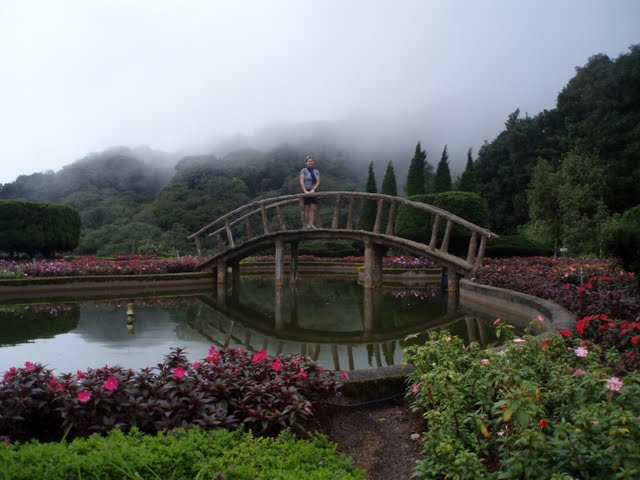
Beside the Queen's stupa is a lush garden.  All the grounds are beautifully manicured.


There were also a few whimsical touches here and there, like these playful elephants and the heart-shaped flower beds.


After visiting the national park, we stopped at a Karen hill tribe village nearby.  The Karen people live in small farming communities.  Their houses are built on stilts and some use the traditional roofing material of teak leaves, which need to be replaced every few years.  Corrugated tin is a modern alternative.


Rice is one of the primary crops grown by the Karen tribe.  They are generally environmental conscious and practice crop rotation to minimize the need for clearing new swaths of forest (unlike some farmers who use slash-and-burn techniques).  Here, rice grows in terraced fields.


There are several divisions within the Karen tribe, the villagers we visited are known as White Karen.  Unlike other subdivisions of the Karen tribe, the women in this tribe do not wear the neck rings that unnaturally elongate the neck.  They are called White Karen because the unmarried women of the tribe wear white woven tunics until they are married.


The women are skilled weavers, using back-strap looms to create colorful fabrics.  This woman is weaving two scarves on the same loom.


She finished just a few minutes later.  It takes about four days to complete each pair of scarves.  A single scarf sells for 250 baht (about $8.33).  When the scarves are sold, each one bears a sticker with the weaver's name on it.  The weaver earns 200 baht per scarf, the remaining 50 baht goes into a collective pool to buy weaving supplies for all the women to use.


This blanket was made by five women.  Each one wove a panel which was then stitched together to make the blanket.


We were so pleased that we were able to visit the national park area while we were in Chiang Mai.  It was a truly memorable experience.  When we got back to the hotel, a surprise was waiting for Kevin from the hotel staff.  It was certainly a birthday to remember!

Tuesday, September 20, 2011

Chiang Mai Old Town

Chiang Mai became the capital of the Lanna kingdom in 1292.  During the reigns of King Mengrai and King Tilok, many wats were built in the city; there are now about 300 of these temples found throughout the city.  Our first stop was Wat Chedi Luang, which means "the temple of the great chedi".


Twin nagas (sacred serpents) stand watch at the door to the wihan (hall).


The temple was quite busy today.  It was supposed to be a local holy day, but I couldn't figure out what it was specifically.


The focal structure of this wat is the Great Chedi.  It was originally 270 feet high and for a time the Emerald Buddha was kept there.  But in 1545 an earthquake destroyed 1/3 of the structure.


It is decorated with elephants (chang) around the base and nagas at the foot of the four stairways.


Each of the four sides has a niche containing a golden statue of the Buddha.


A nearby chapel contained a smaller reclining Buddha.


Other scenes from around the wat:


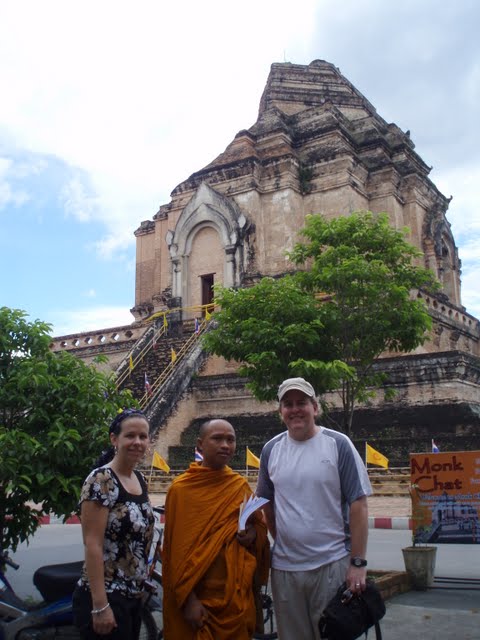
Within the wat complex is a religious university attended by both Buddhist monks and laypeople alike.  A patio area was dedicated to a daily activity called "Monk Chat".  Some of the monks are available to chat with visitors and answer questions about Buddhism, life as a monk, or anything in general.  We sat down with a monk from Cambodia who gave his name as "A".  He has been a monk since the age of 18 and was taking a Philosophy course.  He said he spends most of his day in meditation, chanting, and "chatting".  His English was very good, but explaining complicated Buddhist concepts to a bunch of foreigners must be very difficult!


We then left Wat Chedi Luang and walked through the Old City to another nearby temple, Wat Phra Sing.  It is the largest temple in Chiang Mai.  The Wihan Luang (Great Hall) is very large and houses an equally large Buddha statue inside.


Inside, along one of the aisles, a monk in orange robes was chanting blessings over the faithful.


A large prayer bell beside the wihan.


Another wihan, the Wihan Lai Kham (Gilded Hall), is one of the most visited areas of the temple complex.  It contains the Phra Buddha Singh (Lion Buddha), a very important Buddha image.

Wihan Lai Kham with small chedi

The Lion Buddha originated in Sri Lanka, and is revered in Chiang Mai.  Every year, the statue is carried through the streets of the city for the Songkran festival.


The rest of the temple complex was very lovely.


But we were getting hungry and a little "templed out", so we walked around a little to find some tasty Thai food.  Some signs we saw on the way:


After lunch we walked around a bit more.  The Old City of Chiang Mai is square shaped, with walls and a moat marking its borders.  The walls and gates are old and were dismantled over time.  But the Tha Phae gate has been reconstructed based on old photographs and drawings.


This is a view of the moat and a corner of the city wall that has been preserved.

Sunday, September 18, 2011

Wat Pho and Lumphini Park

A short walk away from the Grand Palace is another famous temple, Wat Pho.  It is one of the oldest wats in Bangkok.  It is also a center of learning for traditional medicine and massage.


Wat Pho is also known as Wat Phra Chetuphon.  There are 99 chedis located around the main bot complex.


At the compound's inner gates are some farang guard statues.  "Farang" means "foreigner" and these statues are made to look like caricatures of westerners with top hats, beards, and large noses.


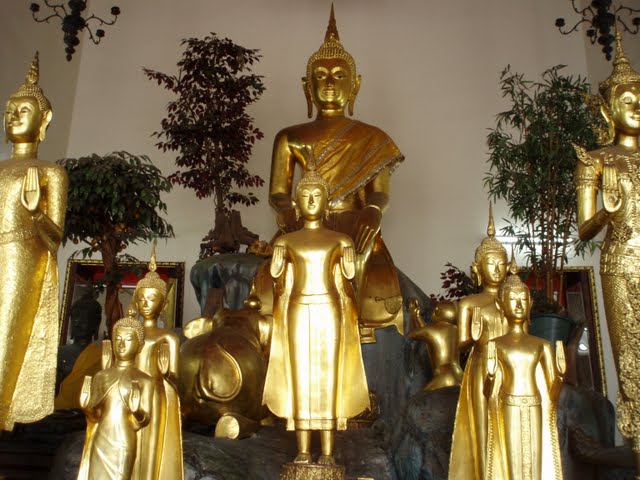
Many Buddha statues are on display in temple buildings.


But the most visited Buddha image at Wat Pho is the Reclining Buddha, Phra Buddhasaiyas.  It is 150 feet long and made of brick and plaster covered in lacquer and gold leaf.


Buddha statues have four basic postures: standing, sitting, walking, and reclining.  A reclining Buddha usually represents the point of ultimate nirvana.


After visiting the Wat, we caught the river ferry and BTS train back to Lumphini Park to meet up with Jonathan (my brother's roommate, also from Arizona).  The park is the main greenbelt in Bangkok and was created in the 1920's by King Rama VI.  A statue King Rama VI stands at the entrance.


Contemporary bronze statues have been placed along the walking paths.


There are two artificial lakes created for boating.  You can rent paddleboats shaped like swans.


But I'm not sure I would want to rent a boat here; there are dragons in the lake.  Don't believe me?  Kevin saw a guy feeding bread to the "ducks".  On closer inspection, it turned out the kid was feeding this:


It looks like a small dinosaur.  It is actually a water monitor, a distant relative of the Komodo dragon.  They can grow up to 10 feet long and weigh around 200 lbs.  A bite can be toxic to humans, so definitely no swimming!


Video: