Thursday, August 27, 2026

Wednesday, August 26, 2026
Venice, Italy
We paid for all of our flights for this trip with points, and Kevin found a better deal to fly home from Venice, Italy rather than Ljubljana. We took a shared van from Ljubljana city center to Marco Polo Airport. It was only supposed to take about 2.5 hours but thanks to traffic and road closures it was more like a four-hour journey. Add in the time taking a vaporetto boat from the airport to the hotel and we were pretty exhausted by the time we arrived. But the decadent luxury of our hotel (also a credit card point benefit) made up for it. The Grand Hotel Palazzo de Dogi is actually nowhere near the the Doge Palace -- it is in the quiet Sestiere Cannaregio district at the northern shore of the island of Venice. The palace was built in the 1600s for the Rizzo-Patarol family and was home to the city's first botanical garden.

It's a beautiful property in a peaceful residential neighborhood. Within a two-minute walk you can get to the Chiesa della Madonna dell'Orto. This is the neighborhood where the painter Tintoretto lived most of his life - the church commissioned several large-scale masterpieces from him and he maintained a strong connection to the Chiesa until his death in 1594. He is buried here in a family tomb.

We loved exploring this beautiful neighborhood. It felt worlds away from the throngs of tourists that swarm around the St. Mark's area.

We loved trying the restaurants in Cannaregio. Our favorite was called Oficina Ormesini and it served something called cicchetti which are light bites to compliment a drink, basically Venetian tapas. It looks simple -- toppings on a slice of bread -- but they used so much creativity to come up with delicious flavor combinations. I would come back to Venice just to eat here again (we ate here twice)!

We also had a memorable meal on the terrace at the Ristorante al Cinema Italia. From our table we could watch the residents below doing their evening stroll (passeggiata).

Why is it called the Ristorante al Cinema Italia? Because next door is a 1915-era Art Nouveau movie theater. Or at least it used to be. The theater inside was decommissioned in the 1990s and has been cleverly repurposed into the grandest grocery store I've ever encountered.

It was easy to get lost or turned around walking around this city, though. Sometimes we crossed a small bridge and wound up in a dead end. The narrow alleyways didn't help -- they often blocked a cellphone signal, making online navigation useless. There are still some places in the world that are best served by paper maps!

We did manage to make our way on foot to St. Mark's Square (Piazza San Marco) on Monday morning. It was a pleasant half hour walk, and the piazza was not as crowded with people or pigeons as we'd expected. Of course it was before 9am so maybe the big tour groups were still eating breakfast. But where were the massive flocks of pigeons? Well the city put a stop to that in 2008 with a feeding ban and a ban on stalls selling seeds or corn in the area. It makes for a less iconic (but definitely more hygienic!) photo op.

We booked a guided tour of the Basilica of San Marco which helped us to get a sense of the sheer opulence of this church. The Venetian Republic put its wealth on display when decorating the exterior and interior. Originally the exterior walls were red brick, but as Venice became more prosperous they could afford to recover the brick with sheets of pure marble. Gold-leaf mosaic tiles inside cover more than 8000 square meters of wall space -- a fortune just in the "wallpaper" alone. For the Venetian Republic, the Basilica was more than a church; it was a showcase for the prosperity and power of La Serenissima -- the "most serene republic".

We had self-guided tickets to visit the Palazzo Ducale (Palace of the Duke) but our St. Mark's tour guide invited us to just join the rest of her group who had booked a combo guided tour. This was great because we got so much more out of our palace visit than we would have with just the basic audioguide. Our tour guide, Denise, was born and raised here in Venice; she was an expressive storyteller and brought the history alive for us.

The first question Denise answered for us was: "what the heck is a Doge, anyway?". The word Doge is often translated as "Duke" but that's not entirely accurate. During the maritime republic, the wealthy merchant families in Venice chose a representative form of government (the republic) but decided they needed a figurehead to stand in place as a head of state. Rather than have a king or an emperor, they chose to elect a leader from amongst themselves. The man (always a man!) had to be independently wealthy, older than 70, and would serve in the role for life. When a Doge died, the office was not hereditary; the families would gather and elect a new Doge. Doing things this way allowed the power to rest with the oligarchs in the Senate and various Councils and limited the power of the Doge and also the power of any one family to seize control of the government. It was a clever system.

Although it is called a palace, the Palazzo Ducale was more like the White House, Capitol, and Supreme Court rolled into one building -- it was the main seat of all the government. Yes, the Doge lived here but the palace's many rooms and offices were also used by the courts, councils and lawmaking bodies.

The palace was also connected to the Prigioni Nuove (new prisons) next door. For very serious crimes, the accused would come to the palace and be tried by the High Court (the Quarantia or Council of Forty). If found guilty, he or she would walk through a passageway over an enclosed bridge to the prison to serve their sentence. The bridge earned the nickname Ponte dei Sospiri (Bridge of Sighs) because there are small latticed windows in the stonework through which the condemned could catch one last glimpse of the free life outside and sigh in resignation as they were led off to the dark prison cells.

In case you were wondering, this is the view of the lagoon from the Bridge of Sighs. Ahhhh!

There's another very famous bridge in Venice - the Rialto Bridge. The Grand Canal runs directly through the heart of Venice and this large channel effectively splits the city into two main islands. Only four bridges span the Grand Canal and the Rialto is the oldest one. In 1181 a floating bridge was built on the site, followed by a wooden one in 1255. Construction on the stone bridge took three years and was completed in 1591. Until 1854 the Rialto Bridge was the only way to get across the Grand Canal on foot; otherwise you had to take a boat.

Boats are still a huge part of daily life in this city -- there are no cars or motorbikes allowed in the historic center, and they would be useless here anyway with all the stairs and bridges. In our short three days here we saw how boats are the foundation of every aspect of municipal service logistics. Porters use specialized stair-friendly handcarts to collect garbage and then it is lifted onto the garbage barge by crane. During emergencies, police boats throw up big wakes zooming down canals with lights on and sirens blaring. Modern motorized boats provide ambulance services, deliver goods, ferry passengers and all the things we generally use cars and trucks for. And gondoliers are really a part of everyday life, too -- there are a handful of gondolas that still do ferry locals across the Grand Canal in spots where there isn't a bridge. Our hotel was right across from a school that offered traditional gondola rowing lessons (I'm assuming for tourists). One night we sat outside and watched as the instructor tried vainly to tell the student how to execute the turn without hitting anything. It was highly entertaining. Gondoliering is truly a skill!

Another Venetian specialty skill is the art of glassblowing. On Tuesday we took the vaporetto to the island of Murano to check out the workshops and watch some of the artisans in action.

We stopped in at the Museo del Vetro (Glass Museum) to understand more about the history of glass in Venice. Glassmaking has been a part of the Venetian economy since the 5th century, but in 1291 the city moved all glassworks to the island of Murano as a fire prevention measure and to preserve the secrets of glassmaking. Glassmakers who worked here were not allowed to leave the island and could not -- under penalty of death -- share their glassmaking techniques with outsiders. This is, in part, how Venice grew so wealthy; they knew how to make high-quality extremely clear glass as well as how to use minerals to give it jewel-toned colors and patterns.

Many of the Murano workshops sell their pieces direct to customers at storefront boutiques that line the canals here, and you can also watch the glass being made in the attached studios. High-end masterworks sell for several thousand dollars.

Since we were already out and about, we took another vaporetto from Murano to the island of Burano, much further out in the lagoon. This island is known for lacemaking and for painting its houses in a vibrant rainbow of colors. We thought we'd come here and escape the tourist crowds, but we weren't the only ones with that idea -- Burano is an Instagrammer's dream.

We enjoyed walking around and found a canal-side cafe serving lunch (more cicchetti!) and appropriately bright spritzes. The long vaporetto ride back to Venice was standing room only but it was worth it to have seen this captivating village.

Back in Venice, we really had no agenda for our last day. We hopped on a vaporetto to the city center then just walked around soaking up the atmosphere.

Kevin came to Venice on a solo trip in 1996; I stayed one night here (!!!) on a whirlwind Europe trip with my friend Jamie in the summer of 1999. A lot has changed in the decades since those trips, and with all the news reports about Venice being "overrun by tourists" I wasn't sure what to expect this time. But our three days here were romantic and delightful, we found ways to avoid most of the crowds, and I am so glad to have returned and spent a little more time enjoying the sights of this magnificent city!

Monday, September 30, 2024
Riva del Garda and Bergamo
Driving from the Dolomites to Malpensa airport is quite a distance so we decided to break the journey into two driving days. We spent two nights on the northern side of Lake Garda in a charming town called Riva del Garda. Parking here was a bit of a challenge; the public lot was showing as "full" so we passed it thinking there would be a place where we could just make a U-turn and park instead at our hotel. But to our dismay, for the next 13 kilometers we drove through a series of narrow tunnels bored directly through the rock until we reached the next town, Limone Sul Garda. It was a Saturday so the heavy car traffic (and extra challenge of bicycle traffic) through the tunnel series meant that we really couldn't pull to the side and turn around anywhere until we arrived in Limone. We were able to finally flip a U-turn and made our way back through the busy tunnels until we found the hotel and were allowed to check-in and park a bit early. Whew, time for a glass of wine!

We had lunch on the main piazza overlooking the lake, and I had a nice glass of Lagrein, a wine which is made from grapes native to the South Tyrol. I'd never heard of it before this trip but now it has become a favorite. To burn off some of our pizza and pasta lunch, we climbed the 110-foot campanile (bell tower) and had a bird's-eye view of the city and lake far below.

The next morning was super breezy. We took the ferry back down to Limone Sul Garda to explore a bit. The 45-minute ferry ride was much more relaxing than driving through the tunnels! Because it was a windy Sunday morning, the lake was packed with kitesurfers, windsurfers and wingfoilers. I'd never seen wingfoils in action before but it looked like they were having a lot of fun out there.

Limone Sul Garda is a very romantic little town right on the water. When we arrived it was early on Sunday morning and we had most of the town to ourselves but as the day progressed it got more and more crowded with tourists and locals enjoying the sunny Sunday weather and charming ambience.

As the name suggests, the lemon has been a significant part of the town's economy since the 1800s. Terraced lemon groves were built into the hillsides and the mild winters on the lake allowed lemon trees to flourish. Although the lemon groves mostly vanished during the mid 1900s a few have been restored and one, the Limonaia del Castel, belongs to the municipality and is a living museum with mature citrus trees of all types. Even though many of the lemon groves have given way to tourist hotels and development over the years, the shops in town are dedicated to selling lemon-themed products - soaps, oils, candies, limoncello, lemon-print textiles, magnets, you name it. Come to Limone Sul Garda for all your lemon needs!

We enjoyed a cocktail while waiting for the next scheduled ferry back to Riva del Garda. A limoncello spritz for me, of course. Strangely, the cafe was called Bar Waikiki, so....aloha, I guess?

For our last day in Italy, we drove ourselves to the historic city of Bergamo. The Città Alta ("upper city") is perched high on a hill and surrounded by 16th century walls. Constructed by the Venetian Republic to defend against the Milanese (and the French...and the Spanish...Venice had a lot of enemies), the walls surrounding the old city are now a UNESCO World Heritage site because they are so well preserved. A funicular links the lower city to the upper city.

In the heart of the Città Alta is the Piazza Vecchia. Vecchia means "old" and I should emphasize that Bergamo is quite old, with a history that pre-dates the Roman Era. Back in Roman days, this square was the site of the forum. And it has continued to be the seat of political power in Bergamo over the centuries -- there are several palazzos and churches in this square. The Palazzo Nuovo ("new palace") was once the town hall.

Two remarkable churches are crammed into the Piazza side-by-side. In most Italian cities the Duomo, or cathedral, is the most important church of the diocese -- it's usually the most ornate and decorative church in the city. However in Bergamo's case, the Duomo is a bit overshadowed by the older - and more ostentatious - Basilica di Santa Maria Maggiore right next door. Prior to 700 AD this was the site of a Roman temple, then a smaller church was built here in the 8th century. But in 1133 the citizens of Bergamo made a vow to build a basilica in the spot if the Virgin Mary would protect them from the ravages of a terrible plague. Apparently Mary held up her end of the bargain, and work on the basilica continued for the next several centuries.

It is truly a masterpiece. We've seen a lot of churches in our travels, and it takes a lot to impress us. Nearly every square inch of the interior of the Basilica is gilded, painted, carved, or embellished in some way. When taken as a whole it seems really over the top -- almost too much, but when you take the time to get up close to the details it really is incredible. This is just one of a series of dozens of gorgeous wood panel inlays in the choir.

The Città Alta is very walkable and we spent the better part of the afternoon just meandering through the crooked streets stopping for both gelato and pastries along the way. Hey, cut us some slack -- it was our last day in Italy so we indulged a bit!

Spending the afternoon in this historic city was a great way to end our trip. We really enjoy the northern part of Italy, and hope to come back this way very soon. Arrivederci, Italia!

Friday, September 27, 2024
Ortisei - Week Two
Finally! Saturday was a truly gorgeous sunny day and the snow on the Seceda ridge had melted enough to capture just a bit of the magic. We had already done all the hiking we wanted to do in the Seceda area so we literally just took the lift up, waited a bit for the clouds to clear from the peaks, and snapped our photos before catching the lift back down.

Our planned hike took us up the Resciesa funicular and then a hike down into the valley just below the Seceda ridge. When we started seeing a pasture full of horses we knew we'd arrived at Malga Brogles. The setting of this family-run farm is idyllic and peaceful. It feels like you are miles away from civilation (because you are!)

From the farm you can see the saddle between the Seceda ridge and the Fermeda mountains. If you look closely on the left, you can see many switchbacks leading up to the Forcella Pana saddle between the two. We were glad we'd taken the longer, less steep route from Resciesa.

On Sunday we drove to the town of Selva and did a beautiful hike up the nearly deserted Vallunga valley.

It was the last day that our lift passes were valid. While the Vallunga hike didn't require using the lift pass, we did head over to the Dantercepies lift after we were finished so that we could have one last meal at Jimmi Hutte. These nutella-filled dumplings were absolutely delicious. All in all, we got a great value out of those lift passes. We rode at least one lift every one of the six days (one busy day we rode 5 lifts). Our passes cost 141 euros each and seemed spendy at the time. However, if we had paid for each lift separately it would have cost 453 euros per person so purchasing a six-day pass was definitely worth it in our case. It also forced us to take lifts and do hikes in areas that we otherwise might not have visited -- well worth the purchase price!

On Monday, we had excellent weather, so we hiked the 1200 feet up to the St. Jacob's church, which sits high above Ortisei with great views of the Sassolungo mountain group. This is the oldest church in the Val Gardena, built sometime in the 1200s along an ancient trading route that connected Venice with the Valle Isarco about 30 km further north of Ortisei.

We took a different route down from the church so that we could stop for lunch at the charming Caffe Val d'Anna. We had an excellent meal and when the head waiter discovered that it was also Kevin's birthday, he sent out complimentary grappa shots accompanied by an enthusiastic waiter shouting "Happy Birthday!" and ringing a cowbell. Very memorable!

It was a day of memorable birthday meals because when we went to dinner at Restaurant Tubladel our meal was kicked off by an unintentional champagne volcano and topped off at the end with a literal firecracker dessert. Ka-boom! Happy Birthday, Kevin!

We did a bit more exploring during the week, including trips to the nearby towns of Castelrotto and Santa Maddalena. But we knew the weather might deteriorate a bit as the week went on. In fact, when we went for a hike in the Puez Odle Nature Park on Wednesday all the peaks were completely enshrouded by fog. At lunch, the menu showed a photo of the amazing views that would normally be seen from Rifugio Odle. But for us there wasn't even a hint of the mountains that were looming somewhere in the mist.

The forecast for Friday was rain all day, so we booked a day at the Adler Spa in town. This historic hotel opened in 1810 and its spa is something else. There are many different saunas, an indoor/outdoor pool, and even a "salt grotto" where you float for 20 minutes in salt water then spend 20 minutes in a salt cave sauna.

But the most interesting sauna to us was the hay sauna. I guess alpine hay being good for sore muscles really is a thing. The benches were packed with fresh hay and its pungent smell was only intensified by the heat. Definitely a unique experience, but maybe one to avoid if you suffer from allergies.

Relaxing at the spa was a great way to end our two weeks in Ortisei. By the end of the day, the sun had come out and the skies had cleared. Even Sassolungo seemed to be saying a friendly farewell to us.

Ciao, Ortisei! At least for now, anyway -- I do hope to come back to this part of the world someday soon. Better to say until next time -- alla prossima!

Friday, September 20, 2024
Ortisei (St. Ulrich) Week One
Ortisei ("Sankt Ulrich" in German) is a charming town, a bit larger than either San Candido or San Cassiano. We are now in the Val Gardena on the western edge of the Dolomites, only about a 40 minute drive from Bolzano where we started a few weeks ago. You can definitely see the Austrian influence in the architecture here.

To get familiar with our surroundings, we decided to walk the length of the valley. The Luis Trenker path is a six-mile pedestrian-only walking path that connects Ortisei with the towns of Santa Cristina and Selva. Luis Trenker was a famous director/actor, mountaineer/skier, and author in the 1930s-50s who was born here in Ortisei.

The route took us past the Castel Gardena, built in the early 1600s. Over the centuries the castle was used as a hunting lodge and residence for the noble family of Wolkenstein, until in the 1860s Count Leopold von Wolkenstein donated it to the community for use as a poorhouse. It fell into disrepair and eventually was bought by a Baron in the 1920s and restored as a private residence. We enjoyed the walk and especially liked the small community of Selva, where we were able to catch the bus back to Ortisei.

On Monday, we booked a farm excursion through the Ortisei tourist office. Our guide Simon led a small group on foot up the hillside to the Chalet Tiscion alpine farm. There we met Barbara and Elmar - they have a family farm with cows, goats, sheep, rabbits, guinea pigs, turkeys, chickens, and various other birds. Currently Elmar is in the middle of bringing in the autumn hay from all their surrounding fields. It is hard and dangerous work, much of it needs to be done by hand because the hillside meadows are very steep. Barbara noted that the alpine hay has medicinal properties -- it can help ease arthritis and sore muscles if you lay on a bed of hay. Who knew?

Elmar brought out Sarah (their most patient goat) so that guests could take a turn milking her. Or I should say we took turns trying to milk her. Turns out milking a goat is a tricky skill to master -- no one in the tour group was able to do it successfully.

My favorite part of the morning was when Barbara handed me one of the three-day-old baby bunnies to hold. The little guy hadn't even opened his eyes yet, and he was very soft! It was a very cool experience to see a working farm and learn about daily life here in the mountains.

While we are here in Ortisei we decided to splurge a bit and buy a six-day unlimited lift pass. Several of the hikes we most want to do can be accessed by lifts and we know we have a good weather window for at least the next week or so. One of the most popular hiking areas is the Alpe di Siusi just south of town, accessible by the Mont Seuc cable car. The Alpe di Siusi is the largest alpine meadow in Europe - 56 square kilometers of pastureland at almost 6000 feet elevation. But...watch out for snakes.

Since our apartment was actually just around the corner from the Resciesa funicular we decided to head over there after our Alpe di Siusi hike. The Resciesa plateau is directly across the valley, so after the 8 minute funicular ride we could see the green meadows and mountains where we'd just come from. Resciesa is a smaller alpine meadow about a thousand feet higher than Alpe di Siusi. Unlike Siusi there was still an awful lot of snow on the ground at Resciesa. From Resciesa we also had a great view of the Sassolungo mountain group. Sassolungo ("Langkofel" in German) means "long peak" in both languages -- it's the tall rounded peak on the left in this photo. The flat sloping part on the right is called Sassopiatto or "flat peak". It's one of the most recognizable mountain groups in the Dolomites.

You never know who or what you'll meet on the trail. We saw an older man leading a donkey and then several minutes later we were passed by four or five more, walking single file, not on leads or anything -- just following their friend to the next pasture.

On Wednesday we really tried to get a good value out of our lift pass. We took the bus back over to Santa Cristina and took two lifts (Monte Pana and Mont de Seura) to get to the base of the north side of Mount Sassolungo. It was pretty darn cold in the shadow of a 10,000 foot mountain and there was plenty of snow still lingering.

We turned around when the trail got icy, took the lifts back down to the valley and then crossed on foot to the other side of the valley (which was a hike in and of itself) to take the Col Raiser cable car, followed by the Fermeda chairlift up to the Seceda ridge. THEN...from the ridge we took two more cablecars back down into town. We are definitely making the most of the lift passes - Kevin is keeping a tally of how much we've "saved" because the lifts are expensive! We had to hurry because we had booked a brewery tour and tasting at Monpiër brewery that evening. Monpiër means "one more beer" in Ladin. It's the first craft brewery in Val Gardena and we had a chance to sample some interesting brews including an American-style IPA, a British Bitter, and an off-the-wall sour. The owner said that it was a bit tricky to get the place going at first because the locals are more into traditional German-style beers like lagers, pilsners, and hefeweizens. But the brewery is starting to have some success, especially with the tourists, and we've seen their beers on taps at several of the rifugios on our hikes.

Yesterday, we headed back up the cable cars to the Seceda area to hike. The Seceda ridgeline is one of the iconic sights of the Dolomites. It's usually a lush green meadow on a slanted plateau framed by a succession of jagged peaks behind. In the guidebook the meadow is bright green and the sun is shining down on the peaks and it looks almost otherworldly. Well, our photo doesn't look much like the guidebooks, that's for sure. Somehow the big patches of snow and overcast skies kind of ruin the effect. We are crossing our fingers and hoping that the snow melts enough so that we can come back on a sunnier day and get our snapshot. For now, this is what it looks like:

We hiked down from the ridge over a slushy, slippery, muddy trail that was crowded with a couple hundred other hikers. I was very glad to have hiking poles and definitely saved myself from falling a few times. But once we got midway down the mountain, the snow started disappearing and the trail conditions improved. The crowds started to thin out, too. We stopped at the Troier hut for a slice of strudel and some coffee.

Then we got to what I considered the prettiest part of the hike. There's a very cool rock needle area called Pieralongia where two formations form an enormous V.

Then just beyond that you hike down into a bowl where you are just surrounded by peaks. For about forty minutes we only saw two other people hiking in this area so it felt very untouched and almost desolate.
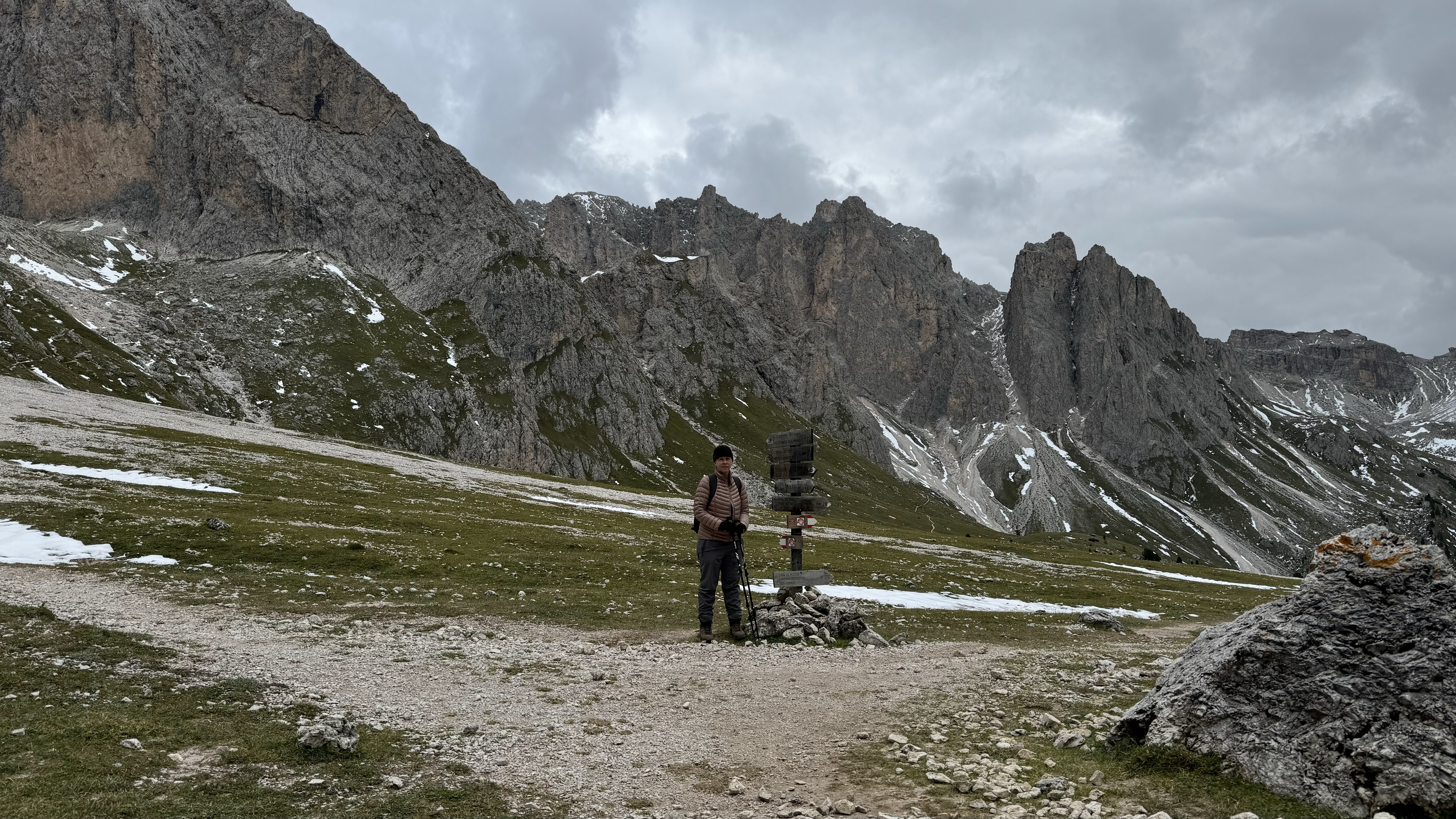
But then just around another bend we found the bustling Rifugio Firenze (also known as the Regensburgerhutte -- have I mentioned that everything here has at least 2 names?) We had an excellent lunch here.

Today (Friday) we drove up the Sella Pass to the southeastern side of Sassolungo. We got to ride one of the most unique lifts in all of the Dolomites -- the Telecabina Sassolungo.

This lift is nicknamed the "coffin lift" because of the size and shape of the cabins. Inside is just enough room for two people. The Telecabina Sassolungo was built in 1972 and the technology back then was a bit more primitive than it is today. The lift moves at a constant speed, meaning that there is no slowing down for boarding or unloading. The shorter rider grabs onto the side of the swift-moving car and hops in, then the taller rider (who is standing a bit further along) has to basically chase after the cabin and launch themselves into it. The lift operator then locks you in from the outside and you begin the 1600-foot journey up the mountain. It takes about 20 minutes. Then, you both have to turn around and face the door and leap out with the assistance of the lift operator at the top. It's pretty thrilling, actually.

At the top of the lift is the Toni Demetz hut. Toni Demetz was a mountain guide who came from a family of mountain guides. In 1952 he was guiding two tourists on the mountain when they were struck by lightning. Tragically Toni and one of the tourists lost their lives. Toni's father constructed the hut in memory of his son and to provide a refuge for climbers.

On the way back down the mountain, we parked the car in Selva and took the Dantercepies lift up past the Gardena Pass. The Jimmi Hutte is just below the peaks of the Gran Cir and overlooks the valley to the Sella Massif on the other side.

We had a really good meal to go with our beautiful view. The bright pink drink that I've got in front of me is a sort of raspberry lemonade called "skiwasser". We split a very generous bruschetta appetizer that was topped with burrata, ham, figs, and arugula.

Behind the hut we could see the Gran Cir which is a popular Via Ferrata route. Via Ferrata translates to "iron path" and is a set route up a mountain that uses fixed steel cables and ladders to assist hikers and climbers. The climbers are still clipped in with a harness but they don't have to fix their own ropes and anchors. You can't see them in this shot but we did see a few guided groups heading up these peaks while we were hiking past. I enjoy watching them defy gravity but to be honest I prefer to keep my own feet on solid ground!
