Showing posts with label 7th Arrondissement. Show all posts

Wednesday, August 31, 2011

Behind the Scenes Tour of the Eiffel Tower

Taking the "Behind the Scenes" tour of the Eiffel Tower was like being on the TV show "How Stuff Works" on the Discovery Channel.


Our tour guide, Aurora, was animated and informative as she described the history of the tower.  Contrary to popular belief Eiffel did not design the tower all by himself.  A team of engineers from his firm did the designing, including architect Stephen Sauvestre and structural engineers Maurice Koechlin and Emile Nouguier.  But Eiffel made sure to keep 99% ownership.  Upon his death, ownership of the tower passed to his family, but the city of Paris eventually purchased it from them.  Currently, the city leases operations to a private company and they split the ticket receipts 50-50.


Aurora walked us over to what appeared to be a maintenance shed near the tower.  It was the entrance to an underground military communications bunker that sits directly below the Champ de Mars and runs from the tower to the École Militaire at the other end.


Did you know that they originally intended to take the tower down after the 1889 World's Fair?  Eiffel saved it by obtaining permission to conduct scientific experiments at the summit.  Near the beginning of WWI, the military began using it as an antenna for the wireless telegraph which put an end to any discussion of taking down the tower.

Poster advertising use of the wireless telegraph; below right: original telegraph lines used (they have since been cut).


After exiting the bunker, we got in line at the tower's east pillar.  It is the only pillar that still uses one of the original elevators.


Before getting on the elevator Aurora took us below, to the inner workings of the elevator.  It was a very technologically advanced piece of machinery for 1889.  A hydraulic piston drives a series of Otis-designed pulleys to raise the elevators upwards and sideways to the 2nd floor.


The diagram does a good job of explaining how it works, but it was also very cool to see the equipment in action.  Aurora noted that because the equipment dates to the 1880's, modern lubricants can't be used.  They lubricate the cables with pork fat; other parts are lubricated with bull and sheep fat.


The white stuff underneath the piston on the left is animal fat.  Yuck.


And now it was time to actually get in the yellow elevator.  There is a little "operator" figure outside; it would have been a real person back in the 1880's.  The elevator moves vertically and horizontally on a diagonal track from the ground to the 2nd floor.  The 2nd platform is only 1/3 of the way up the tower.


There are two levels to the second floor.  The upper level seemed to be one long queue to get on the elevator going to the top.


The "Behind the Scenes Tour" stops on the 2nd platform.  But our "behind the scenes" access allowed us to climb some steps to the roof of the Jules Verne restaurant, and check out the views from there.  The Trocadéro, across the river (with La Défense behind)...


The Seine river, with a view of the Île aux Cygnes ...


A guy playing soccer all by his lonesome...


And of course the view of the Champ de Mars with the École Militaire and the Tour Montparnasse.


There is also a great view of the top of the tower, above...


...and of the tower's shadow across the Pont d'Iéna.


We also spotted the lights that make the tower sparkle at night as well as the upper pulleys for the elevators.


The tour ended on the second floor.  From there we had the option to purchase elevator tickets to the top for 5 euros, but the line was already more than 40 minutes wait time.  Instead we spent a few more minutes enjoying the view, then hiked down the stairs to the first platform and had lunch.


Even from the first floor the view was spectacular.


The people on the ground below look like ants.


We were quite glad to have taken the tour.  Not only was it a great explanation of the inner workings of the tower, but it allowed us to skip the ground floor queues for the elevators and stairs!


Saturday, August 20, 2011

Champ de Mars and the Eiffel Tower

Another solo walk today, this time from the École Militaire to the Trocadéro.  The walk started off at the southeast end of the Champ de Mars, very near where we sat for the Bastille Day fireworks last month.  This is a daytime view of the École Militaire.  Founded in 1750 by Louis XIV as a military academy, it is still in use today for military higher education.


This is the Wall for Peace, a monument inspired by the Wailing Wall in Jerusalem and designed by artist Clara Halter and architect Jean-Michel Wilmotte.


Another view, through the glass.


After the construction of the École Militaire the area to the north was leveled into the esplanade known as the Champ de Mars.  Today, it was full of tourists and Parisians baking in the hot sun.


After a little more walking (and stopping to buy a bottle of cold water) I arrived under the tower.  Here it is, in all its 1063-foot glory.


Up close the base really is enormous.  It has to be, to support the height.  The tower was built for the 1889 World's Fair and at that time was the tallest man-made structure in the world.  Today it is still the tallest structure in Paris.


Around the base, Gustave Eiffel included seventy-two names of French scientists and engineers.  Augustin-Jean Fresnel's specialty was wave optics.  He invented the Fresnel lighthouse lens (we know that name well).


If you are feeling adventurous, you can climb the stairs to the first and second levels (300 steps per level).  Or you can take the elevator, but it costs more.  The third (top) level can only be reached by elevator.


After checking out the insanely long queues, I vetoed the idea of going up the tower today.


This is the view from below the tower, looking up through the open center of the first floor platform to the second floor.


Eiffel specifically designed the graceful curves to help the tower withstand the wind.  As a testament to his design, the tower only sways a minimal 2 to 3 inches in strong winds.


I crossed over the Pont d'Iéna to the Trocadéro gardens, which was a popular spot for weddings today (I saw two just in the few minutes while I was there).


I went up the steps to the Palais de Chaillot, with its pretty gilded statues, to spend the rest of the afternoon at the Cité de l'Architecture et du Patrimoine.  But I'll save that for another post.


Thursday, August 18, 2011

Hôtel des Invalides and Napoleon's Tomb

Although we'd both been to Paris before, neither Kevin nor I had ever been inside the golden-domed Hôtel des Invalides.  So today we decided we should go inside and see what is in there.


Originally the building was intended to be a home and hospital for aging and sick veterans.  It was built at the command of King Louis XIV in the late 1600's by the architects Libéral Bruant and Jules Hardouin Mansart.  Parts of the building are still in use today as a retirement home for veterans, and it includes facilities for inpatient and outpatient care.  The rest of the space is divided into several museums including the Musée de l'Armée, a museum dedicated to the military history of France.  Bronze classical French canons decorate the courtyard inside.


Our first stop was the church, which was created to allow the veterans a nearby place to worship.  Napoleon glowers at visitors from his perch above the entrance.


The church is divided into two chapels: one for the veterans and the Église du Dôme, which was created only for the king.  The veteran's chapel is bright and decorated with flags.  You can enter here without a ticket, since it is a church.


The church's pipe organ was built in the 17th century by Germain Pilon, one of the joiners in the King's Building Regiment.


There is a glass partition behind the altar, through which you can see some of the more ornate decoration in the royal chapel.


The completely separate royal chapel sits under the gilded baroque dome.   To enter this area you must have a ticket.  This is the altar for the royalty.


Looking down from this level, you can see Napoleon's tomb.  Without people in the photo it would be hard to tell, but it is enormous.  Napoleon was originally interred on the island of Saint Helena, but his remains were brought here in 1840 and enshrined in this sepulchre.

 
Looking up from this level you can see the underside of the famous dome.


Downstairs, the entrance to the tomb is guarded by two solemn telemones carved from black marble.


There are twelve winged Victory statues encircling the sarcophagus, each one symbolizing one of Napoleon's military campaigns.


We then made our way over to the military museum.  Some of the display cases along one of the hallways showed models of armor and military dress throughout the ages.

"None shall pass!"

We were intrigued by the exhibit showing objects from WWI and WWII.  The WWI area had soldiers' uniforms, weapons, and a computer-aided map showing the battlefield movements.


This exhibit in the WWII area focused on the Nazis' rise to power in Germany.


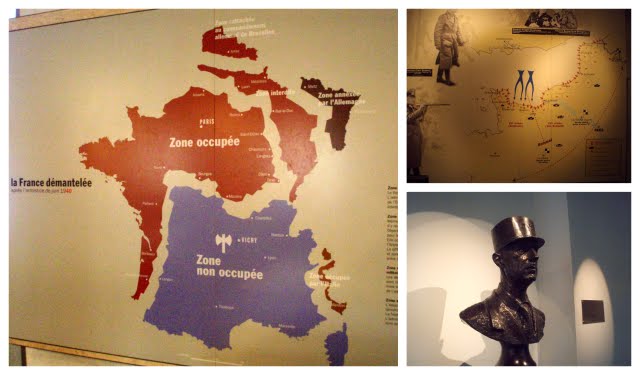
A large part of the WWII exhibit focused on the conflict in France, and the French resistance.  Here are maps showing the German-occupied and Vichy territories, the Allied invasion on D-Day, and a bust of General Charles de Gaulle.


The rest of the exhibit was a weaponry-buff's dream, with machine guns, tanks, mines, rifles, and bombs.  Clockwise from upper left: Renault 31R UE Tracked Infantry Support Vehicle, German naval mine, German MG-34 machine gun, replica of Little Boy (the bomb dropped on Hiroshima), and an American 105 HM2 A1 Light Artillery Piece.


On our way back to the Metro, we passed a few quirky things such as this empty shop window indicating that the owners are en vacances.


Something that really caught our attention was this amazing Art Nouveau building at 29 Avenue Rapp.  It was designed by Jules Lavirotte in 1901.  This is the front doorway and balcony facing the street.


And this is the courtyard behind the house.