The Place du Trocedéro was the site of today's memorial service in honor of the victims of 9/11. In between the buildings of the Palais de Chaillot stand two symbolic towers, each 10 stories high. In the afternoon was a service commemorating the solemn occasion, and in the evening a candlelight vigil was planned.
Showing posts with label 16th Arrondissment. Show all posts
Sunday, September 11, 2011
The French Will Never Forget
With the crisp weather and the falling leaves it is really starting to look like Autumn here in Paris. It was gray and rainy in the early afternoon today, but we were determined to go to the Place du Trocadéro one last time.
The Place du Trocedéro was the site of today's memorial service in honor of the victims of 9/11. In between the buildings of the Palais de Chaillot stand two symbolic towers, each 10 stories high. In the afternoon was a service commemorating the solemn occasion, and in the evening a candlelight vigil was planned.
The event was sponsored by a group called "The French Will Never Forget", an association that is committed to remembering the events of 9/11 as well as the gratitude of France for the US actions during WWII. The group emphasizes the continued goodwill and historical connections between the French and American people. On the left-hand tower are inscribed the names of the 9/11 victims, and on the right-hand tower were hundreds of messages of sympathy, solidarity, and friendship from the people of France and America.
The Place du Trocedéro was the site of today's memorial service in honor of the victims of 9/11. In between the buildings of the Palais de Chaillot stand two symbolic towers, each 10 stories high. In the afternoon was a service commemorating the solemn occasion, and in the evening a candlelight vigil was planned.
Thursday, September 8, 2011
Bois de Boulogne
Today we went for a walk in the Bois de Boulogne (one of two forests just outside the city). Unfortunately we were rained out about halfway through, but I will post the few photos I have. I am hoping to go back before we leave, but we'll see if the weather allows. The bois is 2.5 times larger than Central Park, and we only explored the lakes on the eastern edge. This is Lac Supérieur (Upper Lake), the smaller of the two.
Across the street is Lac Inférieur (Lower Lake), the larger of the two lakes. It has two islands in the center.
This group of swans were all lunching on plants growing on the lake bottom. It was odd to see so many "headless" swans.
Two waterfalls pour into the lake.
Here is a cluster of Firebugs (Pyrrhocoris) and nymphs on a woodpost in the ivy.
Another view of the lake with a folly on the island.
The path along the lake, close up of some (I think) cotoneaster berries.
The central island is very neatly manicured. It looks like a golf course at first glance.
This funny woman was riding her bike with her five (or six) unleashed dogs. When she stopped to turn around and call to a straggler, one of the dogs jumped in the water. "Oh là là!" she exclaimed at the dog, in English with a strong French accent, "You are in the wat-air!" I think she spoke English for our benefit, since we were the only ones around. Clearly we do not look French.
On the island is a restaurant called Châlet des Îles. You can get to the restaurant by ferry. The menu looked lovely, but we had brought our own picnic lunch.
Another way to reach the island is to rent a rowboat.
A stand of tall trees across the lake.
And some younger trees. There was a whole field of recently planted saplings.
We wanted to explore more -- there's a rose garden, a small château, and a botanical garden -- but it started raining at this point and all those things are at the end of the forest far away from the Metro station. So instead we took the nearest path to the park exit.
Across the street is Lac Inférieur (Lower Lake), the larger of the two lakes. It has two islands in the center.
This group of swans were all lunching on plants growing on the lake bottom. It was odd to see so many "headless" swans.
Two waterfalls pour into the lake.
Another view of the lake with a folly on the island.
The path along the lake, close up of some (I think) cotoneaster berries.
| Canine rescue |
On the island is a restaurant called Châlet des Îles. You can get to the restaurant by ferry. The menu looked lovely, but we had brought our own picnic lunch.
A stand of tall trees across the lake.
And some younger trees. There was a whole field of recently planted saplings.
We wanted to explore more -- there's a rose garden, a small château, and a botanical garden -- but it started raining at this point and all those things are at the end of the forest far away from the Metro station. So instead we took the nearest path to the park exit.
Location:
Bois de Boulogne, France
Saturday, August 20, 2011
Cité de l'Architecture et du Patrimoine
The name of this museum translates literally to "City of Architecture and Heritage". It takes up one wing of the Palais de Chaillot. Based on the name I wasn't quite sure what to expect but I had heard wonderful things about it so I went inside. It turned out to be one of my favorite museums in Paris so far. It is comprised of three display areas: the Gallery of Casts, the Gallery of Modern & Contemporary Architecture, and the Gallery of Wall Paintings and Stained Glass. I started my visit in the Gallery of Casts.
Each room contains a variety of casts and models. The plaster casts are done to actual scale and showcase the key features of architecturally important buildings in France.
The models show the entire building and usually have a cutaway so you can also see the interior.
There were copies of other decorative elements as well, like these Pleurant (mourning) figurines -- the originals decorate the tombs of Phillipe le Hardi, Jean de Berry, and Philippe Pot.
Some of the sculptures tended toward the creepy and macabre, such as these two gargoyles and this decomposing skeleton statue.
The next room was also overflowing with casts and models. In all, the museum has more than 350 casts, the oldest of which date to the 1880's.
Some of the models and casts are from buildings that no longer exist, like this model of the Minimes Abbey in Passy. (This was the building that was once above the Wine Museum that I visited the other day).
And some of the models are of structures that have never existed, such as this plan for an opera house by Claude-Théophile Muly. The director of the king's builders called the plans "unrealistic and unexecutable" at the time (1785), so it was never built.
Then it was upstairs to the Gallery of Modern and Contemporary Architecture. Speaking of which, there was a pretty great view of a modern structure right out the window.
The gallery here lacked some of the "wow" factor of the exhibits below, since it was mostly small-scale models. Although you can see in the back a full-scale replica of an apartment in Le Corbusier's "Radiant City" building in Marseilles (it is even furnished).
A few of the more detailed models included the Crystal Palace from the 1851 Great Exhibition in London, the French Pavilion from the 1958 World's Fair in Brussels, one of the follies from the Parc de la Villette (which we visited last week), and this cross-section of the Théâtre des Champs-Élysées.
Other interesting displays showed the difference between Haussmann-era floorplans (note the lack of hallways), and newer 1900's-era plans. I also liked these plaster mockups of Charles Garnier's house in Italy, the Castel d'Orgeval by Hector Guimard (famous for designing the Art Nouveau Metro entrances), and a strange bubble house by Antti Lovag.
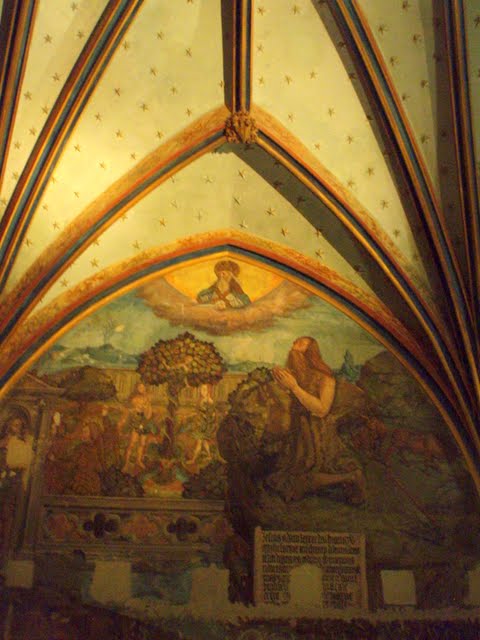
Finally, it was upstairs to view the Gallery of Wall Paintings and Stained Glass. Each room was a life-sized replication of a chapel or tomb somewhere in France.
The crowning achievement was the full-size replica of the painted dome from the cathedral at Cahors.
Eight prophets encircle the central scene which depicts the stoning of St. Stephen.
On my way out of the exhibits I passed this one last model of the Crac des Chevaliers, a castle built in Syria by the Crusaders from 1031 to 1170. The real-life castle still exists and is mostly intact, one of the best preserved medieval castles in the world.
The library and archives contain a comprehensive collection of research tools for historians. And there is also a workshop, where artists work on the models and replicas used in the museum.
To my delight, there were also several classrooms for teaching schoolkids about the basics of architecture and construction techniques. My favorite is the corrugated cardboard castle. Fun!
| The High Gothic room |
| The tympanum from the Église Abbatiale Saint-Pierre in Moissac |
![]() |
| Clockwise from left: cutaway and facade of the Abbey Church at Parlay-le-Monial, model of Notre Dame Cathedral in Laon |
There were copies of other decorative elements as well, like these Pleurant (mourning) figurines -- the originals decorate the tombs of Phillipe le Hardi, Jean de Berry, and Philippe Pot.
And some of the models are of structures that have never existed, such as this plan for an opera house by Claude-Théophile Muly. The director of the king's builders called the plans "unrealistic and unexecutable" at the time (1785), so it was never built.
Then it was upstairs to the Gallery of Modern and Contemporary Architecture. Speaking of which, there was a pretty great view of a modern structure right out the window.
The gallery here lacked some of the "wow" factor of the exhibits below, since it was mostly small-scale models. Although you can see in the back a full-scale replica of an apartment in Le Corbusier's "Radiant City" building in Marseilles (it is even furnished).
| The crypt from the Romanesque Church of Saint-Nicolas in Tavant |
| Adam and Eve fresco from the chapel at Château Dissay |
The crowning achievement was the full-size replica of the painted dome from the cathedral at Cahors.
| Crac des Chevaliers (it's only a model!) |
The library and archives contain a comprehensive collection of research tools for historians. And there is also a workshop, where artists work on the models and replicas used in the museum.
Labels:
16th Arrondissment,
Archaeology,
Architecture,
Art,
Castles,
Churches,
Eiffel Tower,
France,
Museums,
Paris
Champ de Mars and the Eiffel Tower
Another solo walk today, this time from the École Militaire to the Trocadéro. The walk started off at the southeast end of the Champ de Mars, very near where we sat for the Bastille Day fireworks last month. This is a daytime view of the École Militaire. Founded in 1750 by Louis XIV as a military academy, it is still in use today for military higher education.
This is the Wall for Peace, a monument inspired by the Wailing Wall in Jerusalem and designed by artist Clara Halter and architect Jean-Michel Wilmotte.
Another view, through the glass.
After the construction of the École Militaire the area to the north was leveled into the esplanade known as the Champ de Mars. Today, it was full of tourists and Parisians baking in the hot sun.
After a little more walking (and stopping to buy a bottle of cold water) I arrived under the tower. Here it is, in all its 1063-foot glory.
Up close the base really is enormous. It has to be, to support the height. The tower was built for the 1889 World's Fair and at that time was the tallest man-made structure in the world. Today it is still the tallest structure in Paris.
Around the base, Gustave Eiffel included seventy-two names of French scientists and engineers. Augustin-Jean Fresnel's specialty was wave optics. He invented the Fresnel lighthouse lens (we know that name well).
If you are feeling adventurous, you can climb the stairs to the first and second levels (300 steps per level). Or you can take the elevator, but it costs more. The third (top) level can only be reached by elevator.
After checking out the insanely long queues, I vetoed the idea of going up the tower today.
This is the view from below the tower, looking up through the open center of the first floor platform to the second floor.
Eiffel specifically designed the graceful curves to help the tower withstand the wind. As a testament to his design, the tower only sways a minimal 2 to 3 inches in strong winds.
I crossed over the Pont d'Iéna to the Trocadéro gardens, which was a popular spot for weddings today (I saw two just in the few minutes while I was there).
I went up the steps to the Palais de Chaillot, with its pretty gilded statues, to spend the rest of the afternoon at the Cité de l'Architecture et du Patrimoine. But I'll save that for another post.
This is the Wall for Peace, a monument inspired by the Wailing Wall in Jerusalem and designed by artist Clara Halter and architect Jean-Michel Wilmotte.
Another view, through the glass.
After the construction of the École Militaire the area to the north was leveled into the esplanade known as the Champ de Mars. Today, it was full of tourists and Parisians baking in the hot sun.
After a little more walking (and stopping to buy a bottle of cold water) I arrived under the tower. Here it is, in all its 1063-foot glory.
Up close the base really is enormous. It has to be, to support the height. The tower was built for the 1889 World's Fair and at that time was the tallest man-made structure in the world. Today it is still the tallest structure in Paris.
If you are feeling adventurous, you can climb the stairs to the first and second levels (300 steps per level). Or you can take the elevator, but it costs more. The third (top) level can only be reached by elevator.
After checking out the insanely long queues, I vetoed the idea of going up the tower today.
This is the view from below the tower, looking up through the open center of the first floor platform to the second floor.
Eiffel specifically designed the graceful curves to help the tower withstand the wind. As a testament to his design, the tower only sways a minimal 2 to 3 inches in strong winds.
I went up the steps to the Palais de Chaillot, with its pretty gilded statues, to spend the rest of the afternoon at the Cité de l'Architecture et du Patrimoine. But I'll save that for another post.
Subscribe to:
Posts (Atom)