Thursday, September 22, 2011

Elephant Nature Park

When Thailand banned logging in the late 1980's, thousands of trained elephants were put out of work.  Many of those elephants were then put to work in the tourism industry.  As a result, there are many "Elephant Day Tour" companies in Thailand.  Some of them have trained elephants that you can ride, or that do tricks.  But we weren't really interested in riding the elephants (the training/breaking process, called phajaan, can be very brutal).  We did a little research and were so glad we chose to spend a day at the Elephant Nature Park about an hour outside of Chiang Mai.


Started in 1997 by Sangduen "Lek" Chailert in 1996, the park is a sanctuary for injured, abused, and rescued elephants.  The intent is to provide them with a peaceful environment where they can live as naturally as possible.  Visitors do not ride the elephants.  Instead the focus is on education and more natural interaction with the elephants, such as feeding and bathing.  Here, our guide Nui introduces us to a small part of the "herd".


Elephants here tend to group in herds, just as they do in the wild.  They form strong attachments to each other, even though they may not be related by blood.  There are 37 elephants at the park and they have formed about five herds, although some elephants choose to remain solitary.  There are currently two babies, and several of the females (in addition to the mothers) have formed a tight-knit "family".


Most of the elephants here are female, but there are four males.  Hope, a teenaged male who was orphaned very young, seems to have hit it off with one of the older females, and they are inseparable.  Hope is the one on the right.


Many of the elephants have also formed strong bonds with their mahouts, or elephant drivers/keepers.  Traditionally, the methods that mahouts use on trained elephants are cruel -- they use chains and sharp hooks to force the elephant to do what they want.  But here at the park, the mahouts use only positive reinforcement, such as rewards of food.  The animals aren't trained to do tricks, but the mahouts do need to have control when guiding them to the right areas when it is feeding or bathing time.  There are about 50 mahouts at the park and the elephants have a say in the pairing process.  They are only paired with mahouts that they accept.


Feeding time is very important around here.  Elephants eat up to 550 pounds of food daily.  Here is the "kitchen", stocked with elephant goodies such as bananas, watermelon, and pumpkin.


A separate "menu" is developed for each elephant based on their likes/dislikes, and nutritional needs.


Visitors at the park get to help with the monumental task of making sure each elephant gets plenty to eat.  Feeding time!  Some eat faster than others.


Elephants use their long trunks as hands to grab food or other objects.  Asian elephants have one kind of "finger" on the top of their trunk that helps them with dexterity (African elephants have two of these "fingers" on their noses).


The elephants at the park make good use of their dexterity, reaching for anything that remotely resembles food (which is why they have visitors stay behind the red line at the feeding station).


Many of the elephants had very sad histories prior to coming here to the park. Malai Tong was put to work in the illegal logging industry and experienced further tragedy when a landmine took her right hind foot.  After seeing her, Lek was determined to bring her to the sanctuary.  Malai Tong has now made friends with two other elephants and gets around pretty well considering her injuries.


Jokia was quite cruelly blinded when a previous owner shot stones at her eyes to scare her into working.  She lost sight in both eyes as a result of the abuse.  Luckily Lek rescued her and brought her to the sanctuary where she was befriended by one of the most gentle elephants here, Mae Perm.  The 89 year old Mae Perm acts as Jokia's eyes and helps guide her around the park.  In the photo, Jokia is on the left with trunk raised and Mae Perm is on the right.


Trilly was part of a forced breeding program where they tie the females down.  She could not support the weight of the bull elephant and suffered back and pelvic injuries.  She is unable to walk normally but she can get around slowly.  Tilly has a friend and protector elephant named Khum Pen, who is always by her side and looks out for her here.  She also receives special veterinary care.


There are full-time and volunteer veterinarians helping to ensure all the elephants get excellent care.  We were able to meet with one of them who was checking on a patient who had been unable to stand up due to muscular problems and lack of nutrition.  Although she still needs to be immobilized (tethered), she is standing up and able to eat.  (Note the tiny IV bag above her head giving her dextrose and vitamins -- the needle is in a huge vein on the back of her ear).  At right is the rescue van/ambulance donated by Bob Barker of "The Price is Right".  He sponsors several of the elephants at the park.


Elephants aren't the only animals that have found homes at the park.  There are something like 80 dogs, a handful of cats, a few water buffalo, and even an Asian black bear that was rescued.  In Burma, China, and other parts of Asia they put the bears in tiny "crush cages" and drain the stomach bile while the bear is still living for use in traditional Chinese medicine.  Thankfully this bear has been saved from that fate. 


The park has been built to accomodate the needs of the animals while acknowledging that visitors still want to see and interact with the animals.  During feedings and bathtimes visitors can get up close; at theses times there are always mahouts and park personnel on hand to make sure both visitors and animals are safe and comfortable.  During other times, visitors are free to observe the elephants from several areas, including this elevated skyway.


The skyway provides a great view of bathtime in the river.  Groups of visitors are invited to "help" the elephants get clean and cool off.


We were happy to help.


Of course some of the elephants don't want any help and instead prefer to get right in there and swim.


After bathtime, the elephants march off to their "free time" where they can roam the whole park at will.


We were so happy to have had a chance to support this organization with our tourist dollars.  Elephants are an endangered species, but in Thailand trained logging elephants are considered "livestock" and are not protected.  Lek's crusade to ensure that these animals can live out their lives in peace and comfort is truly inspiring.

Wednesday, September 21, 2011

"A Lot of Thai" Cooking Class

I knew our Thai cooking class was going to be great when they picked us up at the hotel in a powder blue 1973 VW bus.


The A Lot of Thai cooking school is truly a family affair.  Siripen "Yui" Sriyabhay and her husband Kwan run the class -- she does the cooking and instructing, he does the driving and web/graphic design.  Their two adorable kids Sid and Jun feature prominently in the cookbook and say hello to the class when they get home from school.  Here is Yui welcoming us to the class.


The class is taught in Yui's home, which is very close to our hotel.  This is the outdoor kitchen, with 8 cooking stations.


Clockwise from left: the ingredients for our first dish (phad thai), our woks, and Kevin modeling the "A Lot of Thai" apron.  All of the ingredients were pre-prepped so that all we had to do was chop the vegetables and measure the liquids.


Yui's teaching style was perfect for us.  She explained everything sensibly, in her own style, and with plenty of humor to keep us laughing.   She first explained and demonstrated the dish, then walked around answering questions as we made our own versions.  This is Kevin making Phad Thai; both of our finished dishes were delicious.


Next up was Tom Yam Gung, which is hot and sour prawn soup.  Here, Yui doles out two shrimp heads for each of us to add to our ingredients.


And here is my finished product.  Yui tasted it and said "Not enough heat, not enough salt".  She was right; I made it mild on purpose by removing all the seeds from the chilis and holding back on the fish sauce, so I doubt any self-respecting Thai would like my Tom Yam!


Our third dish of the morning was Green Curry with Chicken which is one of Kevin's favorites.  It has a whole host of ingredients: coconut cream, curry paste, coconut milk, eggplant, kaffir lime leaves, red chilis, fish sauce, palm sugar, sweet basil, and chicken.  It sounds complicated but is really not too difficult to make.


Here are Kevin's and my respective dishes.  Kevin made green curry; I made red curry.  But mine isn't very red because I wanted to make sure it was not spicy so I used less red curry paste than the recipe called for!  In Thai, the word for "not spicy" is "mai phet"!


And our last dish in the morning was Cashew Chicken, which is my absolute favorite.  I have even learned to say it in Thai, but it took a lot of practice because it has a very long name: gai-pad-med-ma-muang-him-ma-pan.  My version turned out fantastic, but that's probably because I followed the recipe exactly since this dish is not spicy.


After eating all morning, we took a break to go to Yui's local produce market.


She took us around to each stall and showed us many of the local veggies and what they are used for.


This woman sold banana leaf bundles containing all the ingredients to make your own curry paste (mortar and pestle not included).


Clockwise from left: yellow persimmons, green mangoes, bumpy jackfruit, vats of uncooked rice, garlic and shallots, red and green chilis.


Various eggs for sale.  The pink ones are "century eggs" -- they are cured in a clay, ash, salt, lime, and rice husk mixture for up to 5 months and then dyed pink (to distinguish them from regular eggs).


The egg inside is a black gelatinous color.  Yui said that Thais call them kai yieow maa, meaning "egg urine horse", although horse urine is not actually used in the process (it doesn't have the right pH to cure them).  Maybe they got that name because of the smell?

Photo courtesy of www.foododdity.com

Well I hope everyone's hungry now.  Because after the market we went straight back into the kitchen to prepare sweet coconut sticky rice with mango, a traditional Thai dessert.  First the glutinous rice (it doesn't have any gluten, just a high starch content) is soaked in water overnight.  Yui includes a little bit of black sticky rice for nutritional value and to give her rice a purple color.


Then the rice is steamed for about 15 minutes.


Afterwards you remove it from the heat and mix it with coconut cream, sugar and salt.  Once mixed, cover and let it stand for a half an hour.  Just before serving, top it with diced mango.  You can then add additional cream or even Thai custard.


Our final dish was traditional fried spring rolls.  First we stir-fried a mixture of garlic, pork, cabbage, sprouts and glass noodles with sauce.


Then we wrapped the rolls using the technique Yui showed to us.  According to Yui, if you wrap them correctly they should not be very greasy.


Next step was to deep fry for one to two minutes.


And the end result is two perfect, non-greasy, spring rolls.  Here is a photo of our last two dishes.  Delicious!


We really had a wonderful day learning to prepare these dishes.  I would highly recommend A Lot of Thai cooking class to anyone planning to visit Chiang Mai.  Now we can bring the taste of Thailand home with us!

Tuesday, September 20, 2011

Chiang Mai Old Town

Chiang Mai became the capital of the Lanna kingdom in 1292.  During the reigns of King Mengrai and King Tilok, many wats were built in the city; there are now about 300 of these temples found throughout the city.  Our first stop was Wat Chedi Luang, which means "the temple of the great chedi".


Twin nagas (sacred serpents) stand watch at the door to the wihan (hall).


The temple was quite busy today.  It was supposed to be a local holy day, but I couldn't figure out what it was specifically.


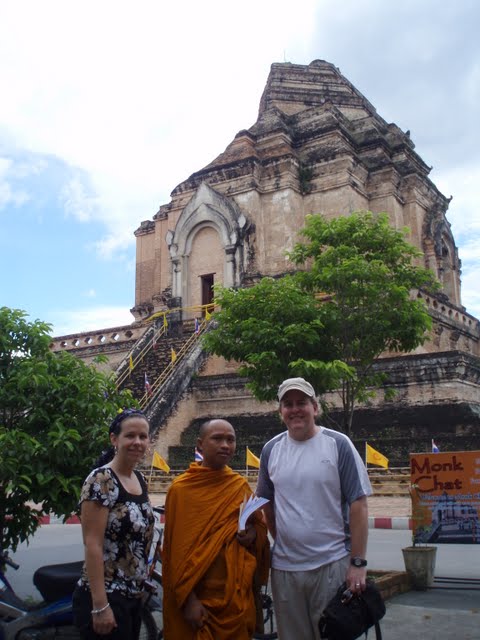
The focal structure of this wat is the Great Chedi.  It was originally 270 feet high and for a time the Emerald Buddha was kept there.  But in 1545 an earthquake destroyed 1/3 of the structure.


It is decorated with elephants (chang) around the base and nagas at the foot of the four stairways.


Each of the four sides has a niche containing a golden statue of the Buddha.


A nearby chapel contained a smaller reclining Buddha.


Other scenes from around the wat:


Within the wat complex is a religious university attended by both Buddhist monks and laypeople alike.  A patio area was dedicated to a daily activity called "Monk Chat".  Some of the monks are available to chat with visitors and answer questions about Buddhism, life as a monk, or anything in general.  We sat down with a monk from Cambodia who gave his name as "A".  He has been a monk since the age of 18 and was taking a Philosophy course.  He said he spends most of his day in meditation, chanting, and "chatting".  His English was very good, but explaining complicated Buddhist concepts to a bunch of foreigners must be very difficult!


We then left Wat Chedi Luang and walked through the Old City to another nearby temple, Wat Phra Sing.  It is the largest temple in Chiang Mai.  The Wihan Luang (Great Hall) is very large and houses an equally large Buddha statue inside.


Inside, along one of the aisles, a monk in orange robes was chanting blessings over the faithful.


A large prayer bell beside the wihan.


Another wihan, the Wihan Lai Kham (Gilded Hall), is one of the most visited areas of the temple complex.  It contains the Phra Buddha Singh (Lion Buddha), a very important Buddha image.

Wihan Lai Kham with small chedi

The Lion Buddha originated in Sri Lanka, and is revered in Chiang Mai.  Every year, the statue is carried through the streets of the city for the Songkran festival.


The rest of the temple complex was very lovely.


But we were getting hungry and a little "templed out", so we walked around a little to find some tasty Thai food.  Some signs we saw on the way:


After lunch we walked around a bit more.  The Old City of Chiang Mai is square shaped, with walls and a moat marking its borders.  The walls and gates are old and were dismantled over time.  But the Tha Phae gate has been reconstructed based on old photographs and drawings.


This is a view of the moat and a corner of the city wall that has been preserved.