Showing posts with label Versailles. Show all posts

Saturday, July 30, 2011

Versailles Part 5: Les Grandes Eaux Nocturnes

Since we were just here yesterday, finding the Château from the RER train station was a breeze.  We expected crowds and a long wait to purchase tickets, but were pleasantly surprised by short lines and lots of ticket kiosks.


We broke the rules by bringing a picnic (expressly forbidden according to the verbage in our map handouts).


But we weren't the only ones, so we didn't feel too bad.


In the post yesterday I mentioned the river-themed sculptures on the Parterre d'Eau (Water Terrace).  Well, here is another one, representing the River Saône.


Sunset illuminating the palace taken from the southern angle...


....and from the other side.


Here is a view of the Orangerie; they had just turned on the lights in the garden.


Numerous attempts to catch the "perfect shot" of the setting sun were unsuccessful.  This is the best one of the bunch.


The gardens opened right at 9pm.  Bubbles floated on the air as we descended the steps.


We walked to the northern section of the garden, towards the Dragon Fountain.  We could see loads of spectators gathering in the Neptune Basin (background)...


...but we ignored that to take photos of the Dragon Fountain.  That was a mistake...


...because we soon realized that the Neptune fountain only runs at 9:15 and 9:30pm.  Despite literally running (okay...jogging) to try to catch the tail end of the 9:30 show, we ended up missing all but the last 30 seconds.  This is a shot of the fountains winding down to a trickle...just 10 seconds before there were 40 jets of water shooting at least 50 feet into the air.


Three Fountains Grove was our next stop, but it was very crowded with people still spilling out of the Neptune Basin spectacle.  There was a fog machine making a cool smoky effect.


The narrow staircases at the Three Fountains were a bit of a bottleneck for all the people, but at least the fountains were lovely to look at.


The Apollo's Baths Grove offered a little more breathing room, and a chance to set up the tripod.  Of course an attendant asked us to put the tripod away, since they are not allowed during the Grandes Eaux shows.


But we did get at least one in-focus shot of the grotto, so it was worth it.


The Bosquet de l'Encelade had a fountain with music and multicolored lighting.


There was no show in the Bosquet de Domes, but the statues were beautifully illuminated.


There was a very impressive display set to music at the Bassin du Char d'Apollon.


The Girandole grove also had a light show, but we got there just at the end.  It was not easy to walk around the entire garden to try to see everything in just a 2-hour time frame.  Even at a fairly fast clip, we know we missed quite a few things.


The sculpted shrubs looked beautiful when backlit.


Even the statues take on a different appearance at night.  Here is a day and night shot of the same statue:


The Colonnade had an eerie green laser and fog display.


Strangely-shaped lanterns lined some of the walkways.


The Bassin du Mirroir had a beautifully choreographed show to Rambeau's Naïs overture; one of our favorites of the night.


And then it was time to make our way back up to the terrace to find a place to watch the fireworks.  This is a shot across the Royal Pathway/Tapis Vert (Green Carpet).


The Feu d'Artifice (fireworks) show kicked off at 11:05 with some shooting stars.


The whole display was set to music and really well coordinated.


On the ground along the Royal Pathway, there were fire jets that were synchronized to the music.


Some more shots of the show, with a collage of the finale.


Here is a video we shot of the finale


The fireworks display was not very long, only 15 minutes.  It ended at 11:20, leaving us plenty of time to walk to the train station and catch our 11:50 train back to Paris after a fabulous evening.

Friday, July 29, 2011

Versailles Part 4: The Queen's Hamlet

In the late 1780's Queen Marie-Antoinette had Richard Mique, her favorite architect, build her a rustic village near her Petit Trianon palace.  There is a mill, a working farm, a dairy, and the queen even kept a small cottage residence there.


The Marlborough Tower was the starting point for boating excursions and it was also used as a signal tower that allowed the queen and staff to communicate with the palace of Versailles without leaving the village.


To reach the farmhouse, you walk past a small vineyard.


The pastoral front view of the farmhouse.  Note the quaint touches such as the thatched roof, wagon, and well.


It is still a working farm -- cows, sheep, goats, mules and chickens were all on display.


Sheep grazing


One of many pumpkins growing in the vegetable gardens.


Pretty windows on one of the farm buildings


This picturesque bridge crosses the stream coming from the lake.


This structure is actually two buildings connected by a balustrade.  On the left, with the wooden spiral staircase, is the Billiard Room.  On the right is the Queen's House.


Each house has a vegetable and/or flower garden.


According to the official Versailles website, the Mill was used as a laundry facility for the hamlet and was also used for grinding flour.  According to wikipedia, the millwheel is non-functional and grain was never processed there.  Either way, it's a pretty building.


Pink flowers line the steps leading to the queen's boudoir.


After touring the hamlet, we made our way on foot back to the Château.  After five straight hours of walking, we were kicking ourselves for not renting one of these convenient golf carts.


And here are a few final views as we leave the Château.  Don't worry, we will be back tomorrow night for the Grandes Eaux Nocturnes (evening fountain and firework show).  Here is one last view of the Latonne fountain with the palace in the background.


And here is a statue representing the River Rhône, one of eight river statues adorning the Water Parterre.

Versailles Part 3: The Trianons

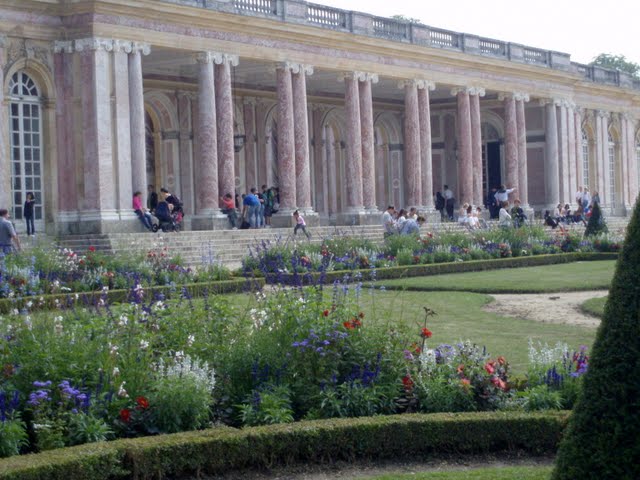
The Grand Trianon was built in the late 1600's as a "home away from home" for Louis XIV.  It was a smaller château where he could spend time with his mistress away from the prying eyes of the court at Versailles.  The Grand Trianon consists of two wings connected by a peristyle, or columned walkway.  The pink marble facade is really striking; this is a view from the back garden.


And a closer view of the outdoor colonnade linking the two parts of the château.


The Grand Trianon has its own gardens, separated from the rest of the Versailles gardens.  We did not walk the whole length of them, but the flowers just behind the palace were lovely.


Inside the Grand Trianon was a special exhibition called "The 18th Century Back in Fashion", showcasing the work of modern clothing designers as influenced by the fashions of the 1700's.


Scattered throughout the rooms of the palace, 50 mannequins sported couture ensembles by designers such as Karl Lagerfeld, Christian Lacroix, and Vivienne Westwood.  Photographs were strictly prohibited.

Pink Vivienne Westwood gown in the antechamber

A ruffly pantsuit in Boudoir of the Empress Marie-Louise

Thierry Mugler & Yohji Yamamoto ensembles in the Emperor's Antechamber

Bedchamber of the Queen of the Belgians, with Christian Dior jacket

Cotton candy pink tulle dress by Doutzen Kroes

If you need an escape from all this haute couture, here's a view of the garden.


Okay, sweetie-darlings, here is some more eye candy.

Jean-Paul Gaultier in the very yellow Drawing Room

Elegantly draped Vivienne Westwood gown in the Emperor's Study

Okay, enough fashion!  The Cotelle Gallery is lined with pictures of Versailles and the gardens.


A short distance away from the Grand Trianon is the Petit Trianon.  This smaller home was originally built in the 1760's for Madame de Pompador (Louis XV's mistress), but it was Marie-Antoinette (wife of the next king Louis XVI) who really made it her home.  It was recently restored in 2008 and is now open to the public.


Marie-Antoinette was only 19 years old when her husband ascended the throne.  The pressure of court life could be too much for her at times so she would escape to the Petit Trianon as a place of refuge.  No one (not even the king) was allowed to enter without her express permission.


The entrance to the Petit Trianon is through a rustic, but pretty, courtyard.


The simple, small chapel features a painting by Joseph-Marie Vien called Saint William Offering Lilies to Saint Louis and Marguerite de Provence.


This tiny carriage belonged to Marie-Antoinette's son, the dauphin (that's what the French monarchy used to call the king's eldest son).  The carriage was intended to be drawn by goats instead of ponies.


A bust of Marie-Antoinette is on the mantel in the billiard room.


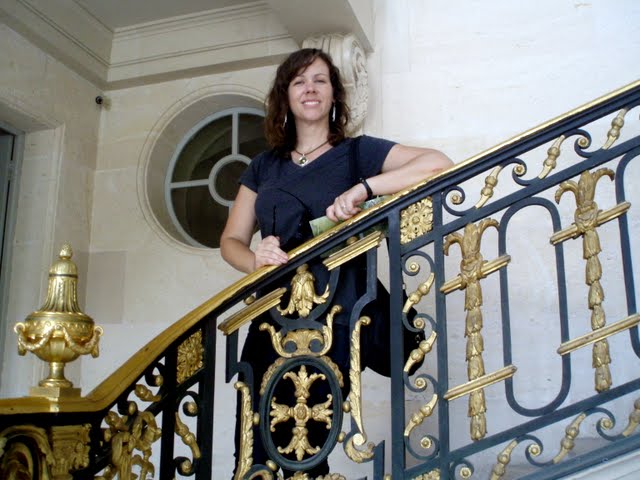
The railing of the Grand Staircase is ornamented with Marie-Antoinette's initials


The Salon de Compagnie was used as a game room and music room.  The pianoforte was made by Pascal Taskin in 1790.


For this inner drawing room, the queen had a system of moveable/sliding mirrors designed to block the windows from prying eyes.


The Queen's bedroom.  Note the small size of the bed -- it's unlikely that the king spent much time here. His bedroom is tucked away in the attic (only accessible with a guided tour).


The Petit Trianon also has its own gardens.  This is the view of the back of the house from the informal English garden.


This solitary swan was swimming in the stream running through the garden.


Several "follies" (miniature artificial decorative structures) were added to the gardens in the 1770-80's.  This is the Temple of Love, built in the classical style.


A more rustic "folly" is the Queen's Hamlet, a small village built within the gardens.  That will be the next post.