Tuesday, July 15, 2025

Seine River Cruise - North from Paris to Normandy

We are on the cruise ship AmaDante, run by the river cruise company AmaWaterways. Although Kevin and I have been on many overnight ferries with cabins (and of course spent many nights on our own sailboat), this is the first time I've ever been on a cruise ship. The ship has 71 staterooms and can accommodate 140 passengers, but on this cruise there are only about 120 passengers. Our staterooms are surprisingly spacious and have great views looking out over the water.


Here's a peek at what the staterooms look like:


Just above us on the ship's top level is the sundeck, which has a walking track, shaded lounge chairs, and a small hot tub.


The lounge and bar area has plenty of seating and nice views out the windows.


For meals you can choose to eat a la carte in the lounge/bar area, or you can get the full menu on the dining deck. The menu each day varies and there is usually a choice of appetizer, salad, soup, entree and dessert. I can see why they need a walking track on the sundeck!


The food has been good and the service is great. We keep coming back to the same table so that we can sit in Alex's section - he is by far our favorite waiter.


But enough about the ship, what adventures have we been up to?? Well our cruise is a seven-night tour of the River Seine as it winds its way through the Normandy region and back to Paris. Our first port was the charming village of Les Andelys. In the background you can see the Château Gaillard, built by Richard I the Lionheart at the end of the 12th century.


Our tour bus took us up the hill so that we could hike to the castle and explore the ramparts, but because it was demolished in 1599 it's really just a ruin so the best part about the hike was the great view of town down below.


Our next port of call included the towns of Honfleur and Le Havre. Honfleur is a beautiful port town that retains a lot of its medieval charm. The cobblestones and half-timbered houses transport you back in time almost instantly. Half-timbered construction was used here because forests were plentiful in this region, while stone quarries were not. A skeleton of timber beams would be raised and then the space between each beam would be filled in with earth, sand, and straw and then coated with lime and clay leaving the wooden beams exposed. 


Kevin and I had been to Honfleur before but not with a tour. Our tour guide was from this part of France and she shared a lot of local knowledge that we missed on our first trip here. One of the "fun facts" we learned was that Claude Monet's teacher Eugène Boudin was born in Honfleur. Although Boudin didn't quite make the cutoff for being considered an "impressionist" painter, he was one of the first artists to paint en plein air (meaning outdoors) and this technique became a hallmark of the Impressionist movement once he introduced his pupil Monet to it. Another fun Honfleur fact is that the picturesque tall houses lining the harbor's Vieux Bassin (Old Port) were actually constructed in two pieces. The lower half of each house was built first, with the front door facing the harbor. Then the upper halves were added years later (sometimes even in a slightly different style or different colored materials) with their front doors facing the higher-level street behind the building. If you look closely at the photo, you can probably find the dividing lines between the two halves of each structure. 


When Kevin and I were in Honfleur in 2014, we had only had a few hours to walk around and grab dinner. So we missed an entire section of town, where the old wooden church of Sainte-Catherine is located. It is one of the oldest wooden churches in France, constructed in the late 15th century after the end of the Hundred Years' War. When this church was built the main industries in town had to do with fishing and shipbuilding. So the shipwrights and carpenters built the wooden church in the best way they knew how -- double naves shaped like two upside-down ship hulls.


Because of the fire danger from lightning strikes, the bell tower for the church was actually constructed as a separate building across the square.


Back at the ship, we got ready for our afternoon excursions to see the sights of Le Havre -- a bus/walking tour for Delaine, and a biking tour for Kevin and me. Le Havre is the second biggest port in France (after Marseille) and a major port city for all of Europe. While Marseille on the Mediterranean handles half a million more shipping containers per year, Le Havre is a key link to the Atlantic sea trade.


Both tours saw many of the same sights. Unlike Honfleur, the city of Le Havre was heavily bombed during WWII in September 1944 by allied forces to oust the Nazi stronghold there and capture the port. The bombings destroyed 85% of the city center and unfortunately there were many civilian casualties. During the period from 1945 to 1964 the city was rebuilt but in a very modern style; there is a lot of concrete and glass, and -- depending on your viewpoint -- not a lot of charm. Many of the newer buildings are extremely modernist in style, almost brutalist-looking, which is why the town has occasionally been called "Stalingrad-sur-Mer". This is the war monument near the town hall. You can see the surrounding buildings look quite different than the quaint half-timbered houses of Honfleur!


Unfortunately, partway through the bike tour it started pouring. We ended up taking shelter (along with the folks from the bus tour) in St. Joseph's Church. This very modern church almost looks like a lighthouse on the outside, with a unique octagonal-shaped central belltower rising 107 meters into the sky. The interior looks unlike any other Catholic church I've seen, with harsh concrete and metal angles and small but prolific stained glass windows rising all the way up the tower. Again, a big contrast to the wooden church we saw in Honfleur that morning!


We actually spent a second night in Le Havre so that we could see more of Normandy. Once again we split up, with Delaine going to Omaha Beach and the American Cemetery at Colleville-sur-Mer. Here is one of the monuments on the beach, dedicated to the Allied Forces who landed on D-Day - June 6th 1944.


Notice the wreaths below that monument. Many American soldiers and their descendants bring a wreath or some kind of remembrance when they visit this solemn site. One of our fellow cruise ship passengers brought a photo of his dad in uniform and laid a wreath at the cemetery. Although his dad was one of the lucky ones who survived, one of his final wishes when he passed was for his son to bring this photo so that a small piece of his memory could be with some of the friends he lost that day.


Kevin and his mom also have a very strong connection to the Normandy Beaches and D-Day invasion history. On D-Day, Delaine's uncle Bruce was a paratrooper with the 82nd Airborne who jumped from a plane and landed not far from here. He survived the war, and thanks to his son (Delaine's cousin) we were able to read a treasure trove of his letters home that he wrote during his time serving here and elsewhere on the European front. Delaine's uncle was fortunate to have survived, but he did lose several good friends during the course of the war. Knowing his story of the loss of his friends and reading his letters made visiting the American Cemetery that much more meaningful. 


Kevin and I had visited Omaha Beach on a previous trip, so we did not join in the Normandy Beach excursions this time. Instead there was a separate tour that took us to a few smaller towns in the Pays d'Auge region of Normandy that we'd never been to before. Our first stop of the morning was the well-to-do town of Deauville.


Deauville is a town filled with ostentatious houses, horse stables, elegant hotels, and a casino. Back in the 1860s when it first became accessible by train, this town grew in to a beachgoing spa haven where the wealthy Parisians came in the summer to see and be seen. In the 1920s the town built a long wooden boardwalk along the beach called the Promenade des Planches. The beach here became even more famous when it was used as a filming location for several well-known French films, including "Un Homme et une Femme" ("A Man and a Woman").


We also went to the pretty towns of Beaumont-en-Auge and Pont l'Évêque, but the highlight of our day was stopping in at the Busnel Calvados distillery, where they make both Calvados (apple brandy) and Pommeau (a fortified aperitif made with Calvados). 


France's Normandy region is known for its 800 varieties of apples. Here at Busnel the Calvados is AOC (Appellation d'Origine Contrôlée) meaning they source all the apples for their brandy from the Calvados département. Similar to the way that sparkling wine can only be labeled Champagne if it originates from the region of Champagne in France, only apple brandy sourced from fruits from this Calvados region can officially be labeled "Calvados". 


After learning all about the distillation and aging process, we did of course get to sample both Calvados and Pommeau. Both were excellent. À votre santé!  


Saturday, July 12, 2025

Our Paris 2025 Trip

Well we are back in one of our favorite cities in the world - Paris! We're actually here for a cruise to Normandy, but we arrived a day early so Kevin found us a great hotel within walking distance of the Palais Garnier Opera House. We aren't alone this time around; Kevin's mom Delaine has joined us for this cruise adventure.


None of us seemed to be too jetlagged after checking in, so we decided to walk over to the Galeries Lafayette shopping mall to see the beautiful glass-domed ceiling.


Despite having seven floors of luxury shops and boutiques, we weren't very tempted to purchase anything at the Galeries Lafayette. Instead we headed to the roof to check out the views of Paris. From there we could see the back side of the Opera just across the street. 


Around dinnertime, we took a taxi to the Musée Jacquemart-André just down the street from our hotel. Built in the 1860s, this private mansion was home to Édouard André and his wife Nélie Jacquemart, both very serious art collectors. It's a beautiful space inside with many different rooms showcasing their collection. When Nélie died in 1913, her will left the house and its collection to the Institut de France so that the artworks could be seen by the most people possible.


We weren't just there for the culture, we were also pretty hungry. There is a restaurant on-site but because we were there during the museum's Friday evening "Soiree", we were able to sit outside in the courtyard and listen to some live music while indulging in a generous charcuterie board


On Saturday morning, we walked over to the Opera Garnier and braved the very convoluted queue with our timed tickets in hand for a 10:30 am tour. It was a bit stressful to navigate the huge crowd of tourists waiting at the gate but once we got inside we immediately felt the stately calm wash over us. The immense grand staircase made it seem like there was no crowd at all even with all the people everywhere. It's really something else!


Our tour took us into the opulent auditorium, where we were able to sit back in the red velvet seats and gaze up at the beautiful ceiling painted by Marc Chagall in 1964. It is actually installed on a removable frame so that the original 1870s painted ceiling can be restored (there is still a minor ongoing controversy about the Chagall ceiling being out-of-place).


The final stop on the Opera tour was the Grand Foyer, an almost overwhelmingly large space with gilding on every surface that isn't painted. The ceiling is so crowded with art that it was hard to know where to look. 


On our way back to the hotel we stopped in again at Galeries Lafayette for a nice lunch before heading over to the cruise port to drop off our bags. Official cruise check-in wasn't until 3pm so our rooms weren't ready and we had a few hours to kill. Just on the other side of the river is the delightful Musée Marmottan Monet. This museum is a bit off the beaten path so it doesn't usually have big crowds. The last owner, Paul Marmottan, willed the house and its original contents to the Académie des Beaux-Arts for it to be turned into a museum in 1932. Later, in 1966 the youngest son of painter Claude Monet died and left his father's entire personal art collection to the Marmottan. 


Over a hundred of Monet's Impressionist works were given to the Museum, and based on that initial gift other benefactors also left their valuable Impressionist collections to the Marmottan. It is now also home to at least 25 paintings by Berthe Morisot and various works by other Impressionists such as Corot, Degas, and Manet. But one of the most-loved paintings here is still a Monet -- his Impression, Sunrise which outraged the 1870s art establishment at the time and gave the Impressionist movement its name. 


After that jam-packed couple of days, we were all ready to check in for our cruise and let someone else do all the planning, driving/sailing, and tour booking for us!


Wednesday, May 21, 2025

Camping in Chiricahua National Monument


Down in the southeast corner of Arizona is the little-visited but awe-inspiring Chiricahua National Monument. It's not easy to get to and it's pretty remote (Wilcox is the nearest big town, almost 40 miles away) but we thought it was a very worthwhile trip.


The area was set aside as a national monument in 1924 to protect the many unique rock formations known as "hoodoos" or "pinnacles". During the Great Depression, the Civilian Conservation Corps built and enhanced the 17 miles of hiking trails that wind through and around the towers of rocks.


A band of Chiricahua Apaches were the original inhabitants who moved into this region in the 1400s. An oasis of trees, water, and big game, these mountains provided them with everything they needed to thrive. They were fierce warriors and resisted colonization, first by the Spanish and then by the countries of both Mexico and the United States. After a nearby farm settlement was raided by another band of Apache in 1861, the farmer mistakenly accused the Chiricahua Apaches and their chief Cochise of raiding the farm. This kicked off a series of escalating battles called the Apache Wars. Using his knowledge of the mountainous terrain Cochise managed to evade the US Army for more than a decade and avoid capture, eventually agreeing to allow a large reservation to be established in 1872 (most of modern day Cochise County) where his people could live in their traditional way. He passed away peacefully in 1874.


After the death of chief Cochise, the Chiricahua Apache lacked a strong leader to champion their rights. The Chiricahua Reservation was closed down by the US Government, and the remaining Chiricahua people were sent to other, less desirable, reservations in the southwest. With war bands led by Geronimo and others they continued to fight into the 1880s for their freedom to live on their own land in their own way. Despite their efforts, the band had been reduced from 1200 Apaches during Cochise's time to less than half that number by the time the US Army ultimately forced Geronimo to surrender in 1886. They were moved off their land to reservations in the Eastern US and held there as prisoners-of-war until 1913.


As I mentioned, this is a pretty remote place, but there is one campground within the boundaries of the monument. Bonita Campground has 26 sites and restrooms with running water. But because there are no showers available we only booked ourselves for two nights. Our campsite was pretty pleasant and got a reasonable amount of shade in the afternoon, but it was still a bit toasty when the tent was in full sun.


This place is great for wildlife watching. We saw some Arizona white-tailed deer...


... a very noisy wild turkey ...


... and we were very lucky to see a white-nosed coati just meandering up the hill behind our campsite.


We enjoyed this part of our great state of Arizona. There is so much history here and Chiricahua National Monument truly deserves its nickname "A Wonderland of Rocks".


Friday, March 28, 2025

Alaskan Adventures - Dogsledding and Ice Fishing

Monday night was yet another great night for the auroras. We had debated booking a guided tour - there are many aurora-chasing tours that run a couple hundred dollars per person and will take you quite far out of town. But everyone says one of the best places to see the lights is from a spot north of town off the Steese Highway called Cleary Summit. Right across the street from the Cleary parking lot is the Aurora Borealis Lodge that also offers non-guests a self-drive option to drive up and watch the northern lights from a deck with a warming room and hot cocoa, cookies and most importantly -- indoor restrooms. So instead of booking a guided van tour we just booked ourselves a much cheaper spot at the lodge and drove ourselves there for the evening from 11pm - 2:30am.


This was definitely a good night to be out. There were a lot of colors and the sky in this area was very dark.


The lodge host, Mok, was very friendly and used red-emitting lamps in the cabin for minimal light interference. In addition to the folks staying in the lodge's four guestrooms there were maybe about a dozen or so people out on the deck at any given time. Kevin took this shot from a nearby snowbank. I walked a little further off the deck and promptly sank into waist deep snow, again grateful for good snow gear.


The deck did shake a bit with all those people walking around, so it was actually better to set the tripod up in the yard, as long as you stuck to the packed snow.


We stayed until a little after 1am then decided to head back to the hotel. For comparison, Kevin took this shot from our cabin. You can still see the aurora even with the light pollution, but the colors are a bit fainter. Notice how the ice on the Chena River has really melted in just a few days.


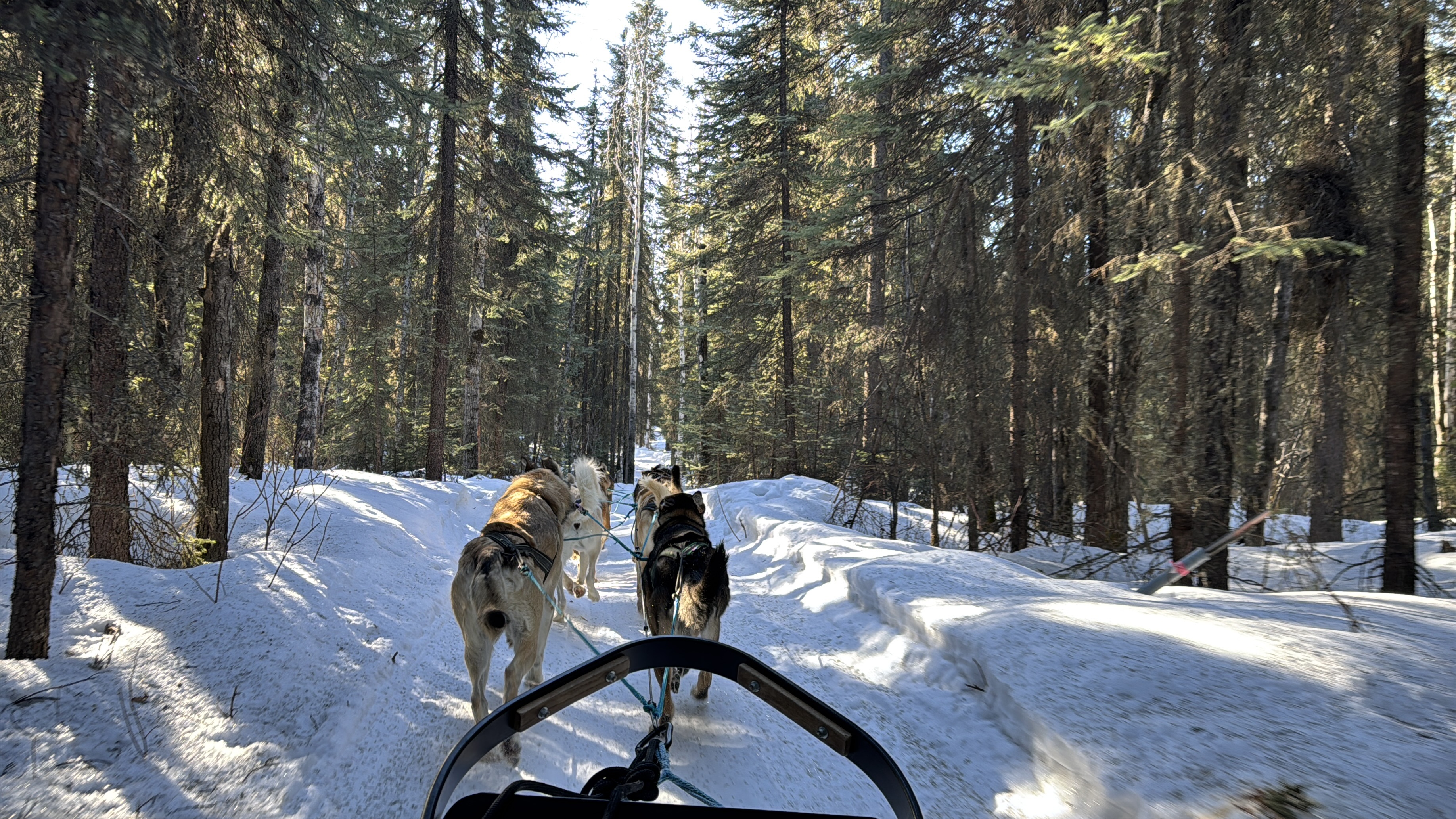
One of our absolute highlights for this trip was to do a dog sledding tour on Wednesday afternoon. When we were here in 2012 it was summertime so there was no snow. We did visit Mary Shields' kennel and meet the sled dogs but did not get to actually ride with the dogs. This time around we booked an excursion with the Last Frontier Mushing Co-Op. After introductions to our human guides, we got to meet each of the dogs on our team. Most were very friendly and loved the attention.


There are different dog breeds used for sled pulling, including Siberian Huskies and Malamutes. But for long-distance running, most mushers use the Alaskan husky which isn't really a purebred but a hybrid mix that has the stamina and drive to pull a sled for long distances without tiring. During a race, the dogs can run more than 120 miles a day at about 10 miles per hour. These dogs absolutely love to run, and when our mushing guide hooked them into the harness they were going nuts barking until he gave the word. Then they took off like a rocket. It was like the Matterhorn Bobsled ride at Disneyland! We went about 7 miles in 40 minutes, and that was considered an easy relaxed pace for the dogs.


About halfway through the ride, the dogs got a little rest and rolled around in the snow to cool off. In case it wasn't obvious, at no point were either of us actually driving the sled. We were packed in like cargo. 


We had a few photo ops with the team. These are the lead dogs, Rainy and Scarlett. They are both females and two of the smallest dogs on the team. But they are the smartest ones in the pack, and understand commands like "Gee" (turn right), "Haw" (left), and "Come Gee/Haw" (turn 180 degrees right or left).


To round out the Alaskan adventure part of the trip, we booked an Ice Fishing expedition for our last day. It was quite a cozy setup -- a heated cabin with bench seats and all the gear we needed (miniature fishing poles and shrimp bits/fish guts for bait).


This time of year you can catch very small King/Chinook salmon, Silver/Coho salmon, and Rainbow trout. Everyone caught at least a couple fish and we kept the biggest ones. Then our guide cleaned and cooked them for us outside on a portable grill.


We were warned to keep our phones and sunglasses secure because they've been known to disappear down the ice holes. My phone was secure in my pocket but of course I did manage to drop my fishing pole straight down the hole. Ooops! Luckily the cabin had an underwater camera. We could see it plain as day, resting on the bottom surrounded by all the fish that I wasn't catching.


Our guide Trevor managed to fish it out using another fishing rod to hook it. It was definitely the catch of the day!


When Kevin first said we should go to Fairbanks in winter, I was pretty apprehensive. I expected it to be frigidly cold and extremely unpleasant. Contrary to my expectations we had a delightful time, saw enough of the Northern Lights to last a lifetime, and had a few other fun adventures to boot. It was a very memorable trip!


Okay, okay...here's one last bonus aurora photo. This one we took through the window while sitting inside our toasty warm cabin. Too lazy to put on all of our gear and go outside. If you've seen one aurora, you've seen them all, right? Farewell, Fairbanks!