Here's a short video Kevin put together of our visit to Mallorca.
Sunday, October 15, 2023

Saturday, October 14, 2023
Cala Millor, Mallorca, Spain
Surprise! We took a side trip to España!

We left our apartment in Nice to meet up with Kevin's cousin Ann-Sofie and her family. Years ago Kevin was doing some genealogical research before we went to Sweden (his great-grandfather had emigrated from Sweden to the US in the early 1900s). He came across a long-lost branch of his family tree on an ancestry website, made contact via email, and we met up with Ann-Sofie and her husband Lasse while we were staying in Stockholm. We've kept in touch ever since.

Ann-Sofie and Lasse were on the island of Mallorca to watch their granddaughter play in an important invitational soccer tournament. It was only a one-hour flight from Nice, so we decided to go over for a few days to watch some games as well.

We enjoyed spending time with Kevin's family and watching the action-packed soccer games. We even learned how to cheer in Swedish, and we were very proud of how well the Lidingö team played. Although they did not win the tournament they won some very tough matches and did very well overall. Go Lidingö!

We also did a little bit of sightseeing while we were on the island. Cala Millor is about an hour's drive from the island's capital city of Palma. There is a long stretch of beach with a pretty boardwalk that has some great views of the clear turquoise water.

Cala Millor is on the northeast coast of the island and has a dramatic coastline with caves and cliffs towering over the turquoise blue water.

We took a three-hour boat cruise and saw some of the highlights including some large sea caves and a natural arch carved away by the waves.

We enjoyed our too-brief visit to this sunny, beachy part of Spain. It was like a mini-vacation from our vacation!

Wednesday, October 11, 2023
Castle Hill, Chagall Museum, and the Hotel Negresco

We had beautiful weather on Monday and to get a little exercise we decided to climb the Colline du Château (Castle Hill). This hill is situated above the old town and overlooks the town and Promenade des Anglais on one side and Port Lympia on the other.

As the name implies, there used to be a castle here in the 11th century. At that time the original town of Nizza was located within the fortifications on the hill. But after a siege by the French in 1706, the castle, fort, and town were totally destroyed (recall that back then Nice was not French but part of the Duchy of Savoy). Currently Castle Hill is a beautiful city park, and there are ongoing archaeological excavations to unearth the foundations of the former cathedral and other original buildings of the city. There is also an artificial waterfall and peaceful cemetery at the summit.

After taking in the views from the viewpoint at the top, we walked down towards the sea and found the Monument aux Morts, a war memorial to honor the 4000 Niçois who died during World War I. Built right into the cliff, the monument is an astonishing 32 meters (104 feet) high.

From the monument, we meandered back into the old town, passing by the pretty Cathédrale Sainte-Réparate in the Place Rossetti.

In the afternoon we headed by bus to the Marc Chagall museum. It's a unique museum because the artist was still living when it was developed, and the space was designed with his input about placement and presentation of the works. The paintings in the collection here have Old Testament themes (Genesis, Exodus, Song of Songs).

Chagall was born in Russia in 1887 (today Belarus) and many of his works reference his Russian and Jewish upbringing, although he lived much of his adult life in France and the US. He was not only a painter; he also created beautiful works of stained glass and mosaic tiles. All of his works showcase his mastery of color and surrealistic imagery. This painting is the fifth in the "Song of Songs" series.

The museum had a temporary installation called "Chagall and Me" where they displayed works by other artists inspired by Chagall. In the Song of Songs display, a parfumer (...perfume artist?) who has worked with Cartier and Hermès created several distinctive scents to accompany the paintings...a high-end version of smell-o-vision.

Kevin made a lunch reservation at the Hotel Negresco for Tuesday so that we could get inside to see this iconic hotel that has an impressive collection of art as well. We made sure to arrive a few minutes early so that we could explore a bit and we were not disappointed. We waited in the Royal Lounge which has a beautiful stained glass ceiling and a Baccarat 16,000-crystal chandelier that was commissioned by Tsar Nicholas II but never delivered (due to the events in Russia in 1917).

The hotel was opened by Henri Negresco in 1913 and passed through several owners until it was bought by the Augier family in the 1950s. Jeanne Augier oversaw the hotel's transformation into a hotel-museum bringing a collection of 6000 works of art and historic furniture. She died a few years ago at the age of 95 but under her guidance the hotel became synonymous with luxury and glamour. In the "Le Versailles Bar" hangs one of three existing copies of the famous Louis XIV portrait signed by Hyacinthe Rigaud in 1701.

The Michelin-starred Le Chantecler fine dining restaurant is only open for dinner, so we instead enjoyed lunch at the La Rotunde Brasserie. We were, as usual, the first ones there and enjoyed some fancy cocktails with lunch. Kevin's drink was the Negresco's take on a Negroni (the "Negresconi") -- a well-crafted portmanteau to go with a well-crafted beverage. À votre santé!

Sunday, October 8, 2023
Bienvenue à la Côte d'Azur, France!
It's been quite a week since we left Lake Como!

We returned to Milan for our final night in Italy, just because catching the ferry from Menaggio and a train from Varenna might have been touch-and-go for catching our reserved 11am fast train from Milan to Ventimiglia. (After spending a month in Lake Como, we knew that the "schedules" for both the ferry and train were more like "suggestions" in terms of precision). We stayed in an unmemorable hotel near the train station for convenience, but I think we would have preferred to stay back over in Brera if we hadn't had to catch the train. I will say that the Milan Centrale train station is quite a work of Art Nouveau/Art Deco architecture, with some fascist-looking elements thrown in for good measure thanks to Mussolini being in charge during the completion of the station. In hindsight, we probably should have flown from Malpensa airport to Nice -- it would have been faster and less hassle than taking several trains and stopovers. Lesson learned!

Ventimiglia is the last Italian town on the Italian-French border of the Riviera Coast. It is the "end of the line" for Italian trains, so from there we took a French regional train (no reservation needed -- yay!) to the French town just across the border called Menton. This charming town has it all -- sea, sun, and lots and lots of citrus. I can confirm that the limoncello we tasted here was magnificent.

We explored the harbor and the beach boardwalk and then walked up the steps toward the formidable church of Saint Michael the Archangel at the top of the hill.

The streets of old town Menton are a maze of alleyways and stairs leading up and down, like a town designed by MC Escher. We were glad we booked one night here so we could explore this town fully before moving on to our Airbnb in Nice.

Here is a quick map courtesy of RickSteves.com with an orientation to the Cote d'Azur (also known as the French Riviera). You can see Ventimiglia and Menton all the way to the right, and then moving westward down the coast you'll see Monaco, Villefranche-sur-Mer, Cap Ferrat, Nice, Antibes, Juan-les-Pins, and Cannes. When we left Menton, we took the regional train which hugs the coast and has beautiful views of the sea from the windows.

Our Airbnb apartment in Nice is a little less spacious than the one in Menaggio, but it has most of the things we will need for a long stay here.

If we lean waaaaay, way out on the balcony we can just barely see the blue of the Mediterranean Sea. Like our apartment in Menaggio, this apartment is on the third floor with no elevator. So we will continue getting our daily workout just going up and down the stairs!

We got acquainted with our new city by taking a couple of long walks. The first walk was along the Promenade des Anglais ("English Promenade").

This uninterrupted path hugs close to the water all the way along the 7 kilometer stretch of rocky beach. Back in the early 1800s, English aristocrats used to winter in Nice to escape the gray drizzly winters back home. They funded the construction of a paved walkway so that they could stroll in all their finery along the sea. We like it because there are no intersections or traffic lights, so you can walk as far along as you'd like without needing to stop to cross a street.

Our second walk took us to Nice's seaport, Port Lympia. The long history of Nice includes: initial settlement by Greeks in 300 BC (Nice gets its name from the Greek city name Nikaia after the goddess Nike), the addition of a nearby Roman settlement of Cemenelum (that eventually merged with the rest of Nice and is now the hilly district of Cimiez), and for most of its history from the middle ages until 1860 the city was called Nizza and was actually a part of Italy (well, since Italy didn't exist yet it was actually part of the Duchy of Savoy and then the Kingdom of Piedmont-Sardinia). The port is a relatively recent development compared to the town's history -- it's only been open since the mid-1700s, and originally was much smaller than it is today.

We had some really great weather to do some exploring around the Riviera this week, so on Thursday we took a short bus ride to the cape called Cap Ferrat, where there is an absolutely gorgeous gilded age palace that was built by heiress Beatrice Ephrussi de Rothschild. The mansion had room after room of precious art, antique furniture, and more porcelain china on display than anyone could ever use in one lifetime.

But what was really stunning was the garden. Or I should say gardens, plural. There are nine gardens you can walk through and each has a theme (Spanish garden, Rose garden, English garden, etc.). The gardens have some really jaw-dropping views as well.

After touring the Ephrussi Villa, we walked to the little town of Saint-Jean-Cap-Ferrat and had lunch, then took a walk along part of the cape. The many hues of blue in the water below explain why this region has the name Cote d'Azur ("Blue Coast"). This is one of several beaches on Cap Ferrat, called Anse des Fossettes.

Heading back on the return bus to Nice, we stopped off briefly at the pretty town of Villefranche-sur-Mer. It's a cute but somewhat touristy town -- cruise ships often anchor here in the deep harbor and tender the guests into town. We noticed that prices for drinks at the waterfront bars were much higher than we were willing to pay, so we headed back to the bus stop and on to Nice.

On Friday we walked north from our apartment to the neighborhood called "Liberation" where they have a nice produce and fish market. We bought some perfectly ripe figs and a couple of super-ripe heirloom tomatoes.
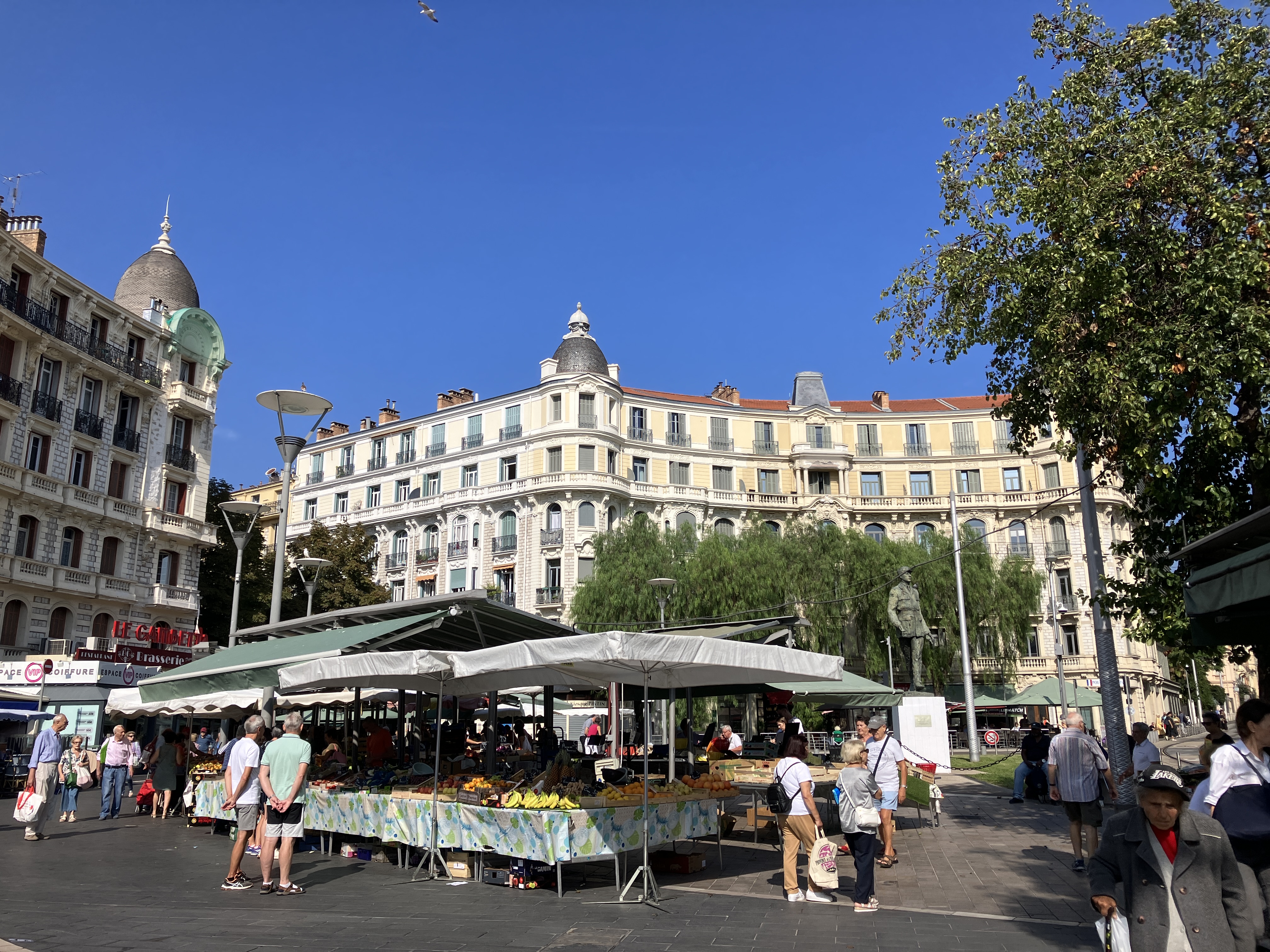
Afterwards we took the city bus over to the Cimiez neighborhood to have a look at the ruins of the Roman arena and bath complex there. The ruins date back to the 3rd century AD.

Saturday, we planned a daylong excursion over to Cap d'Antibes. The town of Antibes was a Greek outpost in the 5th century BC and was later occupied by the Romans. During the Middle Ages it was part of Burgandy and the Holy Roman Empire. Unlike Nice, which has had more of an Italian influence, Antibes has always been French. The French fortified the city with walls and a massive defensive fort to keep the Italians (well not really the Italians but rather whoever was ruling Liguria at the time - Savoy, Spain, Austria...) on their side of the border.

Antibes is also home to Port Vauban, the largest yacht harbor in Europe. It has over 2000 mooring spaces and can dock megayachts up to 100 meters (980 feet). One of the biggest ones we saw was the $200 million megayacht Faith measuring in at 97 meters.

The farmer's market here in Antibes had many more items than we saw in the Liberation market over in Nice -- spices, preserves, charcuterie, cheese, handicrafts, and artistically displayed fresh produce.

Right next to the market was a sign proudly proclaiming "L'Absinthe Bar". We were intrigued so we decided to go in, even though it was only 11am.

Stepping into the bar was like stepping into a museum dedicated to Absinthe. What is absinthe, you might be wondering. Well, it's a high-alcohol botanical liquor that tastes a bit like licorice or anise seed thanks to its main ingredient, wormwood extract (scientific name: Artemisia absinthium). It can have a white or greenish hue and was a popular drink with artists and writers in the late 1800s and early 1900s. Alcoholism was such a problem back then and the 70% alcohol content of absinthe led to claims that it deteriorated moral character. By 1915 it was banned in many countries, including the US and France, and only recently since the 2000s has it been re-discovered and made legal again. You don't drink it straight, but instead it is mixed with plenty of ice water from an absinthe fountain on the table that is slowly dripped into the glass over a sugar cube on a special "absinthe spoon" until the sugar dissolves. There's quite a ritual to it, as the water dribbles very slowly out of the spigot. Was 11am on a Saturday morning too early for a sample? Not if you wear a vintage hat and pretend you are a character in a Manet painting. After just one glass each, we left the bar with a bit of a buzz but with our moral character (more or less) intact.

From Antibes we walked across the cape to the beachy town of Juan-les-Pins. The beaches on Cap Antibes are sandy instead of pebbly like the rest of the French Riviera. If you forgot to bring water shoes or love digging your toes in the sand, this is the place to be.

For contrast, here is a photo of the beach in Nice with the pink-domed roof of the historic Hotel Negresco in the background. If you love the water, but hate sand getting everywhere, this is the beach for you.
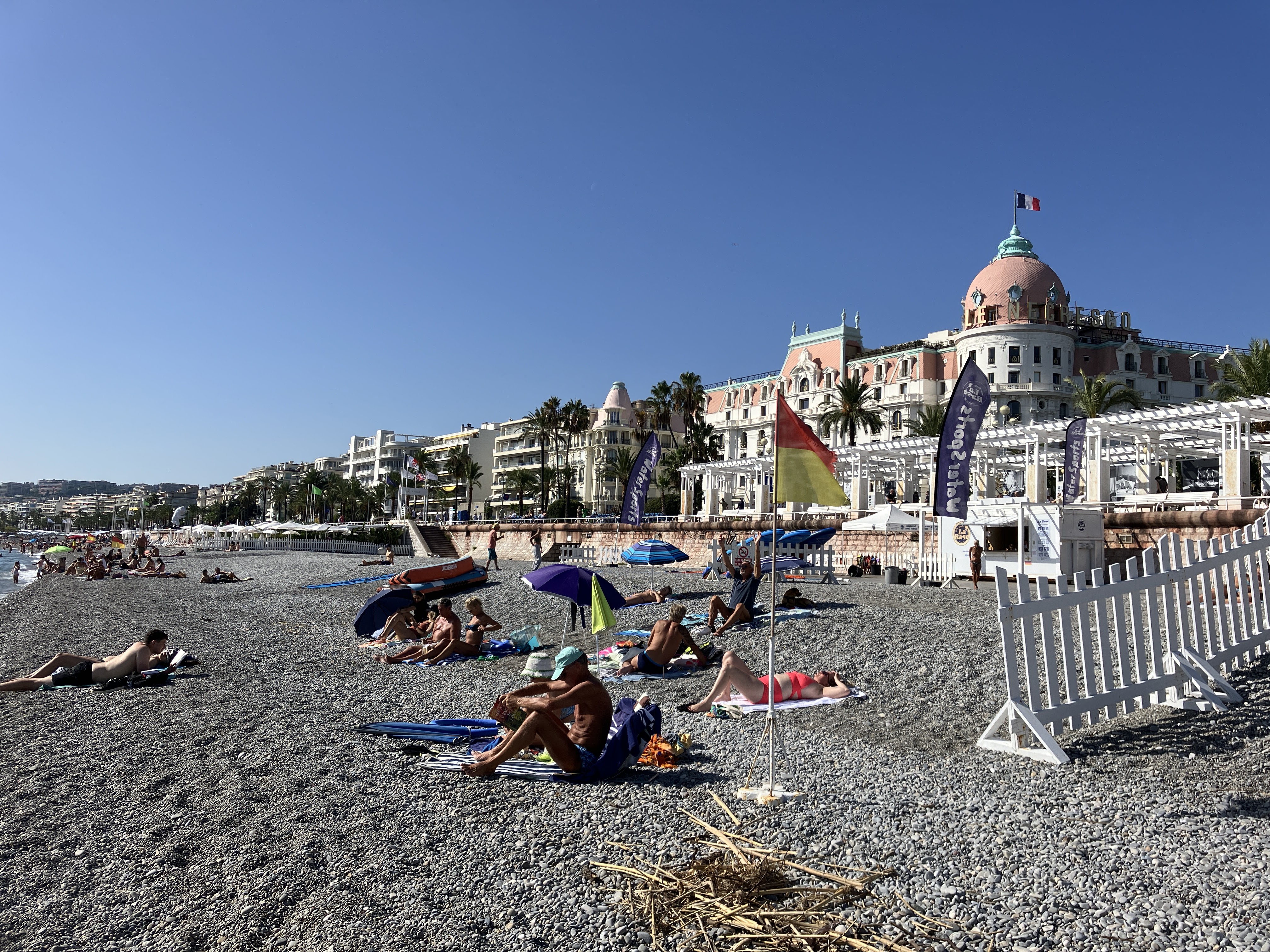
The only problem with the pebbles is that they are not easy on the feet -- ouch! We packed good-soled water shoes just for this purpose. Today we took a day off of sightseeing and rented chairs and an umbrella to relax at one of the beach clubs close to our apartment. It was the hottest day of the week and the water was very refreshing. So were the beers.

As we headed back to the apartment in the late afternoon, we walked past the beautiful Belle Epoque-era Negresco hotel. Lots of famous names have stayed at this hotel such as Grace Kelly, Sophia Loren, Brigitte Bardot, and Paul McCartney. We took note of this Rolls Royce parked out front, loitering for a few minutes (wet watershoes in hand, no less -- très classy!) to see if anybody of note stepped out to claim it. No luck but if we happen to find out who it belongs to, we'll be sure to let you know.

Saturday, September 30, 2023
Videos: Lake Como and Bernina Express
Kevin made three videos of our time in Lake Como. The first one is Menaggio and the west side of the lake, then the second video shows towns on the eastern side of the lake Varenna, Bellano, Bellagio and our taxi boat tour. The third video is our side trip to St. Moritz Switzerland via the Bernina Express scenic railway.
Friday, September 29, 2023
More Lake Como Adventures: Villa Serbelloni Garden, Sanagra Orrido, and Brunate Funicular
We had been thinking that perhaps we hadn't really given Bellagio enough of a chance by just going there for a few hours one morning while tourist season was still in full swing at the beginning of September. Now that we are in the last week of September, we wanted to head over there in the late afternoon and evening to see if the town was still packed with crowds even at dinnertime. Maybe the narrow laneways were more charming at twilight with fewer people? So we took the ferry over, and while we were at it, we booked a late afternoon tour of the Villa Serbelloni gardens. We gathered with about two dozen others at the town square to meet our guide Paola. She unlocked the gate and led us onto the garden path that winds high up the hill that overlooks the town of Bellagio. From up here it really is beautiful.

The Villa Serbelloni is privately owned by the Rockefeller Foundation, but the park surrounding the villa is open for two city-run tours daily. Paola was an excellent tour guide who gave us the history of the home, informing us that it ended up in the hands of the Serbelloni family who eventually sold the prestigious villa in 1870 to a Swiss family who also owned what used to be called "The Grand Hotel Bellagio" right on the waterfront. The hotel owners liked the cachet of the name "Villa Serbelloni" and now that they owned both the villa and the hotel, they renamed the hotel the "Grand Hotel Villa Serbelloni". But then they later sold the original villa to an American heiress, who in turn donated it to the Rockefeller foundation in the 1950s. But the hotel owners were allowed to keep the name. This generates a lot of confusion, since there is now a "Grand Hotel Villa Serbelloni" which is not actually (and never was) a villa, and the actual Villa Serbelloni. Many people book hotel rooms thinking that they are going to be staying at a villa but they end up at a very luxurious hotel with a Michelin-starred restaurant instead.

With all the confusion cleared up, our guide led us higher and higher until we reached what was the old ruin of a castle on the promontory. During the Middle Ages, there was a fortified wall that protected Bellagio and led up here to several watchtowers. The towers were eventually destroyed in the late 1300s after the ten-year war between Como city and Milan.

The best part of climbing up to the top of the hill was the ability to see both legs of the lake at the same time. When we looked to the south we could see the Lecco leg on the left, and on the right we could see the branch leading down to the city of Como. The land in between is the peninsula where Bellagio is located.

After the tour it was almost 6pm and nearly dinnertime. We had hoped the crowds would be gone but we were disappointed. There were still throngs of people everywhere so we got in the long line for the ferry and called it a day. We gave Bellagio a chance but I can't imagine staying there on vacation and fighting the crowds day in and day out to get a table for lunch or dinner. We are definitely happy we found such a charming "home away from home" in the quieter and equally scenic Menaggio.

On Thursday we decided to get some exercise here on the Menaggio side of the lake. There is a huge park up in the hills called the Parco Val Sanagra that has lots of good hiking trails. So we walked up the hill through Loveno to get to the park and headed to the Belvedere viewpoint. The valley here is cut in two by the Sanagra river (sometimes spelled "Senagra" -- I've seen it both ways, not sure which the locals prefer). Across the divide you can see the small hamlet of Cardano.

We took a pathway down to the river level that led to this beautiful old stone bridge that was once the only way to get between the hamlets of Loveno on one side of the river and Cardano on the other side.

A little further downstream the river picked up speed and broke into several cataracts as it cascaded down the riverbed.

But we hadn't seen anything yet! We followed the path towards the Orrido and were in awe of the enormous gorge that opened up below us. It was hard to believe that this beautiful work of nature had hardly any visitors (we only saw a handful of other couple on the metal walkways). But then again it was a lot easier to get to the other Orrido which is literally right in the middle of Bellano town.

The Sanagra Orrido takes a little more work to find than the Orrido di Bellano but it was definitely worth the effort!

When we first arrived in Lake Como, we had a list of the things we wanted to do while we were here. Many of those items needed good weather, so we've been slowly ticking all of those things off the list. However, there was one thing that was not only weather-dependent but tourist crowd-dependent: we wanted to ride the funicular in Como city up to the hamlet of Brunate. When we first arrived in town, Como city was packed with tourists and there were long waits of 30 minutes or more just to board the seven-minute journey to the top of the hill. So we skipped it when we first arrived and then this week we took a bus down to the city to check it out. Woo-hoo, no lines!

This funicular has been running since 1894, although I imagine back in those days the cars were probably not bright purple. The track has a 55% grade and rises steeply over the rooftops and trees of Como city.

At the top of the hill we were rewarded with panoramic views of the city below. The immense size of the Como Cathedral's domed roof was impressive.

After taking in the view, we headed back down into town. While we were there we also did a short walk along a part of the lake we missed the first time around. We saw this beautiful monument to Alessandro Volta, the hometown hero who invented the electric battery.

And we saw a quirky statue in a pretty park that was begging for a photo op. Rather than take the bus back, we took the noontime slow ferry intending to enjoy a leisurely boat ride back up the lake. We had hoped that by this time the tourist crowds would have dissipated, but we were mistaken. The ferry Orione has 472 seats and capacity for 700 total people, and still it was packed with almost no empty seats. By the time we boarded, the only seats left were inside at the middle tables (window seats all taken). We made the best of the situation since this ferry is one of the few ferries that sells drinks and snacks. So we cheerfully sipped beer and prosecco and enjoyed the views as best we could. The ferry just got more and more crowded as we progressed up the lake, stopping in at other towns. Ironically, where do you think all those tourists disembarked? Why, Bellagio, of course!

Subscribe to:
Posts (Atom)