Saturday, July 21, 2012

The Arctic Circle via the Dalton Highway

We thought that once we were done sailing we would never have to wait for a “weather window” to go anywhere ever again.  Turns out we were wrong.  From Fairbanks, the Arctic Circle is just a tantalizing 200 miles away – it was calling to us like a siren.  But there’s only one way to get there and that’s to take the Dalton Highway.  The highway is a tough road in any season (it has been featured on the TV show Ice Road Truckers).  It’s partly gravel and partly paved, but the paved sections are the roughest – riddled with potholes and frost heaves.  The BLM website advises you to bring two full spare tires and extra fuel, just in case.  We decided to take our chances with our single spare tire, but we waited in Fairbanks until the rain let up so the conditions on the road might be a little less muddy.

The road winds its way through black spruce forest into the treeless tundra.  It goes all the way to Prudhoe Bay on the Arctic Ocean, but the last stretch from the town of Deadhorse to Prudhoe Bay is restricted because of the oil field operations there.  Only sanctioned tour groups can go into the restricted area.  We had originally hoped to dip our toes in the Arctic, but it was just too cost-prohibitive to get up there on this trip (guided tours are several hundred dollars per person).  We decided to just drive ourselves as far as the Circle instead. 

The highway, a patch of bright-pink fireweed, and the pipeline

DSC05806The northern section of the Trans-Alaska pipeline runs mostly parallel to the Dalton Highway, sometimes crossing under the road but always within sight of it.  Much of the pipeline is elevated instead of being underground because the crude oil is too warm – at temperatures of 115 to 145 degrees Fahrenheit it could thaw the permafrost below the soil, causing it to become unstable.  Surprisingly, there are lots of places where you can pull off the road and get a closer look.   

DSC05810

DSC05831After about five hours of driving at speeds.as low as 25 mph (trying to avoid the potholes and minimize the teeth-rattling washboard sections), we finally reached the Arctic Circle at 66 degrees 33 minutes North latitude, or so the sign claimed.  However, due to the Earth wobbling a bit on its axis the Arctic Circle is slightly further north than the sign.  Supposedly it is moving northward at about 49 feet per year (Kevin was the one who did all this research; he says you can look it up if you want to).  So just to be sure, we drove about an extra minute of latitude north.  (We are nerdy that way.)  But we still took a photo at the sign, anyway.

DSC05840

Friday, July 20, 2012

Great Alaskan Road Trip: Week 10 Roundup

Each Friday, I post some relevant (and not-so-relevant) stats about the trip, as well as a little write-up of what it’s like to live out of a van for weeks on end. Here’s where we are overall:

  • Total miles driven: 6270
  • Total miles by ferry: 489
  • Total days on the road: 67
  • Total nights in a hotel: 4
  • Total miles hiked: 90.79

Here are some interesting stats for this week:
  • Fuel stops: 1 (diesel: $4.01 in Fairbanks)
  • Technical issues: 1 (A piece of wood broke off the shelf above the TV; we MacGyvered it back on with some tape – good as new.)
  • National Park Service sites visited: 1 – Denali National Park 
  • DSC05146Bears sighted: 14 (Thank you, Denali!)
  • Caribou sighted: 42
  • Dall Sheep sighted: 24
  • Moose sighted: 1
  • Foxes sighted: 1
  • Wolves sighted: 1
  • Lynx sighted: 1

DSC05093

I couldn’t resist including just one more photo of that lynx. 

Sorry, I don’t have much of a write-up about the van for you today, I’m running into writer’s block.  For tomorrow, we are planning a long side trip down a dirt road, and other people have advised us to bring not one but two full spare tires, plenty of water, and extra fuel.  When this RV pulled into the spot next to us I couldn’t help but feel a little envious:

DSC04838

Not to worry, we have faith in our trusty Sprinter.  Although in comparison it looks like David next to Goliath – just look at the size of the tires on that thing.

Anyway, I’m sure we’ll be fine on our side trip, but I wasn’t kidding about that writer’s block – if anyone has any questions or suggestions for van or travel topics for me to write about next Friday, please feel free to post a comment.

Thursday, July 19, 2012

Fairbanks: The World Eskimo-Indian Olympics

The London Games are only a week away, and even though we won’t be there to watch them we got into the spirit of things by attending the annual World Eskimo-Indian Olympics in Fairbanks.  You won’t find any shotputters, parallel bars, or sand volleyball courts at these games, but you will see some more unusual events like the blanket toss and the muktuk-eating competition.

Teams of traditional dancers compete in the WEIO games

The mission of the World Eskimo-Indian Olympics is to “promote the culture, social games, skills, dances, and traditions of Alaska, Greenland, Siberian, and Canadian Eskimos”. People come from all over Alaska to participate, and this year there were even a few folks all the way from Greenland.  And we weren’t the only spectators from Arizona – Jaymee Li Moore, Miss Indian Arizona, was also there and said a few words.

The WEIO games showcase some of the skills and abilities that are necessary for survival in the unforgiving Arctic climate.  The Alaskan High Kick originated as a game to teach balance while hunting.  Picture a very active game of Twister.  The participant starts out with his right foot and left hand on the floor.  He holds his left foot off the floor with his right hand.  Then he has to quickly kick a suspended target with his right foot and land on that same foot without letting go of his other foot or letting any other part of his body touch the floor.  It’s not easy.  Go ahead and try this at home:

DSC05489

One of the more popular contests at tonight’s games wasn’t actually a sport – it was the Native Baby Contest, a parade of chubby toddlers dressed in traditional clothing.  Prizes are awarded for the best outfits in three categories: cloth, skins, and fur.  The “Awww” factor was through the roof.

DSC05379

Some of the kids enjoyed the competition more than others.

We most enjoyed the Blanket Toss, which is traditionally a part of the whaling feast (Nalukataq).  Thirty or so men hold the edges of a walrus-skin blanket.  The contestant stands in the middle of the blanket and gets tossed in the air – sometimes as high as 30 feet – by the blanket pullers.  Contestants must land on their feet.  The prize is given to the contestant who jumps highest with the best form and balance.  Maybe don’t try this at home:

DSC05783

Some of the contestants had never participated in the blanket toss before, which made for some laughs.  Others clearly had lots of experience, like the guy who did a backflip in the air before perfectly sticking the landing.

DSC05792

The final event was the muktuk-eating contest.  Muktuk is a chunk of whale skin and blubber, a nutritious staple of the traditional Eskimo diet.  Each contestant was given a knife to cut it with and the first one to finish their 4 ounces of muktuk was declared the winner.  Although I’m not sure anyone’s a winner when it comes to eating raw blubber…

DSC05801

Tuesday, July 17, 2012

Denali National Park: Activities and Programs

DSC05069

Although we spent a lot of time on the shuttle bus, we found plenty of time to do other fun things like hiking and ranger programs.  One of our favorite activities was the ranger-led Discovery Hike that we went on.  Typically the Discovery Hikes leave from the Visitor Center at the entrance – you meet up at 8am and ride with the ranger on an express shuttle bus to the hike location.  Because we were staying at Teklanika, they picked us up on the way at 9am – which meant we got to sleep in a little bit!

There were only seven people in our group, including Ranger Lauren.  She took us around the creeks and drainage below Polychrome Pass.  It’s a beautiful area, and the gravel bars between the streams make great paths to hike along because you don’t have to deal with waist-high willow bushes and underbrush (although we did some of that, too).

DSC05079

I managed to keep my feet dry while crossing the rivers and streams, but still wish I’d had gaiters on just to keep the twigs and tiny leaves out of my socks and boots.  What was great about going on the ranger-led hike was that it gave us some more confidence when we went off on our own. 

In the evenings we went to Ranger Programs instead of watching TV.  The topics of the talks varied from park history to moose habits to bird calls.  Each was led by a different ranger, and some were better than others.  The lady ranger who gave the moose talk shared some funny anecdotes from her years in the park as both a ranger and a shuttle bus driver.  She also brought some fun props, including a moose puppet.  But by far the most entertaining evening program had to be the one titled “The Scoop on Poop”.  The extremely enthusiastic ranger (think Leslie Knope from Parks & Recreation) even wrote a little rap song about it.

DSC05036

Hers was definitely the most hands-on presentation of the bunch – she had brought along “scat detection kits” and various “samples” for us to dissect (don’t worry – they were made of modeling clay and art supplies).  We had to guess what animal our scat belonged to based on what we’d learned from her lecture.  We guessed ours correctly: bear (she had put little glass bead “berries” in there since that’s one of their major food sources). 

Speaking of poop, one of the most popular attractions here at the park are the sled dog kennels.  The park road is not plowed in winter and it’s against the law to use mechanized transportation in a large portion of the park.  So in the wintertime the rangers get around by dog sled instead of snowmobiles.  The sled teams also haul heavy supplies and equipment to researchers working in the field.  The “Canine Rangers” are federal employees and are housed here year-round.  In the summer months park visitors can stop by the kennels and pet the dogs, or attend the demonstration that is held three times daily (at 10am, 2pm, and 4pm).  It’s pretty neat because they actually harness up some of the dogs and have them pull the sled around a dirt track.  It’s amazing how fast they can go, and how excited the dogs are to run!

We got there early so that we could visit with the dogs and check out the super-adorable puppies – there are three in this year’s litter.  They are ten weeks old and were sleeping in a cute little pile when we got there, but they soon woke up and started playing. 

DSC05192

There are about 30 dogs kenneled here – they raise them from puppies and retire them when they are about 9 years old (they are all adopted out to good homes).  The dogs aren’t purebred, but are just mixed breed Alaskan huskies.  They all look very different from the purebred Siberian huskies and Malamutes that you’ll see at a dog show.  They’re not bred for looks but for characteristics like running, pulling a sled, thick fur to keep warm, and long legs for breaking trail.  But some of them do end up with those gorgeous blue eyes.

After the demonstration, I made Kevin get in line with all the little kids (and a handful of enthusiastic adults) for the perfect dog mushing photo-op:

DSC05277

So that’s it – we had a fantastic four days in Denali National Park enjoying the programs, wildlife and spectacular scenery.  We didn’t get the perfect, crystal-clear photo of Mount McKinley but that just gives us a reason to come back some other time.  After all, who wouldn’t want to come back to this:

DSC04998

My Sound of Music moment on our solitary hike in the hills above Eielson Visitor Center

Monday, July 16, 2012

Denali National Park: Wildlife and Wildflowers

If you ask, most people are under the impression that the reason behind the creation of Denali National Park is The Mountain – Mount McKinley to be precise.  It would make sense that the government would set aside the land surrounding the nation’s (and continent’s) highest peak, right?

If I had a decent photo of McKinley I’d have put it here.  But this shot of wildflowers will have to substitute instead.

Wrong.  The park’s origins are a little more humble than that – sheep.  Yep, that’s right – sheep.  Specifically Dall Sheep, an alpine-dwelling animal that looks a little like a Bighorn Sheep, but with a slight flare to its horns.  In 1906, Charles Sheldon came here to study these sheep.  Prospectors and other residents found them so tasty that Sheldon was concerned about the species’ survival, so he lobbied for the creation of a park.

It was cool to be able to see the sheep on some of the sheer rock faces in the hills along the road, but to me they were nowhere near as exciting as sightings like this red fox.  He sat there facing the chill wind for a good long while as we all quietly watched him out the bus windows before he trotted away.

We also saw our first caribou this week.  There are about 2,000 living in the park.  Both male and female caribou have antlers, so even the females have an impressive rack.

DSC05022

But animals aren’t the only impressive life forms in the park.  We were surprised by the variety of wildflowers that were in bloom around the park.

Bright blue Forget-me-nots and purple Monk’s Hood

The growing season is short here – just a few months – so the plants do all that they can to attract pollinators like bumblebees and flies.  They put on quite a show.

DSC05010

DSC05052Flowers are pretty, but we’re not done with the fauna yet.  On Saturday, we set our new record for bear sightings in a single day – twelve!  The only problem was that they were all far, far away from the bus.  We could see them pretty well through the binoculars, but the zoom on our camera just rendered them into fuzzy brown (roughly bear-shaped) blobs.  (On our next trip to Denali, we’ll be sure to bring a better set of binoculars and a better zoom lens/camera.)  However, we got lucky on Sunday with a hungry grizzly who ignored our bus while he foraged for food along the roadside. 
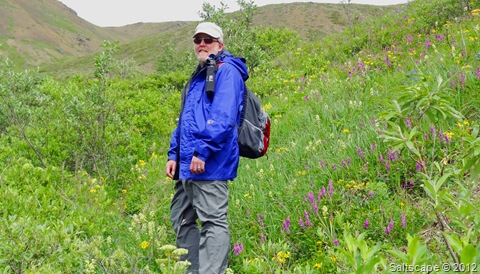
While hiking, we saw plenty of wildflowers but never ran into any animals

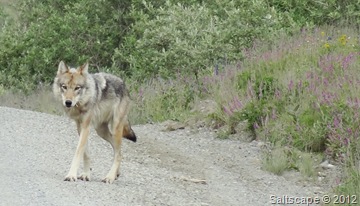
We were pretty excited as well to have a bona fide, confirmed wolf sighting.  And this time it wasn’t sprinting off into the trees or anything.  This guy just casually strolled, dog-like, up the road towards us.  Then he trotted right alongside the bus (that was parked, engine off – the bus driver was as excited about this as the rest of us) before making his way into the surrounding foothills.
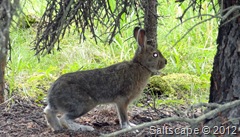
The hands-down, most memorable sighting came on my birthday.  It was like a gift from Mother Nature, or something.  We had seen a snowshoe hare our first day in the park, and on our Discovery Hike the ranger had pointed out signs of hare activity (incisor marks on willow bark).  She mentioned that one of the primary predators of the snowshoe hare is the lynx, and that if you are looking to spot a lynx you should start by looking where there are snowshoe hares.  We had thought maybe for my birthday we would spend the day around the campground and in the taiga forest near the Teklanika River, looking for a lynx that had been reported there.  But instead, we decided to take the shuttle bus into the park since it would be our last day with the Tek Pass.  Wouldn’t you know it – the very first animal we saw on that bus ride was this:

DSC05091

The lynx was in some bushes within about ten feet from the bus.  No one on the bus made a sound, and we didn’t even open our windows for fear of scaring him off.  We just sat there disbelievingly as he stalked his way out of the brush into a rocky area and spent a couple minutes just looking at the bus.  It was as though he was posing for a photo op.  The bus driver said that in all his years of driving, he’s rarely seen lynx from the road and never so close.  So we may not have seen The Mountain in all its glory, but I’ll take this sighting over seeing Denali any day!

Sunday, July 15, 2012

Denali National Park: Finding Mt. McKinley

Denali is the name that the native Athabascans gave to North America’s highest peak (20,320 feet).  It means “the great one” according to our guide book, but we have joked that it must mean “the mountain that hides” because so far we haven’t seen a whole lot of it.  Supposedly it is only visible one day out of three, to me it seems like those clear days must be bunched together for the lucky few and the rest of us get great views of mist and clouds.  Our first glimpse of The Mountain looked like this:

Clouds obstruct the summit but the north peak is visible.  Supposedly we were lucky to even see this much of Denali

What’s in a name?  Near the turn of the century, someone re-named The Mountain (as native Alaskans will tell you, it already had a name) after William McKinley who would eventually become president.  That name has stuck around over the years, even though most people (especially Alaskans) now prefer to call it “Denali”.  The name of the park itself was officially changed at some point from Mt. McKinley to Denali, but every time the issue of changing the name of the mountain comes up in Congress, the legislators from Ohio (McKinley’s home state) manage to maintain the status quo.  We’ve heard it called by three names during our stay: Denali, Mount McKinley, and just “The Mountain” – when someone calls it that they seem to say it in such a way that you can actually hear the uppercase letters.

DSC04944

We saw other people’s images of Denali everywhere. It was as though the mountain was taunting us.

DSC04964

Although Mount Everest is higher above sea level, it only has a rise of about 10,000 feet from its base.  Denali has a rise of nearly 18,000 feet from base to summit.  So Denali definitely has the edge on drama if you could look at them side-by-side.  If only we could look at it!  This is our best photo of The Mountain so far:

The rounded south peak (left) is the summit; the tip of the shorter north peak is almost visible on the right

We have found Denali to be a source of frustration.  Apparently just last week, The Mountain was completely visible.  Every chance we have had to see it so far, it has been shrouded in clouds.  Just today someone who had camped at Wonder Lake told us that although it was obscured all day yesterday, last night it came out completely at around 10pm (we were fast asleep by then, arggghhh!).  One of the rangers we spoke to told us that if your main goal is to see the mountain (with no obstructing clouds), you have a 16% chance of success.  But if your goal is to climb the mountain, you have a 50% chance of success.  Yeah, that sounds about right.  Clearly we have been going about this all wrong.  Instead of buying a van we should have paid to be part of a summit expedition (it runs about 20,000 to 30,000 dollars, so we’ve heard.  Of course 92 people have died up there – it’s the most unpredictable of the Big Seven – but 50%?  I like those odds.)

DSC04845

Anyway, although we didn’t see it so well on this part of the trip, we will still have other chances to see Denali as we continue to drive around this part of Alaska.  Supposedly there are some great viewpoints along the road to Anchorage, so we haven’t given up yet!

DSC05113

The view from Wonder Lake.  I am not doing the YMCA, this is me showing where the mountain should be.