Saturday, September 14, 2024

San Cassiano and the Val Badia

Our rental apartment for our week in San Cassiano had a spacious balcony with amazing views of the town and mountains. The only drawback was that it was up a steep hill so walking back to the apartment from town was a workout in and of itself.


At the base of our street was the charming parochial church of San Cassiano. You can see just how sharply the street ascends up the hill. 


The Val Badia is a north-south running valley in the heart of the Dolomites. Historically, the tall mountains surrounding the valley kept its inhabitants fairly isolated. A unique culture and language (Ladin) developed in this region. Ladin is a romance language that developed as an offshoot of latin and has been spoken here for many centuries. It sounds completely different from Italian. In this part of the valley it is the first language for nearly 90% of the people born here -- meaning that many people here are tri-lingual, speaking at least Ladin, Italian, German, and sometimes English. I say "sometimes" because the staff at our hotel did not speak any English, but we managed quite well with a smattering of Italian (me) and German (Kevin) and abundant use of hand gestures. The Badia valley is a pastoral paradise, with vast stretches of green meadows dotted with farm buildings and peppered with grazing livestock.


We took the car to the nearby town of Corvara so that we could hike to some waterfalls, the Cascate del Pisciadu. The thin threads of the waterfall tumble almost unnoticed in a crevice of the Brunecker Term, a mountain on the north side of the Sella massif.


Luckily there was a trail leading right to the base of the falls. I think we could have hiked to the top but the trail looked a little iffy so we skipped that part.


After a 5-mile trek to the waterfalls and back, we stopped at Villa Eden Cioccolateria for some of the thickest "hot chocolate" we've ever had. Our server warned us in advance -- she said "It's different than the drinking kind you (Americans) know". We said no problem, bring it on. It was delicious, with a rich consistency similar to pudding.


On Tuesday we spent the day in the Lagazuoi area. First we parked and hiked up past Rifugio Scotoni to Lago Lagazuoi. This was a challenging hike with many switchbacks, but the views were incredible.


The lake at the top was pretty small and not much to write home about. Although we could see the Rifugio Lagazuoi high above us, we turned around to head back to the Scotoni hut for lunch. 


This family-run rifugio had a small herd of alpaca and an adorable kitten that believed that it, too, was part of the herd.


Rifugio Scotoni is known for delicious food and it did not disappoint. We ordered the "grill plate" to share and it was absolutely one of the best meals we had on our trip. Sausages, ribs, steak, veggies, and polenta - yum!


We hiked back down to the car and then drove around to the southern side of the Laguzuoi peak so we could take the easy route to the top - the cable car. The Laguzuoi Cable car is a pretty impressive feat of engineering. The two cars each carry up to 50 passengers - one car goes up when the other comes down. The two cars whiz past each other at the halfway point with almost dizzying speed - the total ascent is 630 m (2066 ft) in 3 minutes! You can see some of the twists of the Passo Falzarego road in the valley below.


Lagazuoi is just across the valley from Cinque Torri, and like Cinque Torri it saw heavy action throughout WWI. The whole area is an open-air war museum with well-preserved tunnels, lookouts, and trails. Kevin went in one of the tunnels for a short while but neither of us had the right gear (helmet, flashlight, etc) to follow the tunnel for the full 1km length.


Instead we walked along the windy ridge and just admired the views on all sides of the Laguzuoi peak before heading back down via the cable car. You could walk down from the top but a downhill hike of 2066 feet would take way longer than 3 minutes for sure -- my knees hurt just thinking about it!
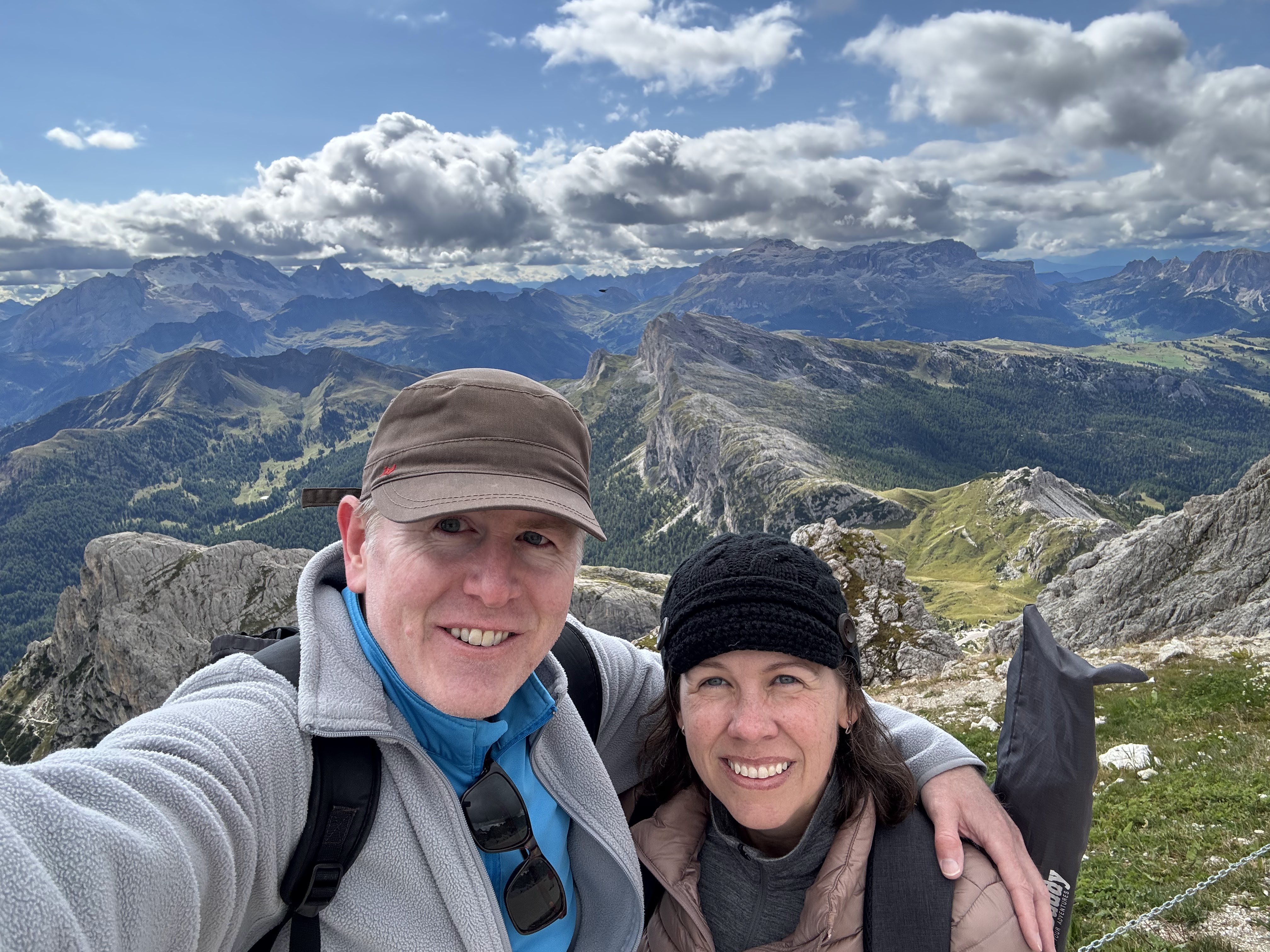

From the window of our Airbnb we can see a cable car to Piz Sorega ("piz" = "mountain"), so on Wednesday we walked over and decided to check out where it went. Imagine our surprise when it took us straight to Las Vegas.


Just kidding. It actually took us up to an expansive plateau with a bowl-shaped meadow. It all started to make sense since "Las Vegas" means "the meadows" in Spanish. This area is a big ski destination in winter, so there were many lifts and almost as many ski lodge restaurants. Luckily for us all of the lodges were open, so we managed a kind of "pub crawl" circuit around the plateau, checking in at each one along the road to see the views and have a beverage. 


We tried a liquor called Bombardino for the first time. We had seen it on several menus and in some shops and wondered what it tasted like. It was similar to egg nog but very sweet and served warm. Not my cup of tea but Kevin found a new favorite drink - yeehaw! 


The weather was expected to turn colder on Thursday, and our weather apps were predicting snow. "No way," we thought, "it must be a mistake -- it's only the second week of September!" On Thursday we woke up to heavy non-stop rain. We had planned for a rest day anyhow so we spent the afternoon watching Netflix. But then, sure enough, Kevin looked out the window and noticed a few flakes starting to fall. 


And then they just kept falling, and falling, and falling. On Friday morning we woke up to a wintry wonderland.


We borrowed the hotel's snow shovel so Kevin could clean off the car. But without four-wheel-drive, he didn't feel much like driving a stick-shift on icy roads, and I don't blame him. Definitely not conditions we are used to in sunny Phoenix!


So instead we walked to the small museum in town dedicated to the Ladin cave bear Ursus Ladinicus, an extinct bear species that lived over 50,000 years ago. In 1987 an exploring mountaineer discovered dozens of skeletons all jumbled together in the nearby Conturines Cave. Researchers realized it was a new species distinct from other cave bears, and named it after the local Ladin people.


We knew Saturday might be tricky with all the snow because we would be driving over the Sella mountain pass to get to our next town. But luckily by late morning Saturday the snow had melted off the roads enough to make it safe for driving. So we set off, hoping to stop for a hike at Col Pradat on the way. We optimistically bought one-way tickets for the cable car, hoping to ride it up and then hike back down. But as soon as we stepped out of the cabin and were hit with the icy wind we realized that we would not be sticking to that plan. We enjoy hiking but not enough to do an unpleasant slog in frigid winds over a slushy, muddy trail.


Instead we made the best of it and had a nice lunch in the toasty warm Rifugio Col Pradat. Then we went out to the deck to enjoy the views of the snowy peaks all around us before sheepishly buying another one-way ticket back down to the valley.


Saturday, September 7, 2024

Hiking Tre Cime, Val Fiscalina and Campo di Dentro, and Cinque Torri

One of the "must do" hikes in the Dolomites is the hike at the Tre Cime ("Three Peaks") de Lavaredo. It's a challenging hike, but a beautiful one. It starts at the Rifugio Auronzo. A "rifugio" is a mountain guesthouse, usually accessible via a hiking trail. Each hut has a restaurant that serves meals and also some rooms available for overnight lodging. We don't really seem to have this concept in the US, but it is a definite advantage to hiking in this part of Europe. There are many rifugios along the hikes, and it makes it easy to stop if you need a coffee break or bathroom break, or are on a long hike and don't want to pack a lunch. I mentioned in my previous post that we visited a malga -- as far as I can tell the difference between a rifugio and a malga is that a rifugio offers lodging, whereas a malga is more of a family-run farmstead that also serves food. The Rifugio Auronzo overlooks the magnificent start of the Tre Cime hike, with views to the pinnacles of the Cadini di Misurina mountain chain in the distance.


We hiked about a mile from Rifugio Auronzo to Rifugio Lavaredo, where we stopped for espressos and pastries. (I'm loving this aspect of hiking here!). Fortified with caffeine and calories, we ascended the steepest part of the trail. Even in shoulder season there were a lot of other hikers on the path, but the trail at this section is very wide and not too rocky.


We came to a fork in the trail, where we could continue on to the famous Rifugio Locatelli. This rifugio is very popular because it has spectacular views of the north side of the Tre Cime. But continuing to Locatelli would have added a couple miles to our already 4.5 mile hike, so we chose  the other fork and cut across the larger loop. It was still very cool to see Rifugio Locatelli from a distance, hopefully we'll get back here someday to see it up close.


Our choice to cut across the valley actually gave us a much closer view of the Tre Cime than we would have had otherwise. And because the Locatelli route is the more popular option, we had most of this trail all to ourselves.


We rejoined the main trail at Malga Langalm, where we stopped for lunch. We ordered a 2-portion charcuterie platter and were astonished when the server brought out enough food to easily feed six people. We weren't that hungry! Luckily a friendly family from Spain joined us at our table and took us up on the offer to share the copious amounts of bread, sausage, speck, and cheese. For less than 30 euros we all had lunch with a magnificent view.


After we completed the loop back to the Auronzo hut, we decided to hike an additional 2 miles out and back to the jaw-dropping Cadini di Misurina viewpoint. These pointy spires are exactly the kind of mountains I think of when I think of the Dolomites. A memorable ending to one of our best hikes!


The next day we drove to the small hamlet of Moos to take a walk in the Val Fiscalina. The trail is more of a country road that cuts through beautiful green meadows where farmers were raking up cut hay to be dried. Although we were a bit late for the summer wildflower season, the purple crocuses were starting to show their fall colors. There were tons of other people on the trail with us -- it's a popular but very pleasant path.


As with our other hikes, there was a rifugio involved at the halfway mark. At times it does kind of seem like we are just hiking from restaurant to restaurant! But all of these restaurants are nestled in among some truly incredible scenery.


And we got our first taste of a local specialty - kaiserschmarrn. It's an eggy pancake dish that is sliced up, coated in powdered sugar and served with jam or lingonberries. (I can already tell I won't be losing any weight on this trip, despite all the hiking.) Ironically we almost always found it in the savory part of the menu, not on the dessert page. It was created for the Austrian Emperor Francis Joseph I -- his chef whipped up this easy-to-make concoction that soon became the Emperor's favorite dessert. The name of the dish translates to "Emperor's Mess", which aptly describes it.


Back in San Candido later that evening, we attended a free concert put on by the traditional regional band. As you might guess from the costumes and instruments, the program was heavily polka-centric. What I loved most was that there were two costumed girls walking through the audience soliciting donations for the orchestra and handing out free shots of grappa. Phoenix Symphony, take note!


On Thursday, despite a forecast for rain we headed to another nearby valley called Val Campo di Dentro. I couldn't find out why but the hike and nearby hut are adorably called Tre Scarperi in Italian and Drei Schuster in German ("Three Shoemakers"). The gray skies meant that we had most of this trail to ourselves.


We had just started to ascend up the side of the valley when the skies got darker and we decided to turn around. I'm glad we did because just after we hiked down the steepest part, it finally started to rain. We donned our rain jackets and hiked back to the welcoming shelter of the Tre Scarperi hut.


It started pouring once we got inside, so we asked to be seated and decided to have lunch and make the best of it. This hut had an intriguing item on the menu called "Salad of the Forest" which I decided to try. I'm glad I did -- it sounds like a crazy mix but there were mushrooms, pickled peppers, wild herbs, some kind of honey dressing, and colorful pansies. It was a beautiful work of art and very delicious!


After we checked out of our rental apartment in San Candido, we knew we had to kill some time before arriving at the next town, San Cassiano. Apparently September 7th this year was the day for big bicycle events -- mountain passes near San Cassiano would be closed to cars all day due to the Sellaronda Bike Day, and there was also a big race in San Candido called the Eroica. No problem, the Eroica did not involve road closures so we were able to get an early start out of town. We decided we would stop along the route so that we could hike in the Cinque Torri area. We took the chairlift up and quickly realized that despite the sunny forecast, the entire mountain was shrouded in a heavy cloud. Luckily, there was Rifugio Scoiattoli where we waited and hoped for the clouds to clear while having a coffee and a snack. Note the wall of cloud behind me -- there is actually a huge mountain back there somewhere.


It was after 11 am by the time the clouds cleared enough to see the Cinque Torri formation clearly. Cinque Torri means "Five Towers". They are striking to look at, with the layers of gray dolomite stacked on each other like pancakes. Dolomite is a carbonate sedimentary rock that is similar to, but different from, limestone. One of the differences is that it doesn't erode as easily as limestone. 


Because of their stability, the towers are very popular with rock climbers. As we hiked we were able to see several groups bravely working their way up the rock faces.


The hike around the Cinque Torri is a short one, only a bit more than a mile, but it is packed with history. This region saw intense fighting between the Italians and Austro-Hungarians during WWI. In fact, the area around Cinque Torri is part of an open-air museum where you can see countless trenches and bunkers from that time period.


After finishing the short loop around Cinque Torri, we took on the nearby challenging uphill climb to the Nuvolau rifugio. This hut is small but very popular because it is located on a tall fin of rock that juts out with commanding views on either side. Photos don't really do it justice -- the views are breathtaking!


Getting up to Nuvolau was an uphill slog, but coming down was equally tricky. We used hiking poles and watched our footing, although it was all too easy to get distracted by the spectacular panorama in front of us as we made our way back down towards the chairlift.


Of course as we passed the Scoiattoli rifugio we had crystal clear views of the Cinque Torri. Lesson learned -- sometimes it's better to not get an early start!


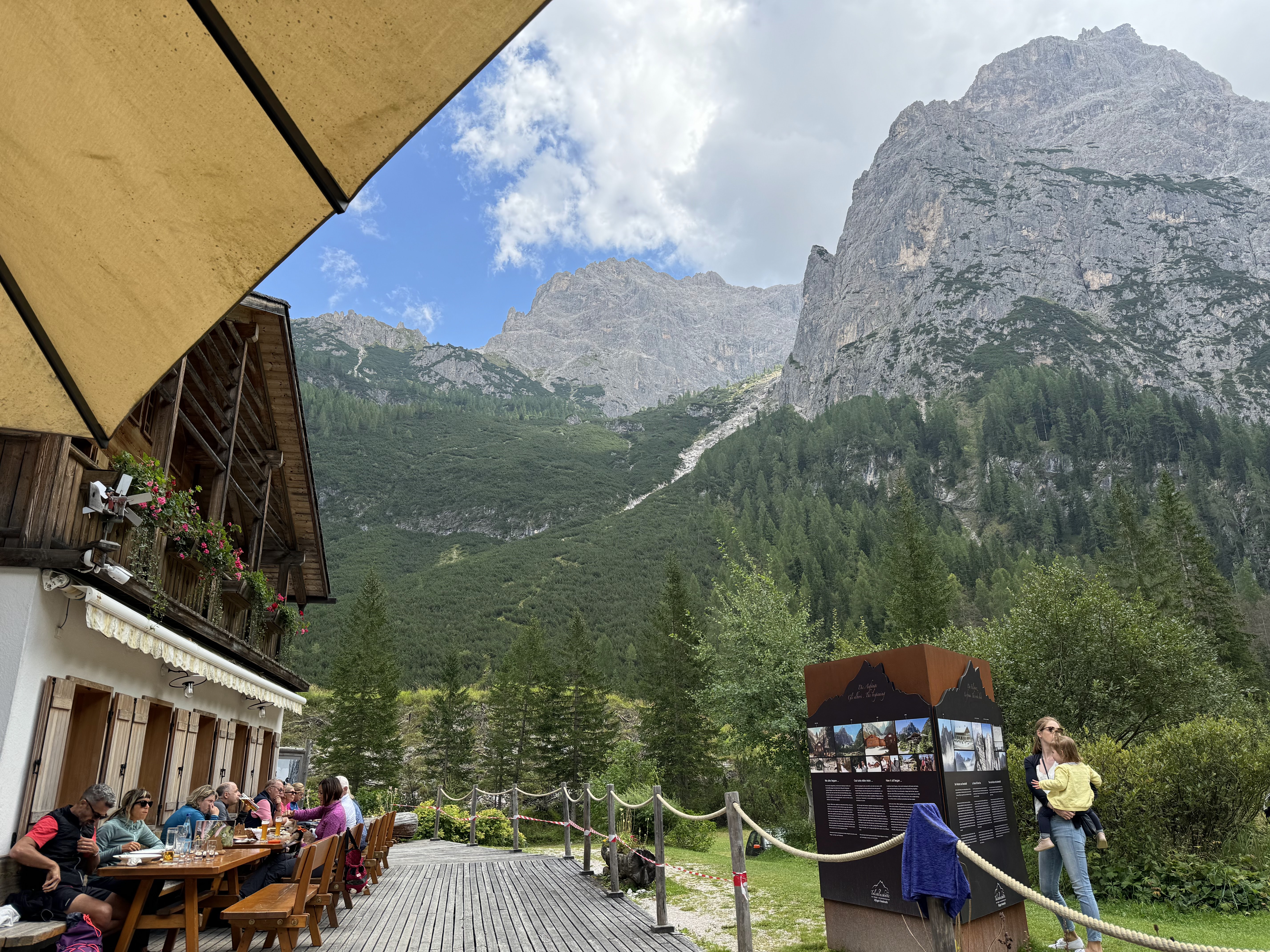
This was one of my favorite locations on the whole trip. The mountains on both sides of the Falzarego Pass are absolutely stunning!


Friday, September 6, 2024

Northern Italy - Sirmione, Bolzano, and the Val Pusteria


After a long flight and a harrowing drive, we made it to Lake Garda. Driving on the motorway here is intense. From Milan there were three lanes - a slow truck lane on the right, a fast car passing lane one the left, and a kind of free-for-all slow car/fast truck lane in the middle. Within our first hour of driving we nearly got squashed like a grape in that middle lane because trucks pull over to the middle lane to pass without even checking their blind spots and you can’t swerve to the left because cars are swooping by in that lane with dizzying speed. My life flashed before my eyes but Kevin laid on the horn Italian style and we avoided disaster. Whew! On to the serenity of Lake Garda…


We stayed just two nights in Sirmione, a postcard-pretty town that is at the tip of a narrow peninsula. A castle built in the 1300’s by the Della Scala family straddles the town and the peninsula. Back in medieval times they could pull up the drawbridges to keep invaders from breaching any part of the peninsula.


We didn’t really have time to do this town justice in only two days, but we did manage to see the town’s other big draw — the ruins of an ancient Roman villa and bath complex dating from the first century BC. This area of Lake Garda is fed by underground geothermal streams, and even today there are a couple of well-known spas that have tapped into the hot sulfur springs that well up from the seabed just off the eastern shore of the peninsula. We took a boat tour and our guide was able to show us one of the offshore spots where the hot spring water bubbles up to the surface. 


From Sirmione we drove north towards Bolzano, stopping along the highway at a farm restaurant for lunch. Kevin ordered the  Knödel, a local South Tyrolean dish with dumplings that are similar to balls of tightly packed Stove Top stuffing only more flavorful and cooked in beer. They are tasty and very filling, and you can find them on every menu in this part of Italy. 


We really liked the town of Bolzano. It was walkable and had many restaurants and cafes. We have now officially crossed into the South Tyrol region - you’ll hear German spoken here just as often as Italian. That’s because this area was a part of Austria until it was given to Italy after the end of World War I.  


Bolzano is also home to the South Tyrol Archaeological Museum - a whole museum dedicated to just one find : the mummified remains of a Copper Age man, nicknamed Otzi. The mummy was found in 1991 in some recently thawing ice just a few meters inside the Italian border. At first he was thought to have been a climber who perhaps fell to his death sometime in the past century or so. But once scientists examined his gear and clothing, they realized he was much, much older - they estimate that he died around 3300 BC. Forensic tests found that he was murdered, having been shot in the back with an arrow that severed an artery in his shoulder. The glacial ice covered and preserved his body for the next 5300 years. You can view the remains, which are kept in a climate controlled chamber, but photos are not allowed out of respect. Instead visitors are encouraged to take pictures of a scientifically aided 3-D rendered sculpture of what he probably looked like in life. 


On our second afternoon we took a cable car ride to the town called Soprabolzano on the ridge above the larger town. From the cableway we had panoramic views of the massive mountains in the distance. We are looking forward to some beautiful hikes in those mountains and the rest of the Dolomites beyond.


On our last evening in Bolzano we took a walking food tour and sampled some pretzels, bruschetta topped with speck (a local smoked ham similar to prosciutto), more knödel, and about six craft beer samples from a local brewery. We probably could have skipped the tour since none of the food was much different than what we had already tried for ourselves. But we did get a chance to see the city at night and saw the Cathedral of Santa Maria Assunta all  lit up.


From Bolzano we drove ourselves to the town of San Candido (“Innichen” in German) in the Pusteria Valley. The view from our apartment balcony was absolutely breathtaking; photos don’t really do it justice. 


We spent a week exploring the beautiful mountains and valleys in this region, and San Candido was an excellent town to base ourselves in, with great restaurants and cafes and two beautiful churches with instagram-worthy towers. 


One of the most popular spots in this area is the scenic Lago di Braies. The mountain lake has been a bit over-touristed in recent years, so the local authorities have restricted access to the road during the busy summer season. We were luckily able to reserve a parking pass on short notice and we arrived early enough to enjoy a peaceful stroll around the lake path. 


One of the reasons why Lago di Braies is so popular is because of the beautiful blue hue the water takes on when the sun hits it. Powdery silt in the form of “glacial flour” is suspended in the lake, which turns the water a turquoise blue that seems to glow in the reflected sunlight. 


A short detour from the lake path took us up to Malga Foresta. A “malga” is an alpine farmstead. Some of them are just regular farms, while others also have a small restaurant serving hearty dishes fit for a hardworking shepherd. We ordered a breakfasty dish that had a description of ham and eggs with roasted potatoes. It turned out to be four slices of speck layered over four eggs with a generous portion of potatoes as a base. We could easily have shared one plate had we known about the massive portion sizes!


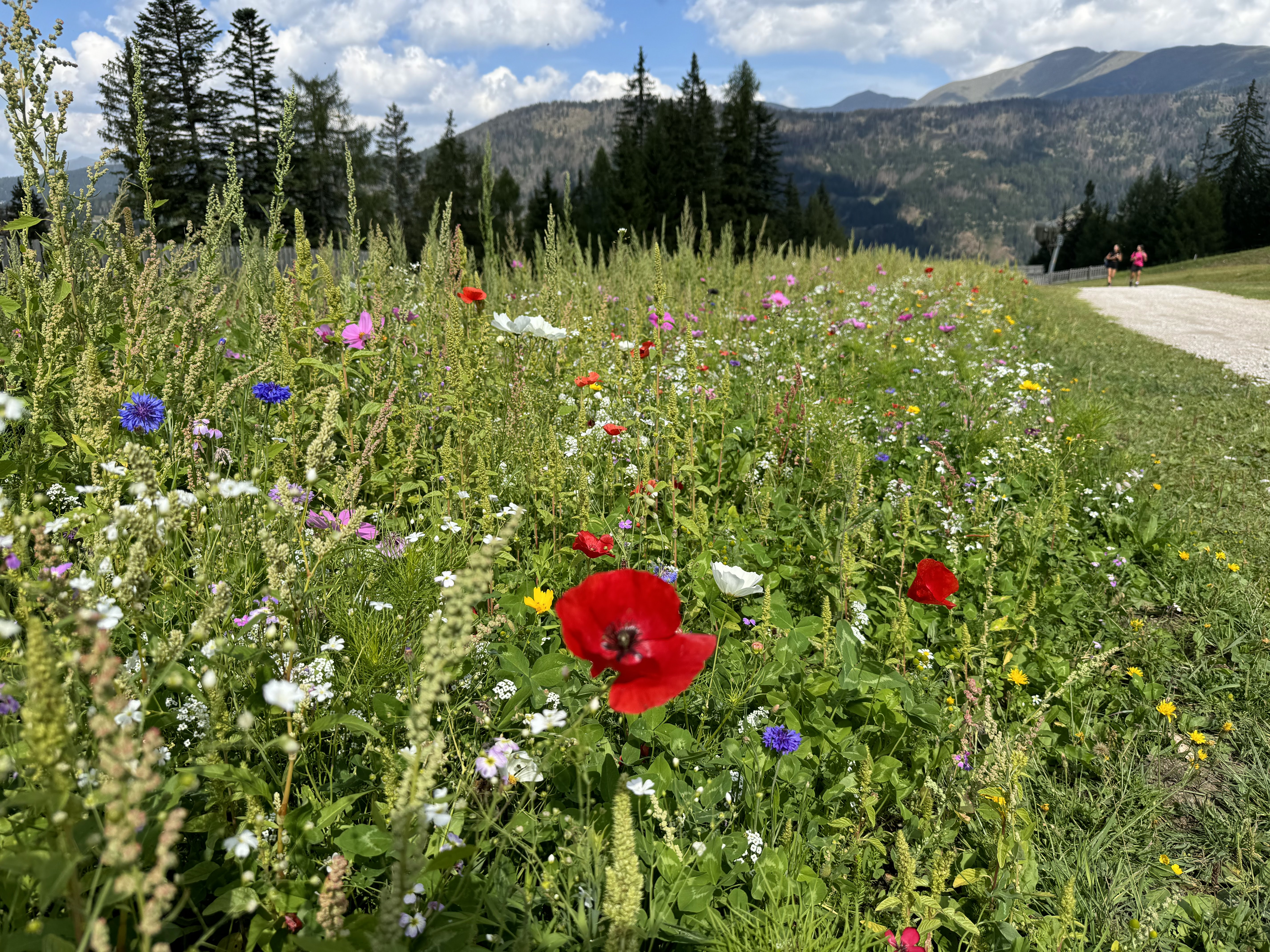
From the balcony of our apartment we can see the Mount Baranci chairlift so we decided to take it up to the top of the hill. We took a hiking trail that claimed to arrive at a Malga. And we soon learned that not every Malga is a farmstead restaurant, some are just private farms. Disappointed and hungry we continued on down the muddiest hiking “path” ever, back to the restaurant at the big ski lodge at the top of the chairlift. At least the scenery was beautiful! And I loved the Lodge's garden of wildflowers that were still blooming even this late in the season. I can't imagine how pretty the mountain meadows must be in the height of summer.


Our week in San Candido/Innichen was pretty ideal. The town was small enough to be walkable, there was excellent hiking nearby, and even if we didn't have a car we could have used the excellent public bus system or rented bikes to ride on one of the many bike paths. I also really appreciated the variety of dishes that were offered at the restaurants. Usually at tourist places in Italy we see the basic 3 Ps - pizza, pasta, panini. But here with the Austrian influence we had the additional option of the 4 Ss - schnitzel, sausages, spaetzle, and strudel. Not to mention the knödel, goulasch, venison, and yummy roasted potatoes. I'm beginning to suspect that this will end up being my favorite part of Italy.


Wednesday, November 1, 2023

Au Revoir à la Côte d'Azur!

In the past week we have done a few fun things around town and made sure to hit the last remaining restaurants on our dining list. Cocodile is a cafe not far from our apartment with spectacular views of the Promenade des Anglais and the Mediterranean Sea.


In the background of that last photo, you can see what appears to be a giant polar bear on the boardwalk. It's one of ten massive statues by Richard Orlinksi that decorate the city. While this statue is white, other brightly colored plasticine animals in the shape of lions, gorillas, and even a T-Rex are scattered throughout Nice.


For one of our last lunches out, we specifically ordered some local specialties. Kevin had the moules frites (mussels and fries) in white wine sauce while I had a local beef stew called Daube Niçoise. 


To burn off all the wine, cheese, and delicious meals we've had on this trip, we made sure to take a few more walks along the Promenade des Anglais to burn off some of the extra calories. This is the view back to the Promenade from an overlook on the eastern edge of the beach. Look how blue the water appears. It's definitely called "the Blue Coast" for good reason!


One afternoon we were walking and could hear snare drums nearby. So we followed our ears and found this Napoleonic marching band. But this band wasn't dressed up to honor the more famous Napoleon Bonaparte; instead they were dressed in the military style that was in fashion during the rule of his nephew, Napoleon III. Napoleon III (or as I like to call him, "N3") ruled France from 1848 to 1852 as its first president and then also as France's last Emperor from 1852 until 1870. Around these parts, N3 is pretty important -- under his leadership Nice became part of France in 1860. The year 2023 commemorates 150 years since his death, which is probably why this marching band was partying like it was 1873. 


We have enjoyed staying in this very walkable city. We loved that we felt safe walking at night in the most popular districts. It does feel like the city of Nice comes alive in the evenings. This is the former train station building (Gare du Sud) in the Liberation quarter -- it's now a food hall.


One of the fun things we were able to see at night while we were here was how the kids in France celebrate Halloween. We did not know Halloween was even a thing here, but we did see kids walking through the streets in costume on the 31st. Interestingly, it would be difficult to go door-to-door to homes here since many apartments are located inside buildings with an entry code. So instead the children go trick-or-treating at the local ground-floor businesses who keep their doors open a bit later to hand out treats to the kids. We saw some cute costumes but they were maybe a little more homemade than what you get in the US (there are no "Spirit Halloween" stores here!) I didn't want to be the weird foreigner taking photos of other people's children, so you'll have to take my word for it. Instead enjoy this nighttime photo of the Palais de Justice (courthouse). 


The meditating human figures in the Place Massena set the night aglow with constantly changing colors. We spent a lot of time in this part of the city in the evenings; it was always lively and filled with people dining at cafes or out for a stroll. Despite enjoying our time here, we are ready to head home after 2 months away. À bientôt, Nice - we hope to see you again soon!