Wednesday, March 8, 2023

Southbank

We've done a lot of walking so far on this trip (so far averaging around 6 miles per day), so today we gave ourselves a bit of a rest by taking the historic tram. Melbourne's 35 Circle Tram is a narrated tour around the outer border of the central business district.


While the other tram routes sport sleek aerodynamic modern cars, the Circle Tram uses historic W-class cars that were all built sometime between 1923-1956. We were lucky to get on a nearly empty one first thing in the morning and we could tell that it had been recently restored inside -- all the wood was varnished, the brass was shiny, and even the leather on the hand straps looked new.


We got off the tram near the Yarra river and walked across the bridge to the National Gallery of Victoria. The museum has a lot of modern art, including an impressive sculpture of the goddess Venus by Jeff Koons. You may have heard his name in the news recently when some yahoo knocked over one of his glass balloon dogs at a Miami art show and it shattered into a thousand pieces. I kept a respectful distance while admiring this piece, although it is made of steel so probably wouldn't shatter if it toppled over anyway. It looks like the windows behind me are being hit by a hurricane of rain, but that's just the iconic waterwall at the museum's entrance.


The gallery space inside the museum includes this stunning Great Hall topped by a gorgeous stained glass ceiling designed by Australian artist Leonard French. Twelve columns support 224 panels with stained-glass insets in 50 different colors.


We joined a free guided tour and were able to see many of the highlights in the collection. I really liked this floral still life by Maria van Oosterwijck -- I had never heard of her before. One of the few female painters of the Dutch Golden Age, she only painted about 30 paintings but her exquisite work was highly sought after by wealthy clients of the era including Louis XIV, the Holy Roman Emperor, and other European royals. 


The National Gallery had a very nice collection of impressionist works. As a Monet fan I was pleased to see this painting of Vétheuil. The water practically shimmers, with all the colors swimming together and reflecting the town's pastel skyline.


On the more modern end of the spectrum was a wall of iPads showcasing recent works by prolific British artist David Hockney. Over his lifetime, Hockney has worked in paint, print, photography, and video, but in recent years he has embraced even more modern technology by painting images using an app on the iPad. This image was one of a series called Yosemite Suite


After the museum, we crossed the street to have a closer look at the floral clock in the  Queen Victoria Gardens (it does seem like pretty much everything in this town was named after Queen Victoria). You can just see one of the clock's hands behind my head.


We grabbed a quick lunch and enjoyed an afternoon stroll along the south side of the Yarra river, cleverly called "Southbank". When it came to naming this area I'm just guessing that maybe "Queen Victoria" was already in use for another section of the riverbank somewhere in town. Anyway, we enjoyed seeing the city skyline from this side of the river.


Tuesday, March 7, 2023

Markets, Gardens, and Street Art in Melbourne

 It is very easy to get around the Central Business District (CBD) of Melbourne. All the trams that run through the CBD area are free -- no need to buy tickets, just hop on! Just make sure to hop off before your tram leaves the free zone. 


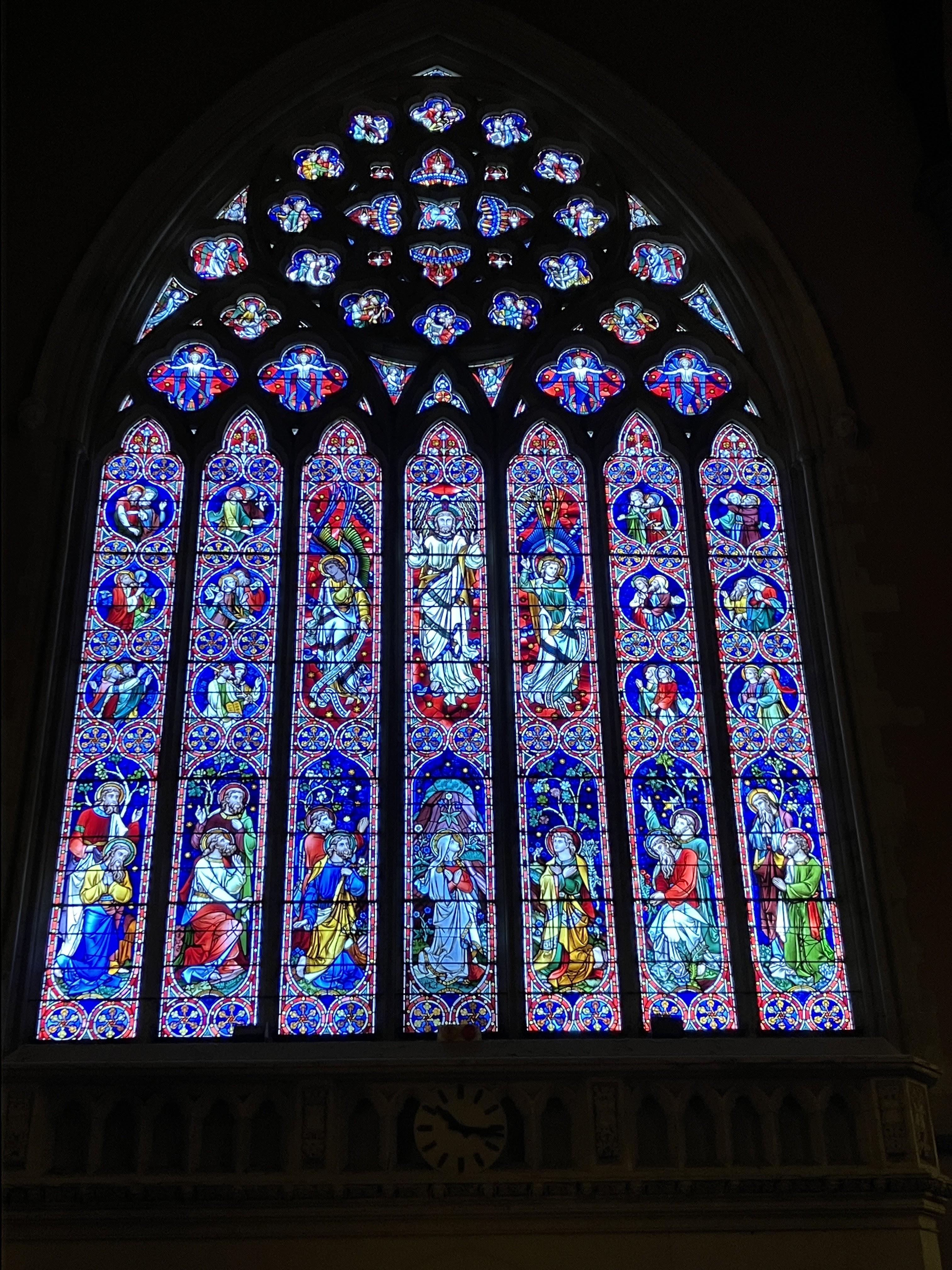
This morning we took a tram to check out St. Patrick's cathedral, Australia's tallest church (so tall I couldn't fit the tiptop of the spire into the photo!). It has a neo-gothic façade but the most interesting thing about the outside is the contrasting two-toned look of the stonework -- the darker basalt stone lower down is called bluestone, but the tan-colored spires are a much lighter sandstone.


It took more than 80 years to construct the cathedral, due to its massive scope and the boom-and-bust economic cycles of the late 19th and early 20th centuries. The foundation stone was laid in 1858 but the spires weren't finished until 1939. Unfortunately the weight of the building caused the stained glass windows to buckle and crack over time. The cathedral underwent a restoration in 1997 and the windows were repaired.


Melbourne has some wonderful gardens and parks to stroll through. The weather today was mild and clear so we decided to explore a few of the city's green spaces.


Just a few blocks from the cathedral is the Fitzroy Gardens, which has some inviting pathways and massive shade trees. Because we are in the Southern Hemisphere, it's just turning autumn here and the leaves are starting to drop.


In one section of the park is a quaint model Tudor village, built by an Englishman who enjoyed making models as a hobby. This village was given to the city of Melbourne in 1948 in gratitude for Melbourne sending shipments of food to Britain during WWII.


Just near the village is the Fairies Tree -- a treestump carved in the 1930's by Ola Cohn who dedicated the carvings to "the fairies and those who believe in them, for they will understand how necessary it is to have a fairy sanctuary".  The colorful carvings consist of native Australian plants and animals and, of course, plenty of fairies.


There are several stone buildings in the Fitzroy Gardens but the most notable one is a cottage where the famous explorer Captain James Cook supposedly lived as a boy in the 1730's. It is a bit weird that it's here in Australia, since: 1. Australia wasn't settled by the British until 1788, and 2. James Cook spent his boyhood thousands of miles away in Yorkshire England. The final owner of the cottage (when it was still back in Yorkshire) put it up for sale in the 1930's and a local Melbourne gentleman bought it, had it shipped here, and donated it to the city to commemorate Captain Cook's "discovery" of the East Coast of Australia. (Let's not forget that there were hundreds of thousands of people already here at that time...)


We wandered back into the urban laneways not far from the gardens to check out some very colorful alleys -- Duckboard Place, AC/DC Lane, and Hosier Lane. 


Duckboard Place actually had some beautiful murals that were very skillfully done.  As we turned a corner the artwork in the next lane was a little more grungy and less refined. There used to be a bar in this laneway where the Australian band AC/DC played in their early years -- the laneway is named after them.


We started getting hungry so we hopped on a tram to the Queen Victoria Market, the oldest continuously running public market in Melbourne -- it's been in business since 1878.


This place is huge -- there are more than 600 vendor stalls selling Australian-themed souvenirs, crafts, and locally-sourced fish, meats, fruits, and vegetables. You could spend all day here just wandering around and doing your shopping. But we were in search of the food stalls -- we had read that the market was a great place to grab some lunch. But unfortunately for our lunch plans, the food hall area is currently under refurbishment and not expected to re-open until April -- we would be waiting for our lunch for a very long time!  


We were a little disappointed because we always make it a point to check out world-class markets when we travel, like the Boqueria in Barcelona, Torvehallerne in Copenhagen, etc. But not this time. Maybe we will have to schedule another trip to Melbourne someday!


Monday, March 6, 2023

Marvelous Melbourne

After a too-short stay in Sydney, we flew down to Melbourne. We will be doing a lot of flying in Australia -- many people don't realize just how big this country is! It's about the same size as the U.S. so to drive from Sydney to Melbourne would be a journey of about 550 miles and take nine hours by car. It takes even longer by train, nearly 11 hours. It was much faster to take a 90 minute flight. 


Melbourne is the second largest city in Australia, after Sydney. But here's a fun fact: neither city is the country's capital. In the early 1900's when the various territories decided to unite into the federated country of Australia, there was a heated rivalry over which of the two larger cities would be the capital. Rather than choose one over the other, the newly-formed commonwealth opted to split the difference distance-wise and build a brand new capital city at Canberra (which is about halfway between Melbourne and Sydney). Melbourne served as Australia’s temporary capital from 1901 to 1927 while the planned city of Canberra was being constructed. 


For the next few days we are staying in an apartment on the 15th floor of a 64-floor high rise building. We’ve got some nice views to the west side of the city. 


Melbourne is a blend of shiny modern skyscrapers and gorgeous old Victorian buildings like the State Library of Victoria, which was built in 1854 and is the oldest library in Australia. 


If you've been following the blog for a while you probably already know that I love visiting libraries on our travels, and this one is exceptionally beautiful inside. The octagonal central reading room is topped by a glass dome that illuminates the enormous space and floods it with natural light. 


In one of the side galleries was an exhibit on the history of the printed book. They had a beautiful volume of Audubon’s Birds of America on display. 


And I was delighted to see an early printing of Michel de Montaigne’s Essays, one of my personal favorites. 


We joined a walking tour that took us through several of Melbourne’s famous “laneways”. Many of these narrow pedestrian-only streets combine cafe and bar culture with street art. With so many cafes the laneways are a popular lunch spot, so you can have a meal while people-watching and looking around at all the interesting murals.


In fact, much of the city is covered in street art (don't call it grafitti!) and our tour guide informed us that artists who want to create a large-scale public art piece anywhere in the central business district have to get city council approval first. That's why the city has so many eye-catching murals like this one.


In contrast to the edgy, arty laneways, Melbourne’s covered shopping arcades are vestiges of the city’s elegant Victorian heyday. In the Block Arcade, we stopped into at a tea room that was established in 1892. The interior was richly decorated and magically transported us back to the gilded age. 


Fancy!


We are looking forward to spending a few days here and enjoying the sights and history of this vibrant city. 


Saturday, March 4, 2023

A Sunny Sydney Saturday

 Before we left the hotel this morning we planned ahead for rain and borrowed an umbrella from the bell desk. This ensured that we would have gloriously clear weather for our last full day in Sydney while we lugged an enormously useless umbrella around town. 


We came back up to the Rocks area because we read that there was a Saturday market. We had hoped for some food and produce vendors, but it was mostly crafts and artwork. Still fun to wander through though. 


We also visited the Rocks Discovery Museum which had an exhibit about the convicts who were sentenced to “transportation” in Australia. Most of the crimes listed seem fairly minor, like theft or forgery. But the sentences were harsh and long, from seven to fourteen years and even life sentences in some cases. 


The Discovery Museum also had an informative exhibit about the Cadigal people who lived in the Sydney area before the British arrived. Due to overuse of the land and sea resources by the colonists, the Aboriginal people were unable to continue their subsistence way of living. They faced starvation as well as suffering from diseases like smallpox brought by the British. Within a year of the establishment of the penal colony, the local population of Cadigal people was decimated by half. Unfortunately over time much of the first inhabitants’ traditions, customs and language was lost. It’s a tragic part of Australia’s history that they are working to reconcile even today. As we've visited important sites around the country, many of them have had plaques or announcements acknowledging the traditional custodians of the land -- this "Acknowledgement of Country" is a small gesture but an important step in the right direction in terms of respecting the Aboriginal peoples' place in Australian history. 

In the afternoon we visited the nearby Australia Museum which had an even larger exhibit hall displaying Aboriginal canoes, tools, and weapons (woohoo boomerangs!), as well as some helpful explanations about the First Australians’ beliefs and culture.


Another very helpful exhibit at the Australia Museum was called "Surviving Australia” about the various deadly creatures here and the many painful ways the country will try to kill you. Just to name a few: there are venomous snakes, deadly box jellyfish, at least a dozen lethal spiders, toxic blue-ringed octopi (...octopuses???), man-eating sharks, and of course the notoriously stealthy saltwater crocodiles. One sign noted that the crocs "only" kill one person per year on average, with about four or five very “close calls”. Crikey!


Directly across from the Australia Museum is St. Mary's Cathedral. It's not the oldest church in Sydney, but it is the largest. We saw it from the bus on our first day in town and thought we'd stop inside to check it out. We weren't able to take any photos inside because there was a Mass just getting started. So instead we headed back out into the sunshine and took some exterior shots of the impressive facade.


We continued our walk to the harborfront by meandering through the Royal Botanic Garden. It was a scenic oasis on a warm day. We found plenty of shade, many beautiful flowering plants, and some creative horticultural displays like this one called "Love Your Nature".


Our final stop on our walk was the Sydney Opera House. We'd seen it several times from the harborfront and from the ferry but today we were able to get a little closer. Actually a lot closer -- close enough to touch the glazed white tiles on the sail-like roof.
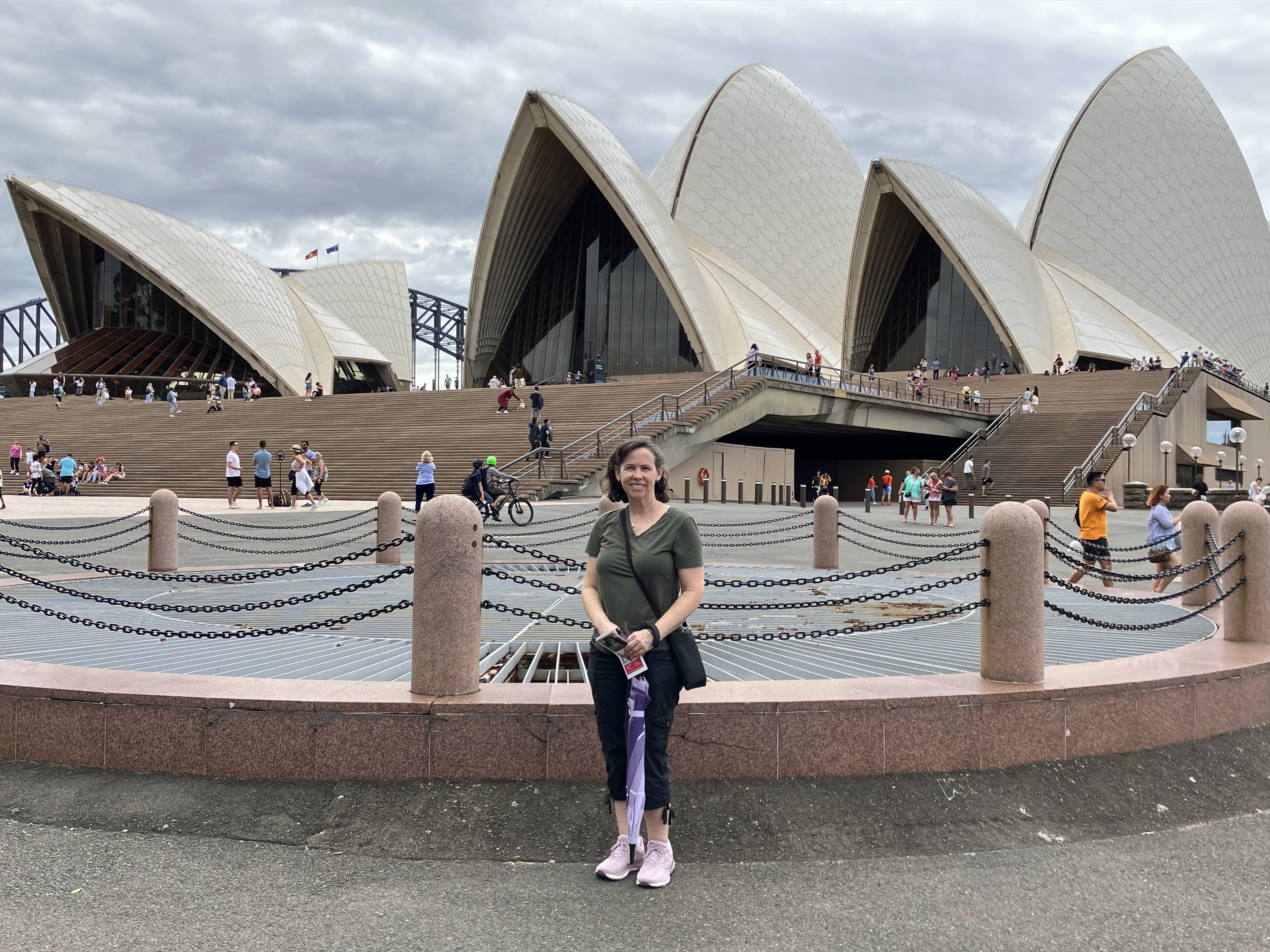

Designed by Danish architect Jorn Utzon, construction on the opera house began in 1958 but wasn't completed until 1973. Over those fifteen years, there were numerous design changes, construction delays, cost overruns, and a great deal of politicking by the New South Wales government. Controversially, Utzon was still owed $100,000 in fees when he left the project in 1966 -- and he never even returned to Australia to see the completed structure. The government did later reconcile with him and acknowledge his crucial role in creating the world-class design of this instantly recognizable building. It is impossible to imagine the city of Sydney without the pristine white sails of the Opera House.


After a short rest back at the hotel and a late dinner, we headed over to Darling Harbor for the Saturday night fireworks display. I was super impressed with the show, they really went all out and had multiple Pride rainbow-themed barrages (which of course I was too slow to capture with my camera...). But I did get a few decent shots since we had a great viewpoint from the Pyrmont Bridge.


The bayside bars along Cockle Bay Wharf were really lively; Amanda from 20 years ago would've certainly gone down for a pint or two! But 2023 Amanda settled for a peaceful view of the moon illuminating the Sydney skyline and a short walk back to the hotel for an early night in!


Friday, March 3, 2023

G'day from Sydney!

Well, after nearly 24 hours in transit we finally made it to the land down under..."where beer does flow and men chunder".


For our first day here we managed to stay awake all day and got our bearings by taking a Hop On Hop Off bus tour around the city. These kinds of tours are perfect if you just want to sit on top of a double-decker bus, learn some facts from the commentary on the headphones, and hear the occasional snippet of some famous local rock song. And yes, they did play the above-referenced song "Down Under" by Men At Work, as well as some INXS tunes and a couple of very Aussie-sounding folk ballads. Beauty!


We caught a few glimpses of the big must-see tourist attractions, like St. Mary’s Cathedral, but as the afternoon wore on we found ourselves too exhausted to do much more than grab a couple pints and an early dinner. 


Our second day in the city was much more productive in terms of exploring. We took a morning walking tour that explained more of the history of Sydney and Australia. The history of the Aboriginal Australians in this area goes back 30,000 years. However the British penal colony was established much more recently, in 1788. Throughout the city, we saw many instances of the old colonial buildings juxtaposed with the new; the modern Sydney Observation Tower looms over the historic St. James Church, for example. 


The British Empire first colonized Australia by sending shiploads of convicts here to settle the land, ignoring the fact that it was already settled by the hundreds of thousands of Aboriginal people already living here. It was a rough life at first for the prisoners sent to the Sydney area; the soil here was poor, there was a decade of drought, and many of the convicts were not used to farming. Over the decades the colony grew, as the prisoners earned their freedom and additional free British settlers immigrated here seeking opportunity. A well-preserved working-class district known as “The Rocks” still has some of the historic buildings left standing, most of them are now touristy cafes and pubs. This area is usually much more crowded with tourists than this picture shows, but there had been a massive hour-long deluge of rain just before the photo was taken.


There are some whimsical modern art installations hidden among the narrow lanes between the old brick buildings. 


After our walking tour, we took a city ferry across the harbor to Manly Beach. The ferry took us right past the iconic Sydney Opera House.


Manly is a popular beach for surfing, and we saw at least a hundred surfers out there catching some waves. There were also several beach volleyball games going on, and half of the beach was taken up by the New South Wales Surf Life Saving Championships. Today’s events featured a Surf Boat Competition which was fun to watch for a bit. Hopefully beachgoers at other beaches in the region were swimming extra cautiously, because judging from the crowds most of the lifeguards in the state of NSW were here in Manly for the event. As far as I could tell, no actual human lives were risked (or saved) during the competition.


Sydney has a huge and vibrant Chinatown, and on Friday nights they have a very popular Night Market with food vendors and all kinds of other merchandise for sale. Since it wasn't far from the hotel, we walked down to check it out. Despite the rainy weather it was super crowded! 


And of course just as we were deciding which stall to order from, the skies opened up and it started pouring. We took shelter inside the nearest indoor food court and had a delicious meal there instead. (Note the whole roasted ducks hanging in the window behind me). 


We waited out the rain and then wandered back to the hotel admiring some of the public art in the Chinatown laneways. 


By the way if you're noticing all the rainbow-themed art and flags in our photos, it's because it is Pride Week here. So far our time in Sydney has been full of rain and rainbows -- very fitting for the "Land of Oz"!