Saturday, December 11, 2021

Portugal - Mafra and Ericeira

We drove further down the coast today, stopping at the inland city of Mafra. The main attraction here is the Mafra National Palace, which is a UNESCO World Heritage site. It has a beautiful cathedral right in the center of the building, and while we ate lunch in the square we listened to a concert of cheerful Christmas music played on the carillon bells.
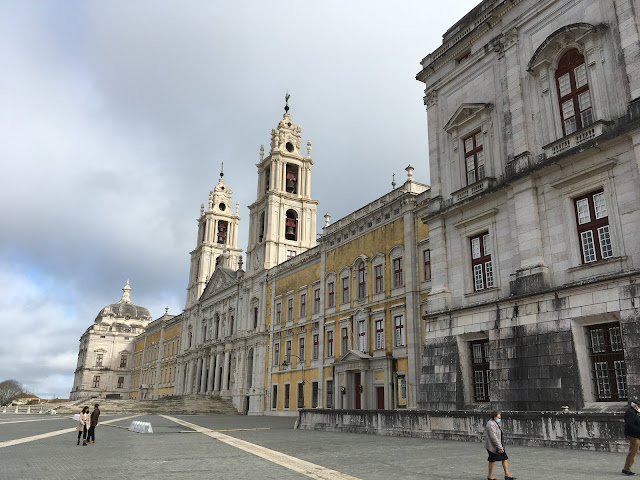
Back when Portugal was a monarchy, the enormous palace was where the royal family used to stay when hunting at the nearby game park (Tapada Nacional). This is the sumptuous throne room.


And this is a more comfortable version of the throne -- a 19th century La-Z-Boy.


Supposedly the royal family didn't live here permanently; they found the rooms to be too gloomy and they had several other palaces scattered throughout the country to choose from. This music conservatory was in the "sunnier" wing -- there were actual rays of sunlight coming in through the windows. 


As always, I am a sucker for a good library. The one here is one of the best Enlightenment-era libraries in Europe, with all kinds of books -- illuminated manuscripts, the first Encyclopedia, books on the Vatican's "Forbidden" list...you know, the stuff you can't usually pick up at the local library drive-thru window.


The typical town library might have hefty fines for overdue books, but this particular library is subject to a papal bull (from 1754) threatening excommunication for anyone who tries to take, remove, or lend books from this collection without express permission from the king of Portugal. And yet you could walk right by a few of the shelves...so very tempting!


We had a pleasant walk through the park next to the palace -- it was the hunting grounds of the royal family and is now a preserve that is home to deer, foxes, and wild boar. It is large -- about 8 square kilometers -- so we only walked a small bit of it, but it was very pretty and green. A forest fit for a king!


After our stop in Mafra, it was a short 15 minute drive to the coastal town of Ericeira.


This beachy town has a great coastline for surfing and is one of the official World Surfing Reserves. (Little-known fact: there are World Surfing Reserves). The rocky beachfront is dominated by a huge hotel - the Hotel Vila Galé. We strolled the small old town area and had coffee in a cafe, then walked along the boardwalk, then hiked uphill to a fantastic viewpoint of the town.


Thursday, December 9, 2021

Portugal - Caldas da Rainha and Óbidos

Today we drove about an hour south to a town called Caldas da Rainha, which means "Queen's Hot Springs". It's named after Queen Leonor who passed through the area in 1484 and tried the natural hot springs. It cured her of some ailment, so she sold some of her jewels and had a big hospital built on the site so that others could be cured. In return, the settlement named itself after her. Portuguese painter José Malhoa painted this portrait of her nearly 500 years later.


José Malhoa was born in Caldas da Rainha -- in the middle of a peaceful park in the center of town there is a good small museum dedicated to his work (and it showcases other Portuguese painters and sculptors, too).


The town of Caldas da Rainha is also famous throughout Portugal for being the home of the Pinheiro ceramics factory, founded by Rafael Bordalo Pinheiro in 1885. 


Pinhero led an interesting life -- he started out as an illustrator and cartoonist. One of his most popular creations was a cartoon character called Zé Povinho (roughly translated: "Joe Public"), kind of a Portuguese everyman. In the middle of town there is a bench with statues of both Pinheiro and his famous creation.


The city has an interesting Museu de Cerâmica, located inside a romantic-era mansion.


The original owner of the mansion was a wealthy Viscount who collected ceramics -- they covered the walls and were on display throughout the three-story home.


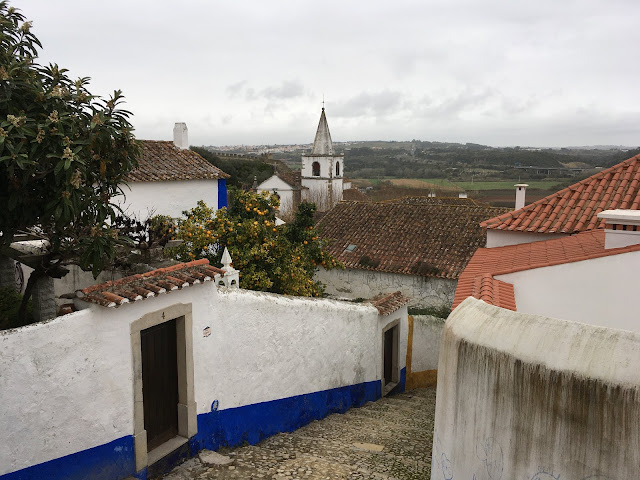
After checking out Caldas da Rainha, we drove to one of Portugal's most picturesque towns -- Óbidos. It's a walled medieval town that feels a bit like a setting for a Renaissance fair.


The castle keep is now a fancy hotel for tourists. The narrow cobbled lanes are packed with shops and restaurants. It's definitely a touristy town.


I can only imagine how packed this tiny town would be in summer. But on a rainy weekday in December, there were only a handful of other tourists wandering around. Once we detoured off of the main shopping street, we had the place nearly to ourselves.


Which was great, because the other reason we were here was to check out the Vila Natal (Christmas Village). The town sets up an ice skating rink, trampolines, a theater for shows, photo op with Santa Claus, and a mini-train for the kids. It's normally a very popular attraction and draws people from all over central Portugal.


When it's not raining, that is.  The skies got progressively darker throughout the afternoon and I think that kept the crowds away.  But we were glad to have a little holiday cheer, even if it did start raining pretty hard by the end of the day.


As we walked back to the car, the rest of the town was illuminated by lights and decorations.


Feliz Natal e Boas Festas!


Tuesday, December 7, 2021

Portugal - Fátima, Tomar, and Batalha


Today we took the car to make a small pilgrimage to the sanctuary of Fátima. This is an important site in the Catholic faith. In 1917 three young shepherds saw visions of the virgin Mary on several occasions. The local people built a small shrine at the site, which is now part of a much larger complex including two sanctuaries and a large central plaza. The small chapel is just that -- very small! An open-air structure was later built around it to protect it (the original chapel is the tiny white house at the back).


The Basilica of Our Lady of the Rosary was built in a very similar style to the Dos Clérigos Church in Porto, with a single tall bell-tower that can be seen throughout the town.


Even on a very rainy day in November, there were many other pilgrims at the sanctuary complex, some even making their way to the sanctuary on their knees despite the rain. Although I was not quite that dedicated, I was grateful for the opportunity to come to Fátima and light a few candles for my loved ones and to be able to see one of the most important Catholic pilgrimage sites in the world.


Today was a day for seeing important historical religious sites. Despite the lingering rainclouds we headed to the nearby town of Tomar to visit the 12th century stronghold of the Knights Templar. As we got closer to town, the Pegões Aqueduct looming over the street was a clue that perhaps we were going in the right direction.


The six-kilometer long structure was designed to bring water to the castle and monastery known as the "Convent of Christ". The Knights Templar were an organization of warrior monks who fought in the Crusades and became a very powerful charitable organization in the middle ages. They built this stronghold and dormitory in the tenth century as a defense against the Moors who controlled southern Portugal at the time.


Walking the length of the ramparts, we could just imagine the walls being covered with soldiers and archers defending the castle (or covered with tourists, in summer). But today we didn't run into a single other soul on the battlements -- we were the lone defenders of the castle walls on this dreary day.


The chapter house where the monks lived has been preserved and you can see inside the monks' cells. The living quarters are attached to one of the most interesting church chapels I've ever seen. It's round (well, octagonal), with an ambulatory aisle circling the central chapel. Gothic sculpture and colorful frescoes cover the walls and ceilings with religous scenes of saints and angels. In the 12th century, knights would enter the church -- on horseback! -- and circle the ambulatory to receive a blessing before heading off on crusade in the Holy Land.


Our final stop today was at a town called Batalha (in Portuguese literally "Battle"). In 1385 this town was the site of a battle between the invading kingdom of Castile and the Portuguese defenders. Because the previous king of Portugal had died without an heir, the Castilians tried to move in and claim the land of Portugal as their own. However, Portuguese forces led by João of Aviz (later King João I) won a decicive victory; newly crowned King João I made a promise to build a great monastery to commemorate the victory. It was built in a completely new and uniquely Portuguese flamboyant gothic style.


This Portuguese gothic style evolved into what is now called "Manueline" style -- decorative stone elements reference nautical themes and seafaring motifs. At first glance, it almost looks like the sides of the building are covered in barnacles because they are so encrusted with sculptural decoration.


It took hundreds of years to build the monastery and church and it still isn't quite finished. In fact, one area of the monastery is called "The Unfinished Chapels" to this day because work on this section of the monument was never completed. The ornately decorated chapels remain open to the sky and the elements. Ironically, the cloudy skies cleared up just as we were getting ready to head back home!


Monday, December 6, 2021

Portugal - Aveiro and Coimbra

Originally we had hoped to fly to southern Spain to visit with Kevin's Swedish relatives who we haven't seen since our Scandinavia trip in 2016. Unfortunately, traveling during the pandemic is getting trickier, and the rules here in Portugal are becoming more strict. This is a good thing -- they want to protect the local population and encourage responsible tourism for the economy. But it also meant that it would be too risky to leave Portugal and possibly not be able to return. We were quite sad to cancel the original plan, but in the end we changed our travel plans to include a rental car and use an Airbnb in Nazaré as a base for exploring central Portugal via day trips. We picked up the rental car and our first stop was in Aveiro, which was on our route about an hour south of Porto.


Aveiro is a vibrant seaside town, usually. Our photos look a little drab due to the fact that it was raining most of the morning. The town is known for the colorful traditional moliceiro boats that are moored throughout the town. Once upon a time, sailors would harvest the seaweed or algae from the bottom of the lagoon to be used as fertilizer for the fields. But now the boats are used to ferry tourists through the canal network -- Aveiro is known as the "Venice of Portugal". Each boat is uniquely decorated with brightly painted scenes on the curved bow and stern.


Just to the west of Aveiro is another picturesque town called Costa Nova. (Actually I am not sure if it is a town or just a suburb of Aveiro.) Stretching along the beach are the striped wooden huts that were formerly used to store fishing equipment but nowadays have all been converted to vacation cottages.

Between the boats in Aveiro and the beach cottages here, local paint stores must do a pretty brisk business.


The rain continued to drizzle as we made our way to Coimbra, home to Portugal's oldest University founded in 1290. Nestled next to the Mondego River, it's a beautiful and walkable hilltop town, as long as you are into hiking and have good shoes for the slippery cobbled streets! The University of Coimbra is -- of course -- all the way at the tippy top. There is also an elevator/funicular combo that will take you up without any exertion if you want to skip the hills.


Undeterred, we opted to hike up the narrow slippery cobbled streets to get to the oldest part of the city. This is the Old Cathedral (and Ye Olde Parking Lot, apparently). In Portuguese, it's called the Sé Velha (old cathedral, constructed in late 1100's) not to be confused with the Sé Nova ("new" cathedral, built in late 1500's) further up the hill.


We didn't have much time here in Coimbra, but we wanted to see the 18th century Joanine Library, which has been storing books for the University since 1750. Here is the courtyard just outside the library.


We were not allowed to take photos inside, but here is one that I found on the Visit Universidade de Coimbra website. The library vault is maintained at a constant temperature and humidity and holds over 200,000 volumes. For the squeamish, I should mention that it is also home to a colony of bats that keep the insect levels to a minimum to protect the books. Thankfully, we did not see any bats perusing the stacks during our visit, and I was glad to be wearing a KN95 mask. The staff cover everything at night to protect the decorative surfaces, and uncover/clean up every morning. Add that to the list of "Jobs I Do Not Want".

Photo courtesy of the Universidade de Coimbra

We also just barely had time to visit the nearby Capela de São Miguel, which was formerly the private chapel for the king.


Nearly every flat surface is painted or encrusted with azulejo tiles. No bats live here, I'm guessing.


There was much more to do and see in Coimbra but with the rain and our limited time we hopped back in the car to head down to Nazaré and get checked into our next Airbnb before dark. Our apartment in Porto had a great central location, but no view to the outside -- the windows all looked out at the wall of the next building. We are glad that is not the case here in Nazaré! We're a little further out of town but with a nice view all the way to the ocean. Boa noite!


Saturday, December 4, 2021

Porto, Portugal - Week Four

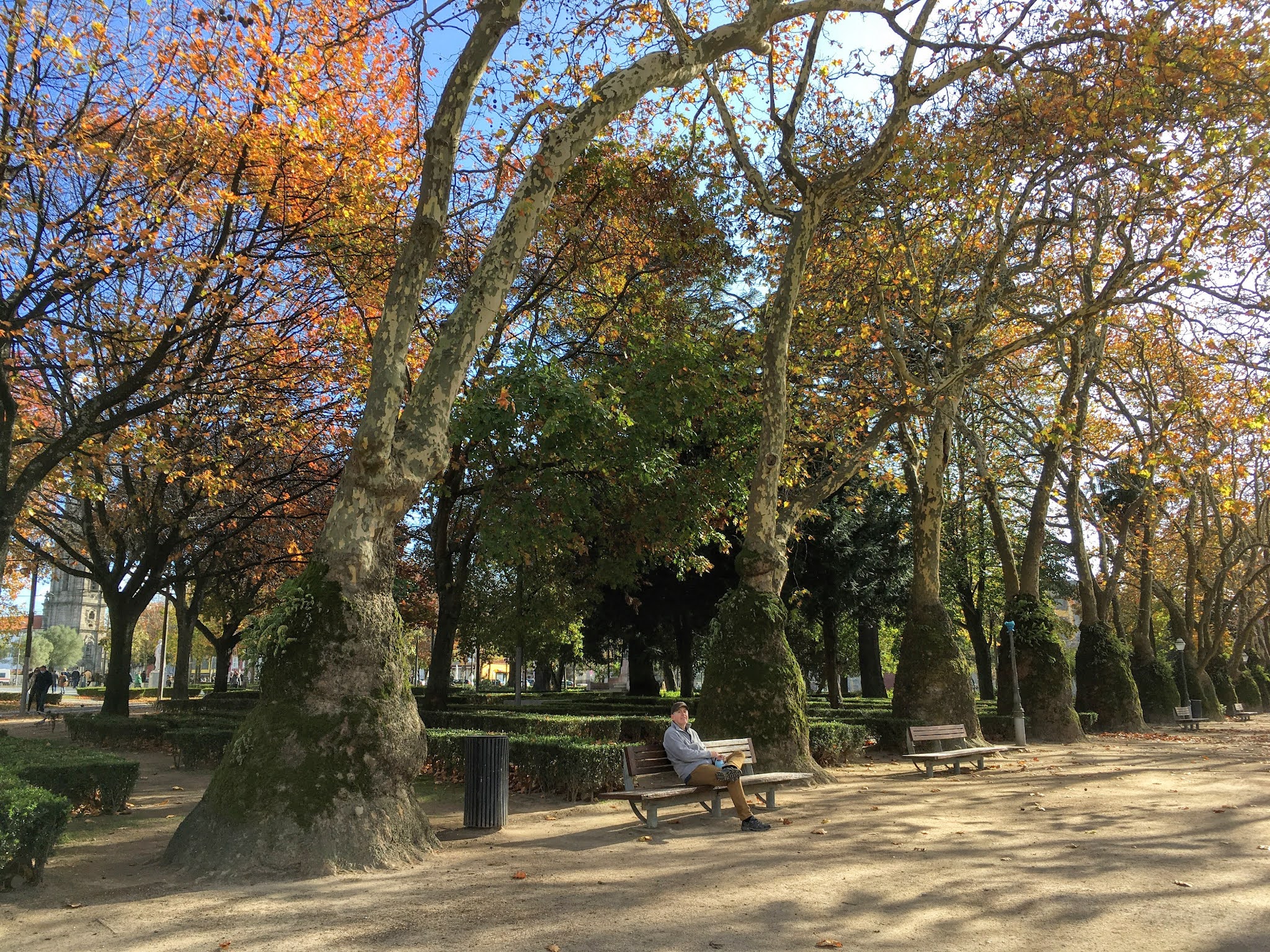
Well, it's officially December and the weather is getting colder in Northern Portugal. The autumn leaves on the trees are rapidly disappearing.


And did I mention the rain? We made the mistake of visiting the Botanical Garden on a rainy day. When we left the apartment it wasn't raining but once we got to the garden it was. The garden had a large collection of cactus, succulents and other familiar-looking plants.


Huge colorful lanterns had been installed all around the garden showing travel scenes from countries like Japan, Egypt, and India. This was part of the "Magical Garden" holiday luminary show.


Faced with several days in a row of rain, we made plans that included indoor or sheltered places that wouldn't be completely packed with other tourists (it is still a pandemic, after all!). Churches are always a good bet, so we headed to the Sé do Porto (Porto's Cathedral). Dark clouds were gathering, so we got there just in time.


The church interior is a blend of styles. Construction on the current cathedral began in the late 1100's but it has been changed and enlarged over the centuries. Even up to today -- the nave of the church is currently under restoration and was behind a wall of tall scaffolding. But I preferred the gothic arches in the cloister, which turned out to be a nice place to shelter under once it started to rain.


Next to the cathedral is the opulent Bishop's Palace. Clearly, bishops used to live in the lap of luxury -- everything inside the palace was decorated to the hilt and dripping with gold and silver leaf. The bishop of Porto doesn't actually live here anymore (the clergy fled the palace in the 1800's during the Civil War when Porto was under siege), but if I were a modern-day bishop, this is where I would want to live.


One more church was on our list of "must-sees" before we leave Porto -- the Clerigos church (Igreja dos Clérigos). The single bell tower of this church is one of Porto's best-known landmarks and is the tallest point in the city. We didn't climb the tower; instead we opted to go into the church itself so we could hear a little bit of the free pipe organ concert that happens almost daily at noon. The church has two historical pipe organs that are over 200 years old. In other churches, the pipe organs are hidden in the back of the church and you have to crane your neck around to see them, but in dos Clérigos both instruments are visible from every seat in the house. In this photo you can just see the pipes of each organ on either side of the altar.


We had a bit of bad luck trying to go to another popular museum. The Soares dos Reis museum is in a beautiful 18th century palace and is supposedly full of the treasures of Portuguese art -- sculpture, paintings, furniture, and other decorative arts. 


Unfortunately the lady at the front desk informed me in Portuguese that the museum was closed. Well, she *tried* to inform me in Portuguese. She didn't speak English. I don't speak Portuguese. But we did have one language in common -- finally my years of French came in handy! She said that due to nearby construction (subway extension) and COVID, they had closed off most of the museum. Only two small exhibits and the garden were open for visitors, and only two sculptures by António Soares dos Reis (the guy who they named the museum after) were on display. This one is "O Desterrado" (The Exile).


Since early November, we have been watching crews of workers install Christmas decorations everywhere. It seems like they finished installing them more than a week ago, but none of them have been lit at night until now. Apparently here in Porto, the holiday season starts on precisely December 1st and not a moment before. 


The tree in front of the town hall is 34 meters high and puts on a constantly changing display of colors and animations.


This was our final week in Porto. Next week we will rent a car and head south, where hopefully it will be a few degrees warmer and maybe a bit less rainy. Até à próxima, Porto!